
The Hopewell Valley Regional School District (HVRSD) Board of Education has officially voted to move forward with two bond proposal questions for the upcoming November 4, 2025, election. This decision follows months of discussions and community feedback after a previous referendum failed last fall. The district considers both questions essential for the future but has split the $84 million referendum into two parts: one addressing critical infrastructure needs and the other expanding classroom space to accommodate growing enrollment.
The Two-Part Bond Proposal
The proposed bond referendum will be presented as two separate questions for voters:
Bond Proposal Question #1
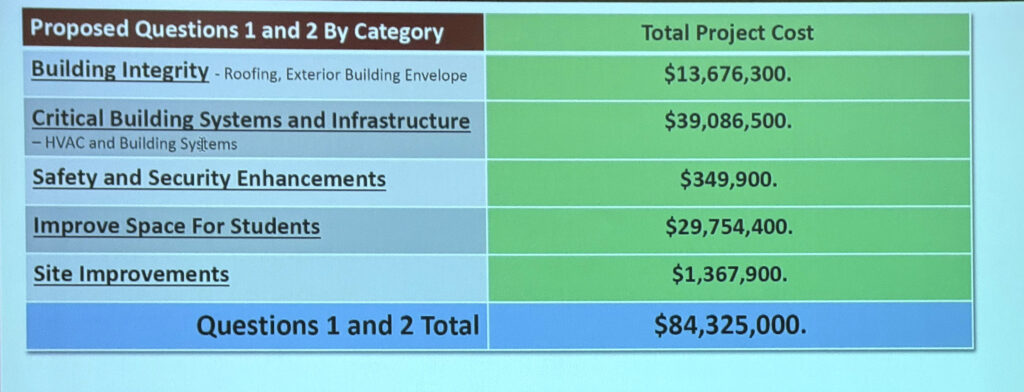
This question authorizes the district to appropriate $58.4 million for critical infrastructure repairs across all existing schools, including Hopewell Valley Central High School, Timberlane Middle School, Bear Tavern Elementary, Hopewell Elementary, Stony Brook Elementary, and Toll Gate Grammar School. Key improvements include roofing, HVAC systems, security upgrades, and necessary repairs to ensure the schools remain safe and operational. This question is eligible for 40% state debt service aid, reducing the local financial burden.
Bond Proposal Question #2
This question, which will only be considered if Question #1 is approved, asks voters to approve $25.8 million for expansions and further renovations. This includes the construction of additions at Bear Tavern and Toll Gate to provide more classrooms and essential facilities. These renovations will allow the district to eliminate the use of trailers at both schools, addressing the need for more permanent classroom space. The improvements in this question are not eligible for additional state aid.
Impact on Taxpayers
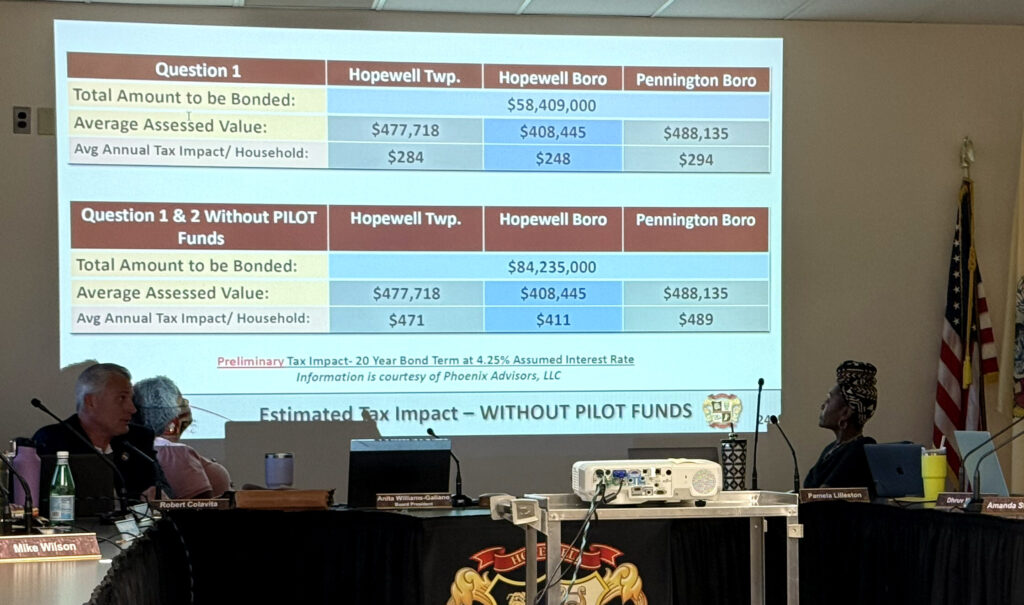
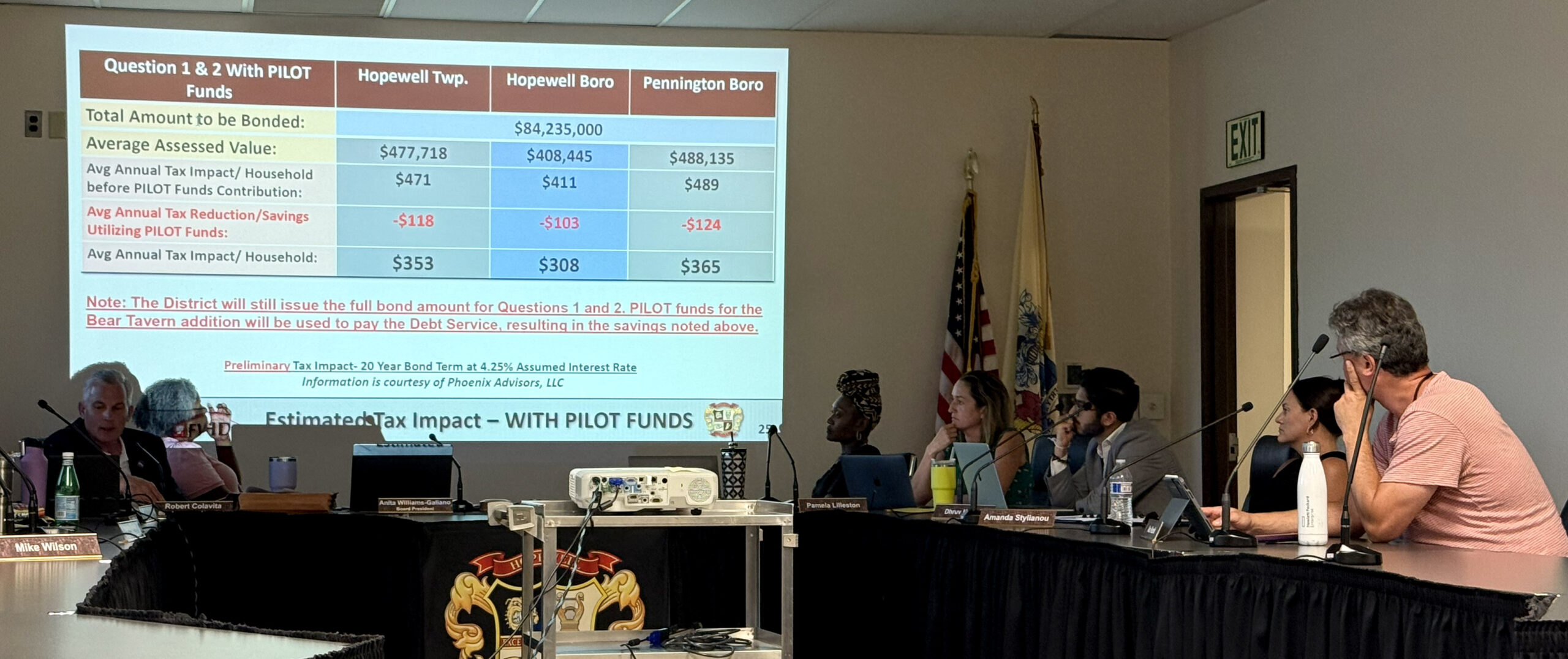
If both bond proposals are approved, the estimated tax impact on residents will increase in all municipalities. On average, homeowners in Hopewell Township will see a $471 increase in their property taxes, while those in Hopewell Borough will face an additional $411. Pennington Borough homeowners will see a $489 increase. However, if Question #2 passes and Hopewell Township approves $16.1 million in PILOT (Payment in Lieu of Taxes) funds, contingent on legal developments with Pennington Borough, it could reduce these amounts by up to $124 per household in Pennington, $118 in Hopewell Township, and $103 in Hopewell Borough.
Community Involvement and Revisions
The district revised the original proposal that was voted down last fall following feedback from the community. Projects such as the synthetic turf field and accessible bathroom upgrades were removed, and other critical repairs have been prioritized.
Superintendent Rosetta Treece emphasized the importance of community input in refining the proposal:
“We’ve listened to our community and made adjustments to ensure that these projects focus on the most urgent needs while keeping costs manageable,” Treece said.
Clarification on Roof Repairs and Warranty Concerns
A significant portion of the discussion centered around the need for roofing repairs at the schools, a crucial aspect of the proposed bond referendum. Treece and Assistant Superintendent Robert Colavita provided clarification on the issue, addressing community concerns regarding warranties and past repairs.
Treece explained that while the roofs at several schools were originally covered by warranties, those warranties are no longer effective.
“The roofs we’re proposing to replace are at the end of their useful life,” Treece said. “The warranty expires soon, and while some repairs have been made under the warranty, they no longer cover the issues we’re facing. We’ve been patching these roofs, but they are no longer a viable solution and are causing damage inside the buildings.”
Colavita further explained that the warranty covers only a small portion of the roof’s life, as the materials are now over 20 years old.
“The roofs are 20 to 25 years old,” Colavita said. “Warranties cover defects in materials or construction, but not normal wear and tear. Even though there’s still a warranty on some roofs, it only covers a fraction of the total cost, and the rest of the roof is no longer covered.”
Treece also addressed concerns regarding the previous referendum and noted that none of the roofs in question were replaced during that process.
“It’s important to note that these roof repairs were not part of the last approved referendum,” Treece clarified. “The roofs that are now being proposed for replacement were not addressed before. We’re now at a point where the roofs need to be replaced to ensure the safety and functionality of our schools.”
Other Critical Infrastructure Needs
In addition to the roof repairs, other critical infrastructure projects include:
- HVAC System Upgrades: Many of the district’s HVAC systems are outdated, failing, and in need of significant repair or replacement, particularly at schools like Timberlane and Bear Tavern. Colavita noted that some HVAC systems are over 25 years old, far beyond their intended lifespan, and are no longer adequate for modern climate control.
- Security and Safety Improvements: Upgrades to security infrastructure, including the replacement of outdated interior and exterior doors at multiple schools, are included to meet modern fire and security codes. Colavita added that these renovations are essential to maintain safe learning environments.
- Other Essential Repairs: These include repaving parking lots at Hopewell Valley Central High School and Toll Gate, addressing drainage issues at Stony Brook Elementary, and replacing worn-out flooring at Timberlane. A secondary well also needs to be dug at Timberlane so the school will always have a source of water. These projects are part of a broader effort to ensure that the district’s buildings remain safe, functional, and accessible for both students and community members.
“These are the kinds of repairs that, if not addressed, could lead to serious disruptions to learning,” Treece said. “If we don’t fix these now, we’ll be facing higher costs down the road, and some of these issues could force us to close schools or interrupt student learning.”
The Financial Stakes
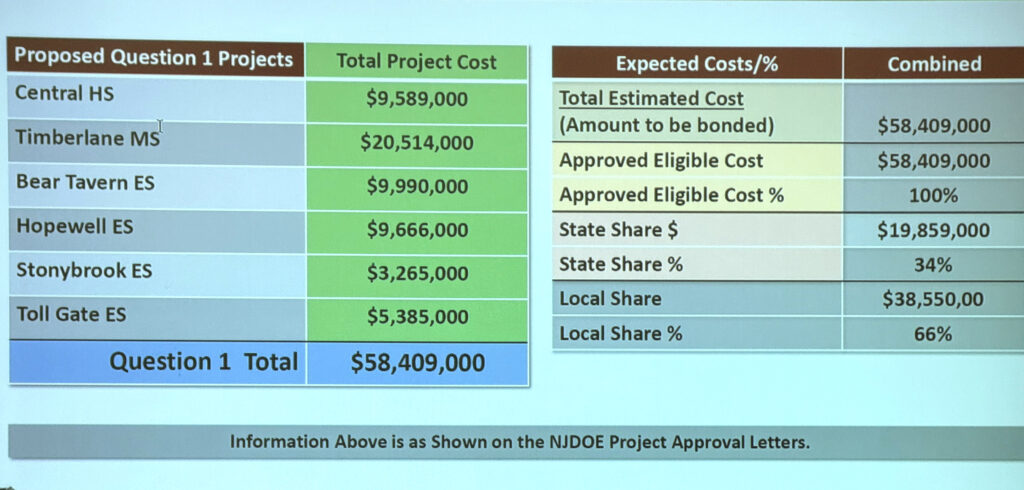
Colavita emphasized that the referendum is the only way to secure state funding for the proposed capital projects.
“The state wants you to go to referendum because they want to give you the money that they’ve taxed you already for,” Colavita explained. “The only way to get the money is through a referendum.”
He also addressed the district’s financial constraints:
“Everything has gone up post-COVID. The cost simply is too great to handle in our regular budget with a 2% cap,” Colavita said.
Board member Amanda Stylianou raised a key question regarding the state funding, “if we do not go to referendum, and we attempt to pay out of budget, what does that look like for that state share?”
Colavita responded, “Zero. We do not get any money from the state.”
Board member Pamela Lilleston further emphasized the importance of the referendum, noting the financial consequences if it fails,
“These are projects that we absolutely have to take on as a district,” Lilleston said. “If the referendum does not pass, it’s going to be at a higher cost to the taxpayer. It’s going to result in more interruptions to student learning, and the money is going to come from teacher salaries, cutting positions, and cutting programs.”
Board member Alex Reznik echoed these sentiments, stressing the importance of moving forward with the referendum:
“I know it’s a large ask, but it’s the only way we can get these projects done in a responsible way,” he said.
Reznik then read aloud a letter from Mark Peters, Chair of the Finance and Facilities Committee, who was unable to attend the meeting. In his letter, Peters spoke about the district’s ongoing fiscal challenges, particularly in budgeting for capital projects,
“Simply put, capital projects are nearly impossible to budget for given the current constraints of how administrations are told to budget by Trenton,” Peters wrote. “While we still have much work to do with finalizing commitments from Hopewell Township and the money promised through PILOT, we continue to operate in our decision-making to be as fiscally responsible as possible for our community and our constituents.”
Passing Question 2 May Be the Only Way to Unlock PILOT Funding
The two-question referendum, a topic of ongoing discussion for months, is now presented as the best option for the community to address critical infrastructure needs and expansion requirements.
Treece emphasized the importance of both questions, explaining,
“Question 1 must pass for Question 2 to pass. The reason why we put this in two different questions is not because I don’t feel like the additions aren’t important at Bear Tavern and Toll Gate. I think that they’re all important enough to be one question, but we heard the community loud and clear. We wanted to give you all of those options as a decision for the community.”
One of the key aspects for the tax implications of the referendum is Hopewell Township’s promise of $16.1 million in PILOT funding for the Bear Tavern expansion. However, the township has been clear that these funds are contingent upon the successful resolution of ongoing litigation with Pennington Borough.
Colavita clarified the impact of this funding, stating,
“We cannot take that off of our question (the $16.1 million), but when that money comes through, if that money comes through, based on how successful they are with the lawsuit, that would go to relieving the debt on this portion of the bond.”
However, during the meeting, Treece and the board discussed a potential caveat: without the approval of Bond Question #2, there may be no way to access the $16.1 million from Hopewell Township. “If Question #2 doesn’t pass,” she noted, “we will not be able to access those funds.”
The board also said to expect class sizes to increase in all elementary schools if Question 2 doesn’t pass.
Next Steps
The board’s resolution, which officially authorizes the bond proposals, ensures that the necessary steps will be taken to bring the proposals to voters this fall. A detailed explanatory statement will accompany the proposals on the ballot to ensure voters fully understand the scope and financial impact of the bond measures.
As the election approaches, the district will continue to engage with the community through meetings, informational sessions, and outreach efforts to clarify any questions and ensure transparency. The next board meeting will take place at the high school on September 15, with a tour of the facility at 5:30 p.m. to showcase the issues that need to be addressed at that school. The regular meeting will begin at 6:30 p.m.
Additional items from Monday’s meeting will be covered in future stories this week.