

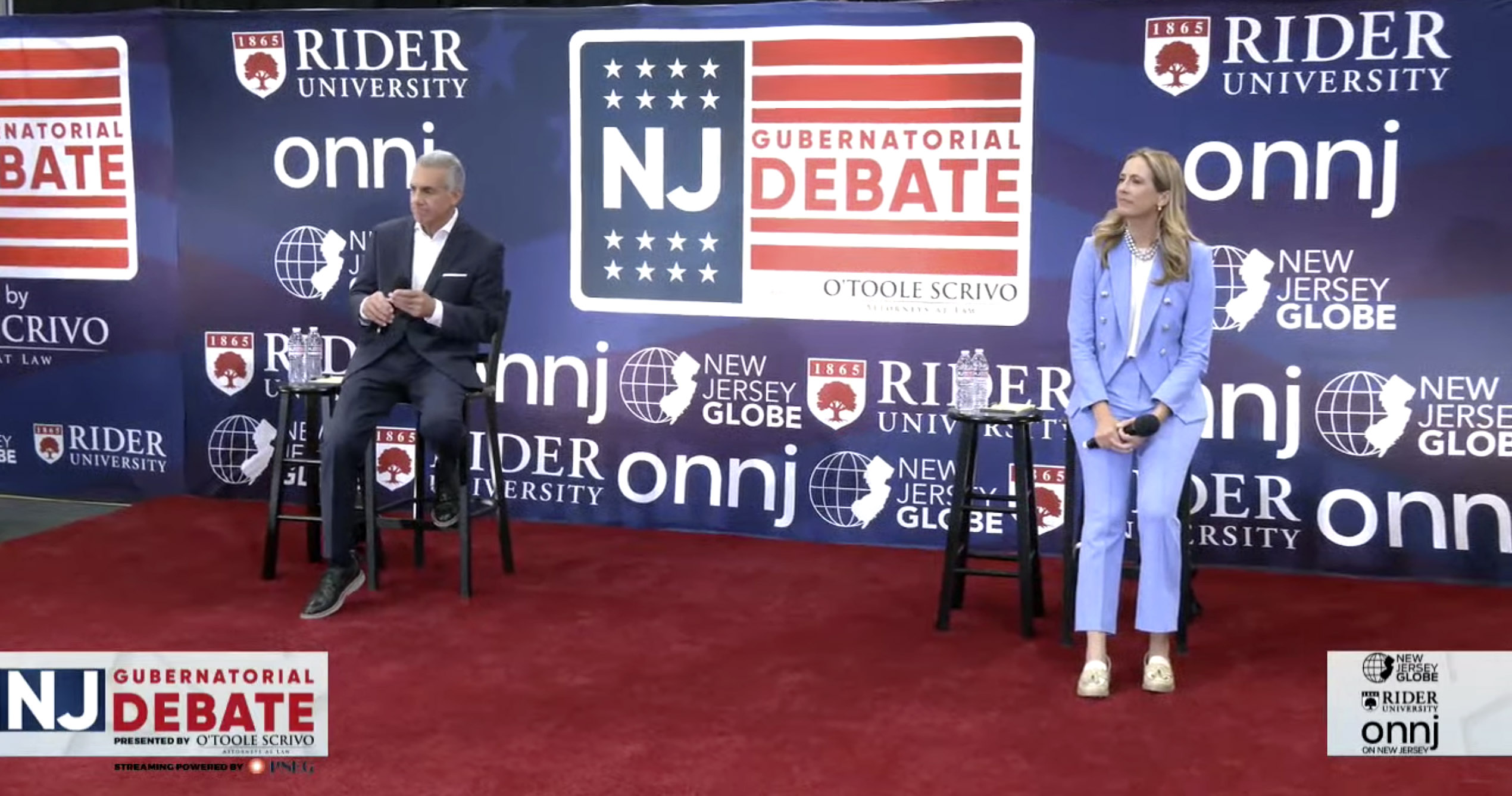
Democrat Mikie Sherrill and Republican Jack Ciattarelli clashed repeatedly Sunday night at Rider University in the first debate of New Jersey’s 2025 gubernatorial race, a lively 90-minute forum that put taxes, energy, education, and public safety front and center while underscoring sharp personal and political differences between the two candidates.
The town hall–style debate, hosted by Rider and sponsored by the New Jersey Globe and On New Jersey, drew questions directly from voters as well as a panel of journalists. It was the first of two debates approved by the state Election Law Enforcement Commission ahead of November’s election.
Opening Remarks

Sherrill, a Navy veteran, former federal prosecutor, and current congresswoman, promised to be “a different kind of governor” who would freeze utility rate hikes, streamline permitting, and hold government accountable. She painted Ciattarelli as a longtime politician who has “voted to raise your taxes” and would “do whatever Trump tells him to do.”
Ciattarelli, a former state assemblyman making his second bid for governor, cast himself as a “hands-on CEO” ready to tackle crises. “There’s an affordability crisis … a public education crisis … a public safety crisis … and an overdevelopment crisis,” he said. “We are the worst place in the country in which to do business.”
Affordability and Taxes
Affordability dominated the evening. Ciattarelli laid out proposals to make retirement income tax-free, freeze property taxes for seniors over 70, cap property taxes for first-time homebuyers, and replace New Jersey’s current income tax structure with three brackets of 3, 4, and 5 percent.
Sherrill countered that Ciattarelli’s record undermines his promises, saying he had voted against more than a billion dollars in property tax relief. She touted the state’s Anchor and Stay New Jersey programs to help seniors remain in their homes and proposed consolidating administrative costs in schools and municipal courts.
On the sales tax, Ciattarelli pledged not to raise it. Sherrill declined to make the same commitment, citing a looming $5 billion budget hole from federal cuts, but said she would “be fiscally responsible with your money.”
Energy and Climate

New Jersey’s rising electricity costs were another flashpoint. Ciattarelli blamed Gov. Phil Murphy’s energy policies for plant closures and higher rates, vowing to reopen facilities, expand nuclear power, speed rooftop solar, and withdraw from the Regional Greenhouse Gas Initiative, which he called “a failure.”
Sherrill promised to declare a state of emergency to freeze rate hikes, arguing that utilities were reaping profits while families struggled. She pledged to increase in-state power generation and hold PJM, the regional grid operator, accountable.
On climate change, Ciattarelli acknowledged human-driven impacts but argued for a slower, “all-of-the-above” transition with natural gas as a bridge fuel. He criticized Democrats’ push for high-density housing in every town as “anti-environment.” Sherrill pointed to her congressional record on environmental policy and said she would cut carbon emissions while preserving open space.
Education and School Consolidation
Both candidates pledged to improve schools but with different priorities. Ciattarelli pushed a “high-impact curriculum” focused on core skills, warning that students not at grade level by eighth grade risk being “underemployed their entire life.” He also backed more school choice through vouchers and charter schools.
Sherrill supported regionalizing some of the state’s more than 600 districts and potentially mandating consolidation where inefficiency persists. She promised high-intensity tutoring to combat pandemic learning loss and a renewed emphasis on phonics in early grades.
On segregation in schools, Sherrill said she would address disparities in resources and outcomes. Ciattarelli argued that integration alone would not improve results without curriculum reform.
Political Violence and Safety
The debate touched on national concerns in the wake of conservative activist Charlie Kirk’s assassination. One question asked if political violence should be classified as a hate crime.
Sherrill, noting threats against herself and her family, stressed the need for more protection and a commitment to free speech. “We should be able to have free speech … but it should never devolve into political violence,” she said.
Ciattarelli offered a firmer stance: “Yes, I believe we should do that here in New Jersey,” he said of making political violence a hate crime. He urged candidates to use rhetoric that “doesn’t divide us.”
The exchange grew heated when Ciattarelli accused Sherrill of dodging the question and invoked her criticism of Kirk following his killing. Sherrill fired back that it was “a neat trick” to call for unity while citing a divisive example, reiterating that she has “stood against political violence” her entire career.

Culture and Social Issues
Cultural debates also entered the spotlight. In a discussion about online safety and children’s privacy, Ciattarelli pivoted to denounce school policies on gender identity, saying, “If we’re concerned about protecting kids, I don’t think biological boys should be playing in girls’ sports.”
Sherrill, a mother of four, responded that parents should be engaged in their children’s education but stressed that schools must also address mental health and safety. “As parents, it’s our job to make sure we’re keeping our kids safe at every level,” she said.
On vaccines, Sherrill warned that falling immunization rates put children at risk of preventable diseases like measles and pertussis. Ciattarelli said he supports standard vaccine schedules but shifted to criticize policies on gender and parental notification, a move Sherrill dismissed as political deflection.
Transit, Housing, and Technology
Transportation and housing concerns also surfaced. Sherrill highlighted her work on funding the Gateway Tunnel and rail upgrades, pledging to modernize NJ Transit. Ciattarelli proposed consolidating agencies into a Garden State Transportation Authority for “better management and accountability.”
On housing, Sherrill vowed to crack down on rental price collusion and expand affordable units. Ciattarelli argued that rising rents stemmed from property taxes, insurance, and energy costs and promised structural tax changes.
Asked about artificial intelligence, Ciattarelli warned of “social manipulation and job loss,” while Sherrill described deepfake harms and pledged guardrails on AI while expanding STEM and vocational schools.
Tone and Attacks
The debate was as personal as it was policy-driven. Sherrill repeatedly tied Ciattarelli to Trump, saying he “has nothing he disagrees with Donald Trump on.” Ciattarelli accused Sherrill of “generalities and platitudes” and misleading voters on taxes.
Each accused the other of ethical lapses: Ciattarelli raised questions about Sherrill’s congressional stock disclosures, while Sherrill said his claims were false and countered that he had ducked accountability for raising taxes.
What’s Next
Two more debates are scheduled before Election Day.
- Lieutenant Governor Debate — Tuesday, Sept. 30, 2025, from 7–8 p.m., hosted at Kean University in Union. Co-moderators are Dan Mannarino and Henry Rosoff. It will air on PIX11/WPIX-TV, PHL17/WPHL-TV, New Jersey 101.5, and stream across partner platforms.
- Second Gubernatorial Debate — Wednesday, Oct. 8, 2025, from 7–8 p.m., at the New Brunswick Performing Arts Center, co-hosted by the Edward J. Bloustein School of Planning & Public Policy at Rutgers University. Moderators are Tamala Edwards and Bill Ritter. It will be broadcast on WABC (ABC7 New York), WPVI (6ABC Philadelphia), and WXTV Univision 41, with simultaneous streaming on abc7ny.com, 6abc.com, mobile apps, ABC News Live, and Univision with Spanish captioning.
Election Day is on Nov. 4, but voters will start voting this week as mail-in ballots arrive. The deadline to register to vote is Oct. 14. And in person early voting starts on Oct. 25. Register to vote and learn more at vote.nj.gov.