

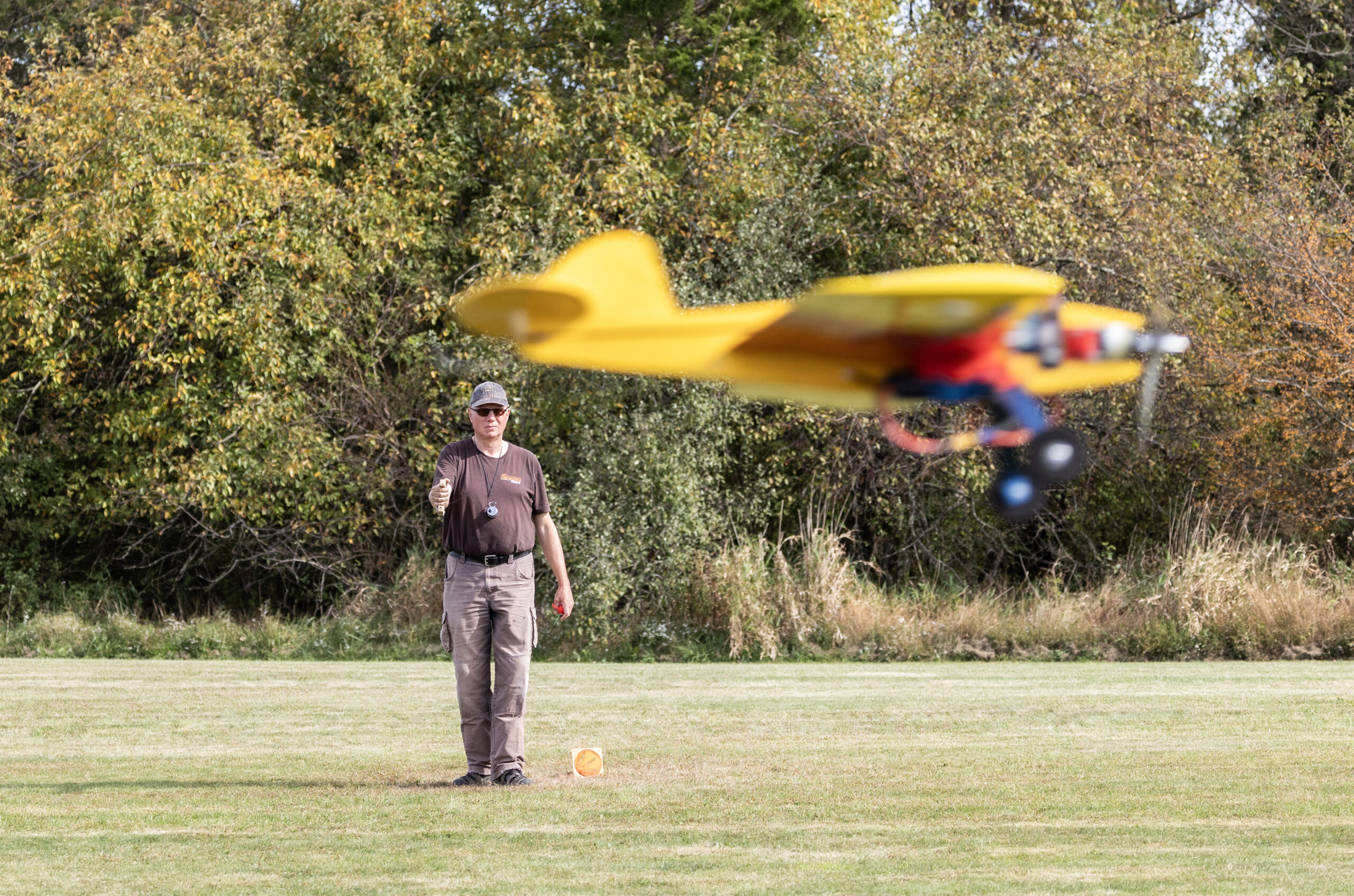
A bright yellow model airplane whirred through the autumn air at Washington Crossing State Park, circling a pilot standing in the grass. After a handful of laps, the aircraft touched down, its motor paused briefly, and it was airborne again.
Then again. And again.
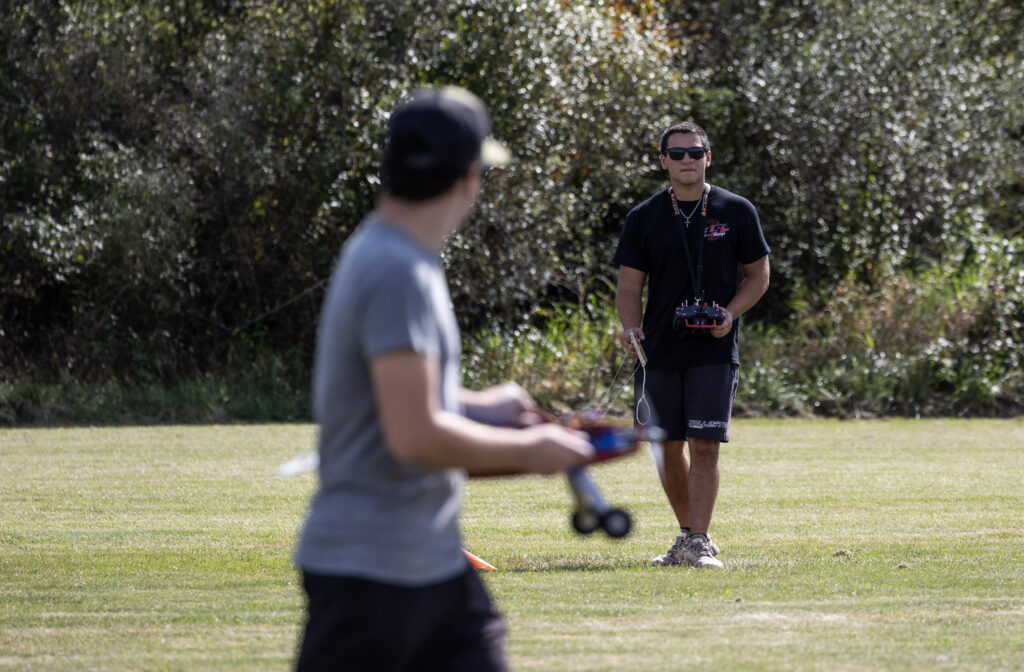
Across the field, other pilots were doing much the same thing, sending miniature aircraft around in carefully controlled circles, counting flights and working toward a goal that had brought dozens of model aviation enthusiasts together.
For the Washington Crossing RC Flyers, the objective was ambitious: break the record for the most flights by a single club during the annual Worldwide Ringmaster Fly-A-Thon.
But the reason behind the effort was more personal.
The club wanted to honor John Kukon and his son, Jimmy, two longtime members whose passion for model aviation helped shape the organization and its flying traditions. Both have died in recent years.
By the time the flights were counted, 15 pilots had completed 2,307 flights, according to the event’s international tally released Oct. 14. The total surpassed the previous single-club benchmark of roughly 1,600 flights that organizers had set out to beat and was the highest club total reported in the tally.
The accomplishment was particularly meaningful because the Kukon family’s connection to the field continues through a third generation.
A family legacy takes flight
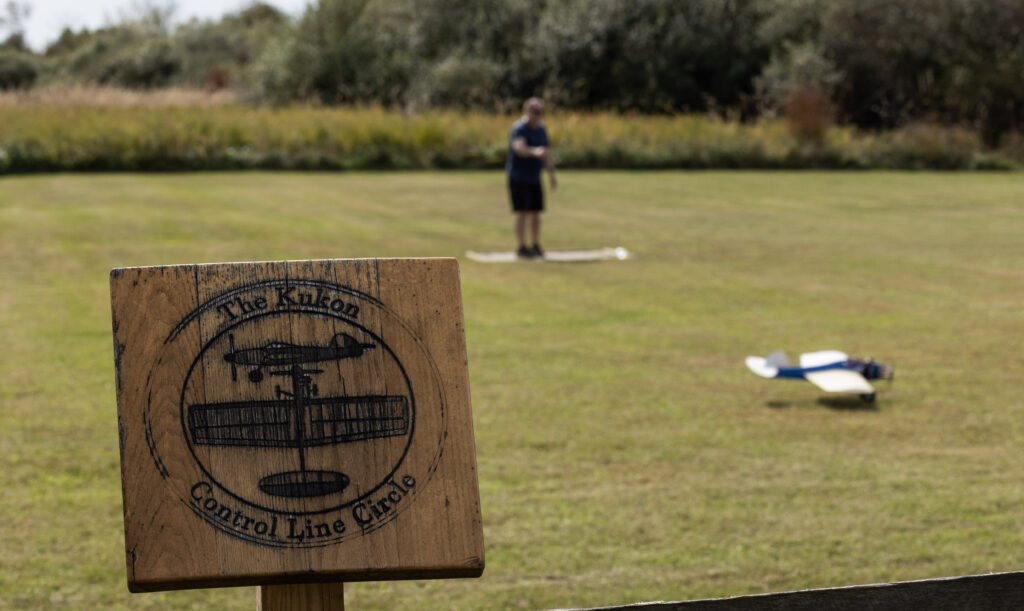
The model aircraft flying field at Washington Crossing State Park bears the name of John Kukon, a longtime club member remembered for his expertise with engines and his accomplishments in control-line flying.
Kukon was known for flying high-speed model aircraft, including pulse-jet-powered planes that could travel at extraordinary speeds while tethered to a pilot by control lines.
His son, Jimmy, shared that passion for the hobby.
Steve Fields, a longtime club member who helped organize the record attempt, said the deaths of the two men prompted members to consider how best to recognize their contributions.
“We’re trying to really do it to honor them,” Fields said.
The club had considered a more traditional memorial, but members ultimately decided that a flying event would be a fitting tribute to two people so closely associated with control-line aviation.
Although the Washington Crossing club primarily flies radio-controlled aircraft, control-line flying had been central to the Kukons’ involvement.
The Ringmaster Fly-A-Thon offered an opportunity to bring that tradition back into the spotlight.
Among the pilots participating was John Luca Kukon, John’s grandson and Jimmy’s son, who grew up around model airplanes.
“Since I was old enough basically to learn how to fly, my grandfather had a transmitter in my hands,” he recalled.
As a child, he even brought a small helicopter to school for show-and-tell.
Now, he was helping carry on the family’s aviation tradition, contributing 216 flights to the club’s final total.
He described control-line flying as a different experience from radio-controlled aircraft, but one that is more accessible to newcomers.
“Anybody can do it,” he said. “It’s a lot cheaper than getting into RC.”
For the club, having a third generation of Kukons participating made the tribute more than a remembrance of the past.
An old-school way of flying
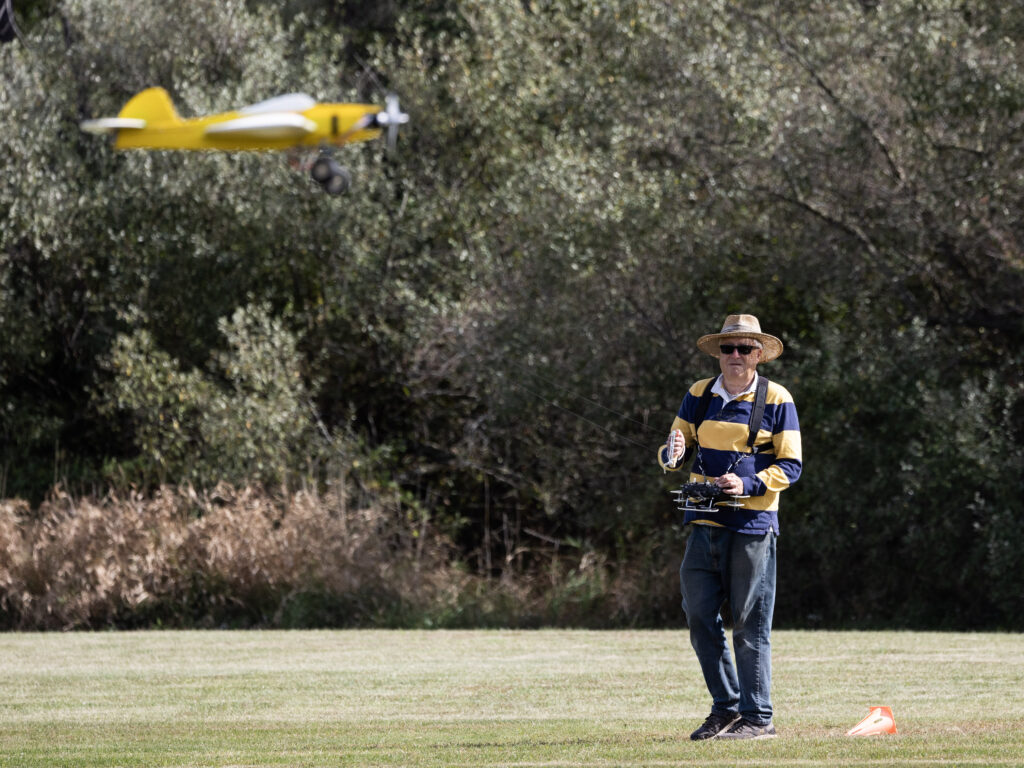
Unlike the radio-controlled airplanes that most visitors might associate with model aviation, control-line aircraft remain physically connected to their pilots.
Two thin cables extend from a handle in the pilot’s hand to a mechanical system inside the airplane. Small movements of the wrist raise or lower the aircraft’s elevator, controlling its altitude as it flies around the pilot.
The airplane’s design keeps tension on the lines, allowing the pilot to maintain control.
Control-line flying became especially popular in the 1950s, before affordable radio-control technology transformed the hobby. Although it is less common today, enthusiasts continue to compete in speed, aerobatics and other specialized events.
For the Fly-A-Thon, however, the goal was not complicated aerial maneuvers.
It was repetition.
A qualifying flight required a warm-up lap followed by five complete laps and a landing. Once the aircraft was back on the ground, the pilot could take off again and begin another flight.
That created a rhythm across the field: take off, circle, land, repeat.
Some aircraft were powered by traditional fuel-burning engines. Others used electric motors, allowing pilots to control precisely when an engine started and stopped.
Those electric aircraft proved particularly useful when every second on the ground mattered.
Engineering a record attempt
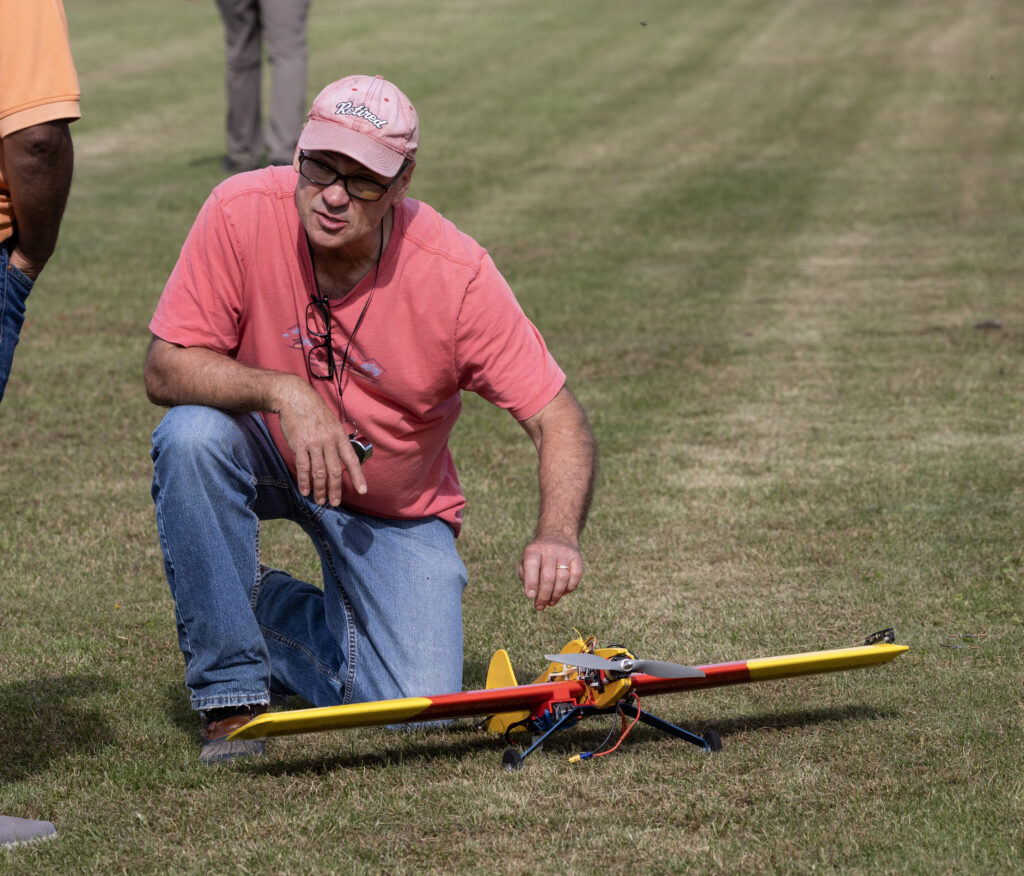
Fields and fellow organizer Johannes Dapprich spent months thinking about how to make the club’s attempt more efficient.
Their solution was a simplified version of the Ringmaster aircraft, a longstanding model airplane design that gives the international event its name.
Fields developed a plane with a flat wing, sturdy landing gear and modular parts that could be repaired or replaced quickly.
The design also incorporated throttle control, allowing pilots to complete multiple qualifying flights without retrieving the airplane and resetting everything between attempts.
“We were actually brainstorming how can we make a very easy to build Ringmaster design so that as many people in the club could get involved with it,” Fields said.
Dapprich compared the process to an engineering experiment.
The pilots studied the rules, developed procedures, tested their designs and made adjustments.
Even small changes mattered.
When pilots discovered that an airplane could turn inward after landing, potentially causing its control lines to lose tension, they experimented with adding a small brake to one wheel to improve its position for the next takeoff.
Other adjustments focused on reducing downtime, minimizing crashes and making sure enough charged batteries were available.
Fields brought spare parts, including an extra wing and fuselage, in case an aircraft suffered damage.
There were mishaps along the way, but the simplified designs helped keep planes flying.
For Dapprich, the event demonstrated how much could be accomplished through small improvements and cooperation.
One pilot keeps going
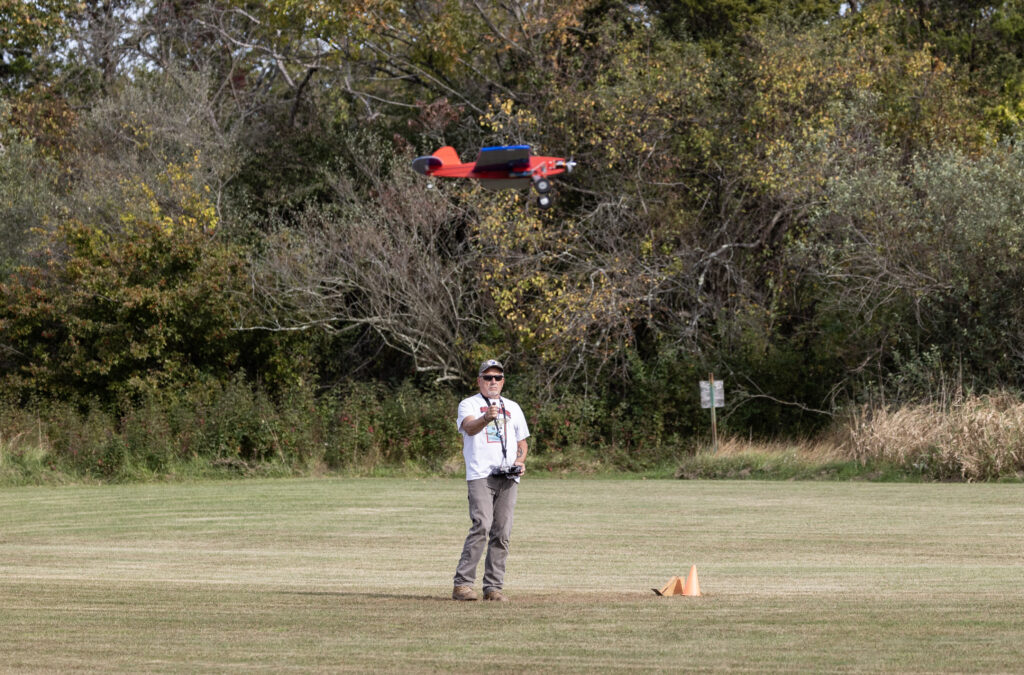
Few participants embodied the day’s persistence more than Alan Fiel.
Fiel spent hours at the field, flying one of Fields’ specially designed aircraft and returning it to the air again and again.
He had brought dozens of batteries to keep the plane running.
By the end of the event, Fiel had recorded 686 flights, the largest individual contribution to the club’s total.
He said the aircraft’s design made a substantial difference.
“That thing is fantastic,” he said.
Fiel, who has been flying model airplanes since he was 10 years old, said he does not ordinarily spend so much time flying control-line aircraft. But this event was different.
His motivation was the memory of the Kukons.
“It’s for the club. It’s for John Kukon and Jimmy Kukon,” he said.
He remembered John Kukon as the person everyone turned to when an airplane engine would not run properly.
“He was like the engine guru up here,” Fiel said. “If you had an engine problem, a couple clicks here, he gets you going.”
Fiel said he missed both men.
The hours of flying were his way of paying tribute.
A worldwide event with a local connection
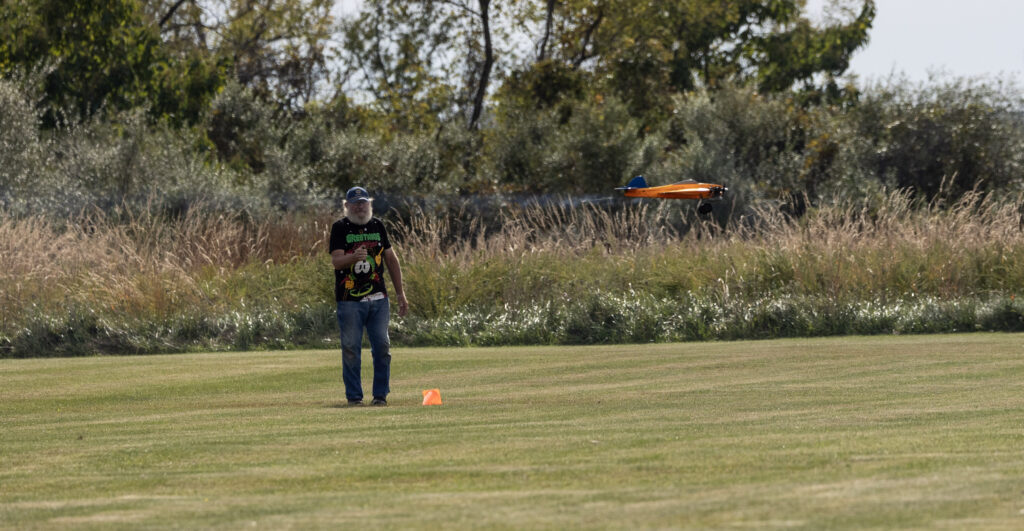
The Ringmaster Fly-A-Thon brings together model aviation enthusiasts from around the world, with pilots and clubs submitting their flight totals to an international tally.
The 2026 event was the 19th annual Joey Mathison Memorial Worldwide Ringmaster Fly-A-Thon.
Washington Crossing’s effort began the previous weekend, but poor weather interrupted the planned two-day event. Organizers returned to the field Oct. 10 to complete their attempt.
The club had recorded 786 flights during the first weekend. With better weather, more efficient aircraft and determined pilots, members substantially increased that total.
The final tally listed 2,307 flights by 15 pilots from the Washington Crossing RC Flyers.
The worldwide report, dated Oct. 14, recorded 10,342 flights by 608 pilots overall.
The Washington Crossing club’s contribution represented more than one-fifth of the reported worldwide flights.
The record attempt brought together pilots with different levels of experience, along with volunteers who helped launch airplanes, maintain equipment, recharge batteries and keep the event running.
The club has approximately 65 to 70 members, according to members interviewed during the event, and organizers estimated that 25 to 30 people were on hand at various times during the day.
There was food, conversation and plenty of good-natured encouragement between flights.
Dapprich emphasized that the final total reflected far more than the work of the pilots.
Support crews were essential to keeping aircraft in the air, he said, whether they were charging batteries, helping with repairs or preparing planes for another flight.
“It’s not just about who scores the goals, but it’s the teamwork,” he said.
More than a number
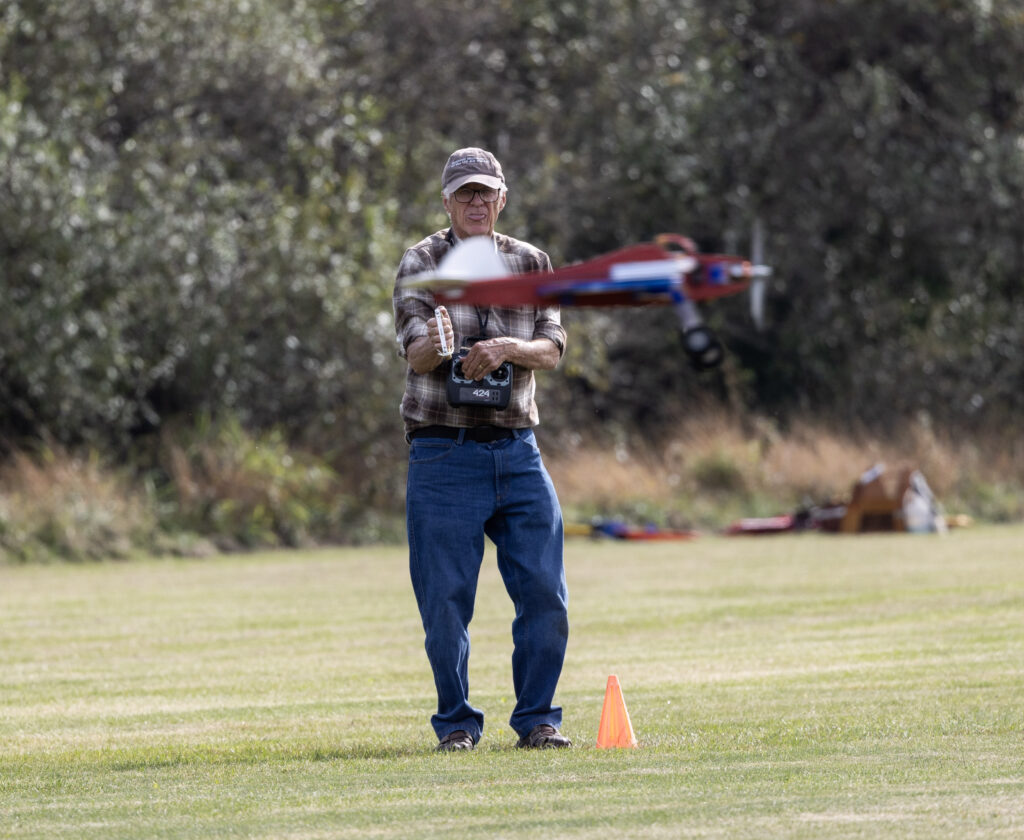
For a club that normally devotes much of its time to radio-controlled aviation, the Fly-A-Thon brought members together around a form of flying that connected the hobby’s history with its present.
The aircraft may have been traveling in circles, but the club had a clear destination in mind.
The goal was to honor two people who had given so much to the organization and to make their contributions part of a lasting club memory.
With the final tally exceeding expectations, the tribute became a record-setting accomplishment.
And for John Luca Kukon, who still helps maintain the field his grandfather helped make special, the event provided another opportunity to take to the air alongside the people who knew his family.