

New Jersey is taking several new steps to address its housing shortage by helping municipalities move from planning affordable housing to getting projects built. At the same time, the state is expanding financial and technical assistance for local governments while evaluating public land that could support future housing development.
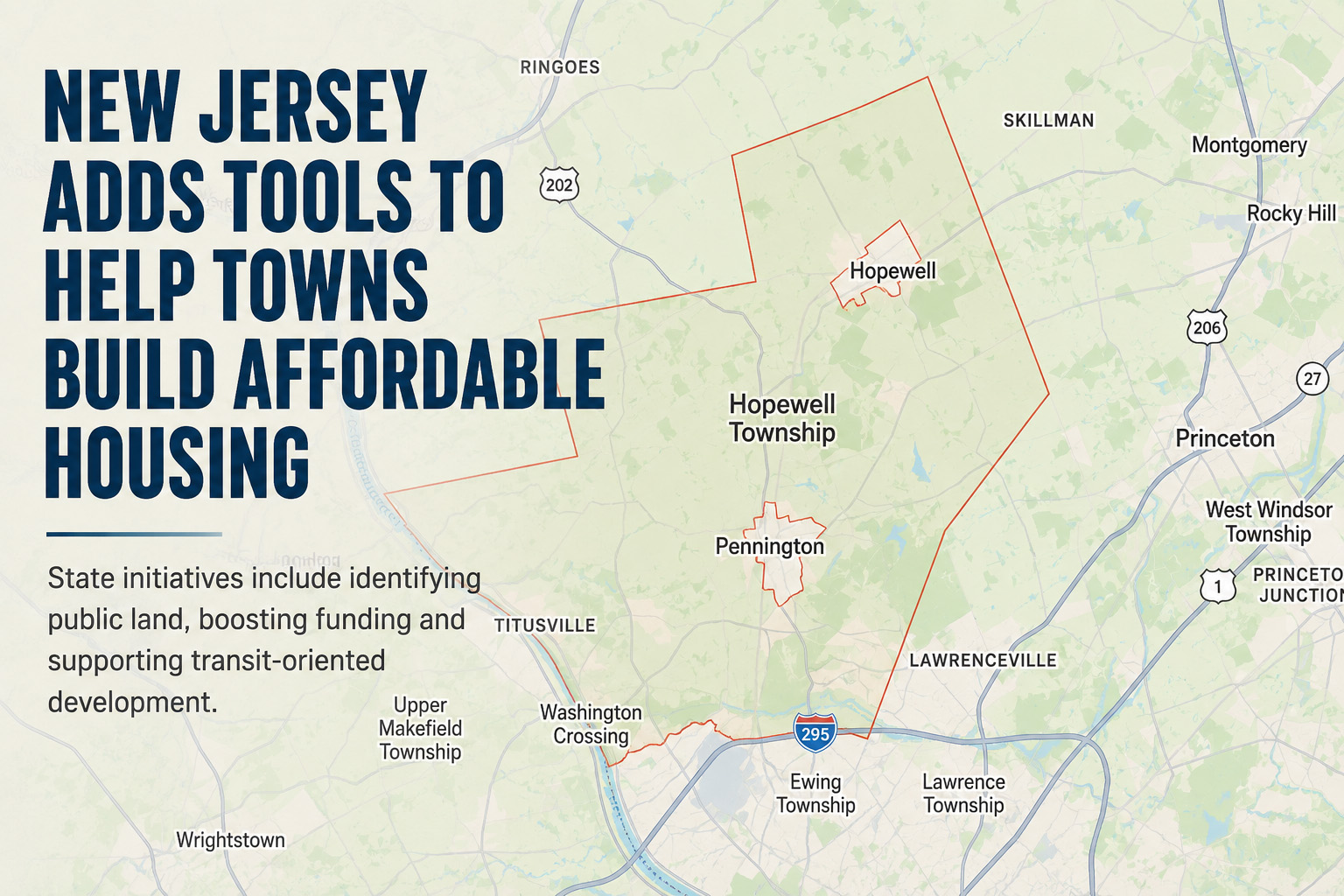
The initiatives come as municipalities across New Jersey — including Hopewell Township, Hopewell Borough and Pennington Borough — work through their latest affordable housing obligations under the state’s updated planning process.
The effort is part of Gov. Mikie Sherrill’s plan to make New Jersey more affordable for middle- and working-class families, a central promise of her campaign.
“More than a third of New Jerseyans spend over a third of their income on housing. We have a severe shortage of affordable homes. It’s driving working families out of the state,” Sherrill said.
From planning to production
Several reforms are driving the state’s push for additional housing.
Sherrill issued Executive Order 17 on April 27, directing state agencies to identify unused, underutilized and surplus public land — particularly near transit stations — that could support affordable or mixed-use housing. The administration has also expanded tax credits to encourage development.
The executive order follows the Legislature’s 2024 overhaul of New Jersey’s affordable housing process, which replaced the Council on Affordable Housing with a new system for determining and enforcing municipalities’ constitutional affordable housing obligations.
Of New Jersey’s 564 municipalities, 431 adopted resolutions to participate in the state’s affordable housing planning process.
“The messaging we’re hearing from the administration is partnership, not preemption,” said Michael Cerra, executive director of the New Jersey State League of Municipalities.
Executive Order 17 also established a Housing Governing Council charged with coordinating housing policy across state government and developing recommendations to accelerate housing production. State agencies were required to report on land they own, current or planned housing projects, and regulatory barriers to development.
Looking at state-owned land
An NJ Transit spokesperson confirmed the agency submitted its required report under the executive order, though it did not identify which additional properties may have been included.
Cerra said the initiative gives the state an opportunity to examine its own role in addressing New Jersey’s housing shortage.
“Maybe the state, for the first time, is assessing its own house,” he said.
Tim Evans, research director at New Jersey Future, called the effort worthwhile but cautioned that it is unlikely to have the same impact as the state’s affordable housing law.
The 2024 legislation, he noted, requires every municipality to develop a plan to meet its affordable housing obligations. Executive Order 17, by contrast, requires only an evaluation of whether state-owned properties could realistically support housing.
Transit-oriented development offers opportunities
Even if the state’s inventory of available land proves limited, Evans said areas surrounding transit stations remain among New Jersey’s strongest opportunities for future housing.
NJ Transit has already begun evaluating its properties through its LAND Plan, released in October 2025. The agency estimates the initiative could produce between 14,000 and 20,000 housing units over the next decade, including approximately 2,600 to 4,000 affordable homes.
Under state law, residential developments built on NJ Transit-owned or controlled property must reserve 20% of newly constructed units for low- and moderate-income households.
The opportunities vary across the state, however. Northern New Jersey’s rail network provides stronger connections to employment centers, while South Jersey’s more limited rail service presents additional challenges.
Evans also noted that successful transit-oriented development depends on more than simply identifying land.
“If the street network isn’t connected to what’s around it, it ends up functioning like a little pod of urbanism,” he said.
Finding land is only the beginning
Identifying available property is only one piece of the puzzle.
Evans said state agencies may also need to help connect publicly owned land with developers capable of building housing.
NJ Transit said any potential project must still undergo evaluations of local zoning, environmental conditions, infrastructure capacity, financing, market demand and operational needs.
Cerra believes financing remains the greatest hurdle.
Affordable housing projects often depend on complex combinations of private investment and federal tax credits.
“Sometimes you need the stars to line up perfectly in order to make a project like that happen,” he said.
He added that new housing also requires investments in roads, water and sewer infrastructure, and public transportation while municipalities continue maintaining aging infrastructure.
“I hope it’s going to go beyond the inventory of land,” Cerra said. “I hope it’s going to be an identification of the resources to match the infrastructure.”
Additional support for municipalities
The Sherrill administration is also expanding NJHOMES, a Department of Community Affairs program that provides municipalities with technical assistance, training and resources for smaller affordable housing projects.
The program will grow from 10 participating municipalities to 30 additional communities.
Cerra said the expansion reflects a shift from previous affordable housing cycles, when municipalities often received their housing obligations with little assistance in meeting them.
The administration has also launched a permitting dashboard to track state approvals, used its first tax-credit auction to generate $35 million for affordable and workforce housing — with nearly $400 million expected over five years — and continued funding the state’s Affordable Housing Trust Fund.
Rather than simply assigning affordable housing obligations, Cerra said, the state is increasingly providing municipalities with planning assistance, financing tools and land resources to help meet those requirements.
Even if relatively few state-owned properties ultimately prove suitable for housing, Evans said the effort could encourage counties and municipalities to examine their own land holdings.
“If the state does it, it can serve as an example for lower levels of government to look at the properties that they own and size them up as potential sites for building housing,” he said.
Whether the initiatives significantly increase housing production, Evans said, will ultimately depend on whether land, infrastructure, financing and developers can be brought together.
“They don’t even know where it’s going to lead, but it’s good that they’re doing it because at least it’s drawing attention to the issue,” Evans said. “Leading by example is important.”
Federal housing legislation also advances
Meanwhile, a bipartisan federal housing package co-sponsored by New Jersey Sen. Andy Kim became law Saturday.
The measure provides additional resources intended to help states and municipalities expand housing by restricting large corporate purchases of single-family homes, streamlining zoning and permitting processes, and authorizing a $200 million annual grant program to encourage local governments to create more housing.
The legislation passed both houses of Congress with broad bipartisan support. President Donald Trump did not sign the measure, allowing it to become law without his signature after lawmakers did not approve separate voter identification legislation he supported.
By Devon Williams, NJ State House News Service