

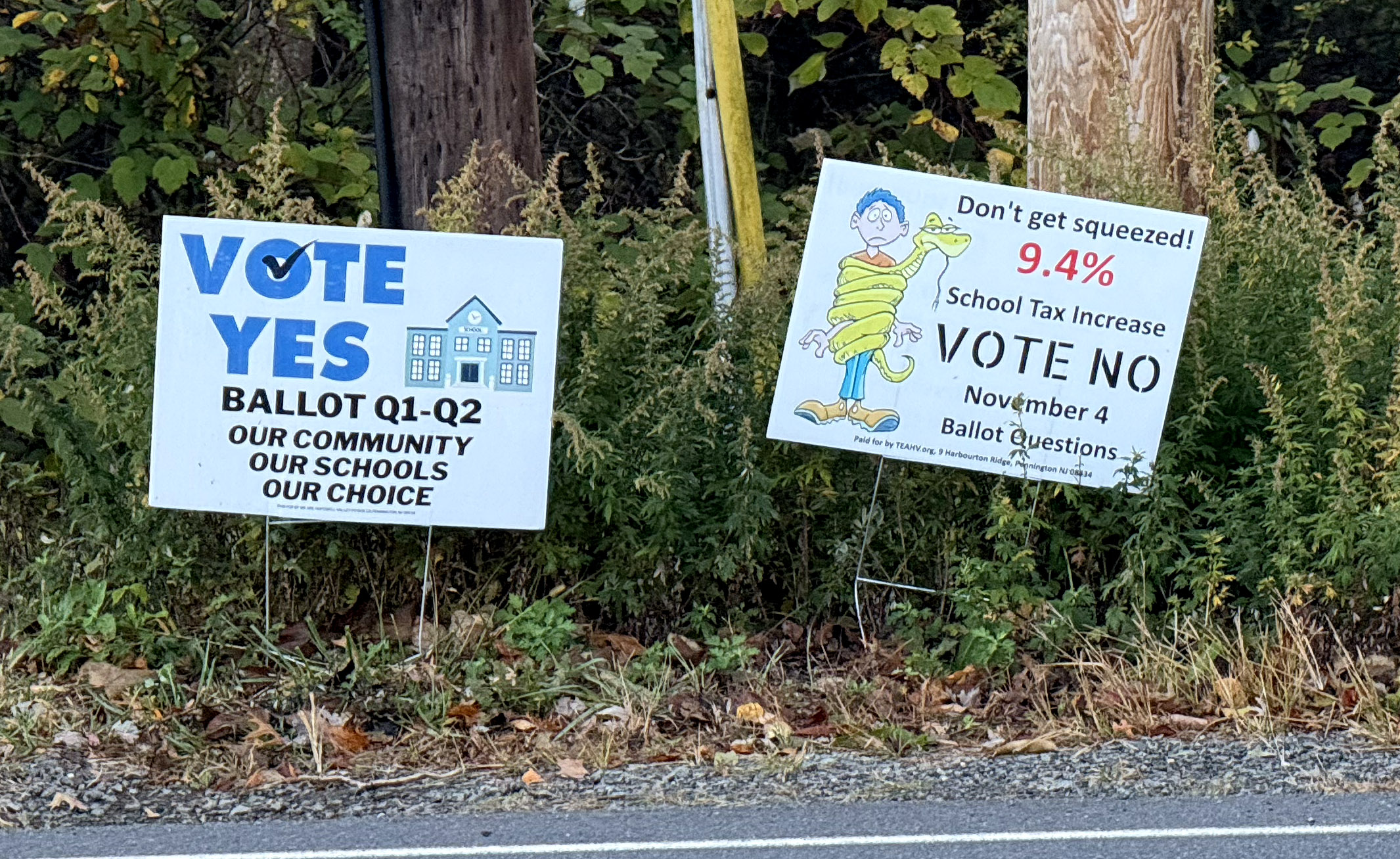
Across the Hopewell Valley, the debate over the school referendum has moved beyond meetings and auditoriums. It’s playing out in front yards, on postcards in mailboxes, and on social media message boards, where signs urging residents to “Vote Yes for Our Schools” or “Vote No on Q2” stand as symbols of a community deeply engaged — and divided — over how to plan for the future of public education.
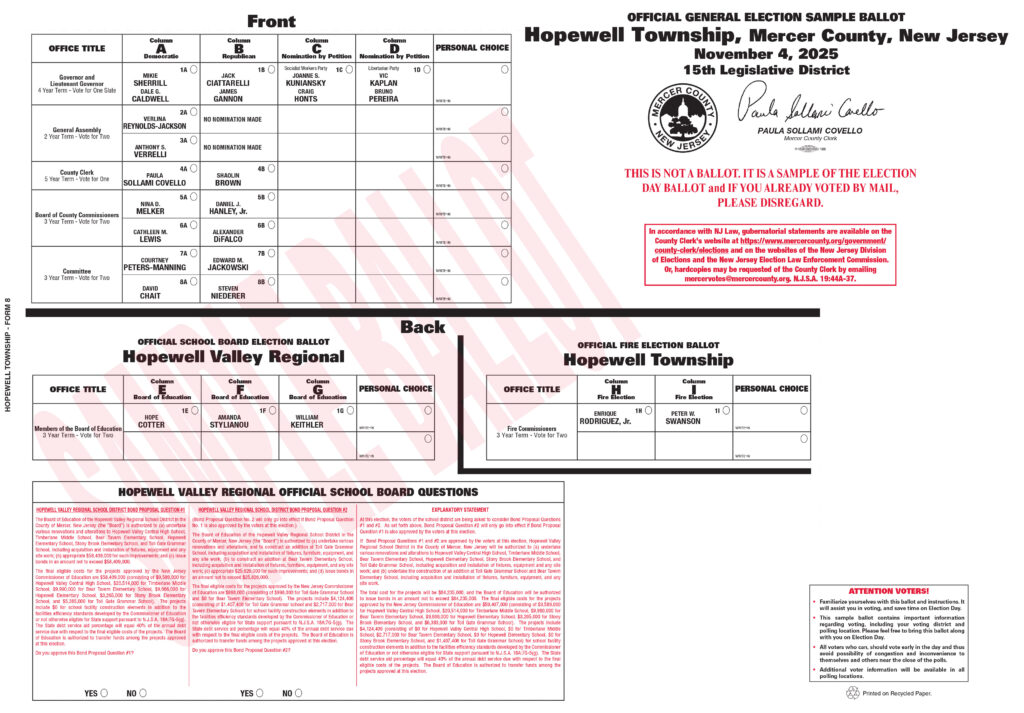
On November 4, voters in the Hopewell Valley Regional School District (HVRSD) will decide whether to approve two bond questions totaling more than $80 million in facility and infrastructure projects. The referendum has inspired a level of local interest as sides for and against continue to share their thoughts, analysis – with educators and local officials all weighing in on what’s at stake for the district’s six schools.
Two Questions, Distinct but Connected
The referendum is divided into two parts.
Question 1 would fund districtwide repairs and upgrades to all six schools — from replacing aging HVAC and roof systems to replacing doors, modernizing bathrooms, ensuring compliance with safety standards, and addressing other critical infrastructure projects.
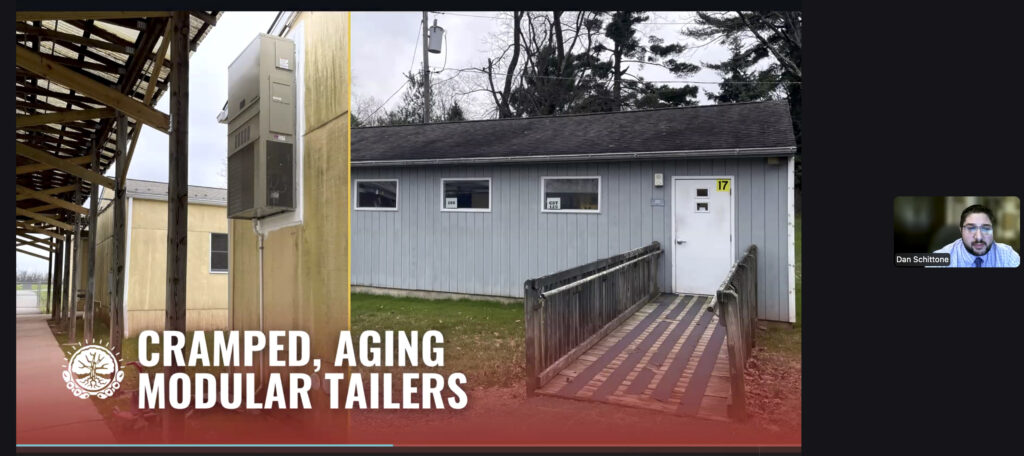
Question 2 focuses specifically on classroom additions at Bear Tavern Elementary School and Toll Gate Grammar School, replacing trailers that have been in use for decades and creating age-appropriate spaces for kindergarten and pre-K students that can also be used by other grades.
Question 2 cannot pass unless Question 1 also passes — a structure Superintendent Dr. Rosetta Treece said reflects community feedback after the failed 2024 referendum.
“These questions represent essential improvements that would increase the energy efficiency, safety and function of our school buildings,” Treece said in a written response to MercerMe. “They will also provide students with the space they need now and as our enrollment continues to grow.”
Supporters Say Needs Are Urgent
After a failed referendum last year, district officials have worked all year on creating a new referendum that still addresses the needs while many of the district’s core systems are showing their age.
Treece pointed to HVAC failures, closed bathrooms, and leaky roofs as more than inconveniences.
“Our students deal with disruptions such as closed bathrooms, shuttered media centers due to leaky roofs, and displacement from classrooms because of failing HVAC systems,” she said. “Students continue to learn in trailers at Bear Tavern and Toll Gate where their parents attended classes 30 years ago.”
She said the district has “maximized existing resources” but can no longer rely on patchwork fixes. Portable air conditioners are being used in parts of Timberlane Middle School, and some trailers have been deemed unsuitable for occupancy.
Without the referendum, Treece said, such repairs would have to be paid from the operating budget, directly competing with classroom programs, staffing, and curriculum.
“This is just one example of how building system breakdowns will result in the district having less control of how it can allocate its funds,” she said.
Passing the referendum allows the district to have specific infrastructure projects and make use of state aid to help offset the debt service.
Opponents Question Scale and Timing
Former Hopewell Township Mayor Vanessa Sandom, a longtime community leader, is among those urging residents to scrutinize the proposal closely — particularly Question 2.
Sandom, along with former Mayor John Hart, has helped lead Taxed Enough Already Hopewell Valley (TEAHV.org), a grassroots group arguing that the district is overspending and underexplaining its long-term plan.
“I look at this as a taxpayer,” Sandom said in an interview with MercerMe. “What I pay every year includes both the operating budget and the referendum debt. That’s one bill to the taxpayer, and it keeps growing.”
She said she takes no position on Question 1, which covers core maintenance, but believes Question 2 — the classroom additions — should be delayed until the district finalizes an agreement with Hopewell Township over its PILOT funding (payment in lieu of taxes).
Hopewell Township has pledged $16.1 million from PILOT revenues to support the Bear Tavern expansion, contingent on the resolution of ongoing litigation with Pennington Borough over revenue distribution.
“Why should we incur the cost of bonding and pay interest when that money is already pledged through the PILOT?” Sandom asked. “That’s like taking out a loan when someone has already agreed to cover part of your bill.”
She also raised concerns about redistricting, staffing costs, and the district’s decision not to explore converting the district office on South Main Street into classrooms.
“Have we considered all realistic opportunities — even those that aren’t politically palatable?” she said. “We should be planning with an open mind and total transparency.”
Treece is quick to point out why the district office is not a viable option for students. “The district office is not a realistic option to accommodate students for several reasons,” Treece said. “This 100-year-old building lacks essential spaces such as a cafeteria, nurse’s office, media center, and age-appropriate bathrooms, and it does not have an internal lift to the second floor. It would likely be more cost-effective to construct a new school than to retrofit this facility for instructional use.”
District: PILOT Still in Discussion
Treece said that discussions between the district and Hopewell Township are active but that no final agreement exists yet.
“Counsel for Hopewell Township and the district are in discussions to create a formal memorandum of understanding regarding PILOT funding,” she said. “This would be in place pending the resolution of the litigation between Hopewell Township and Pennington Borough, which makes the funding inaccessible at this time.”
She emphasized that whatever funds the Township provides would go directly toward debt service for Bear Tavern.
“The district is pursuing every possible option to offset local costs,” she said. “Funding from the Township would be in addition to more than $20 million in debt service aid from the state.” Most of the state aid that is available is tied to Q1.
The Per-Pupil Debate
A major flashpoint in the referendum debate has been spending per student — a metric that opponents say shows Hopewell Valley as an outlier.
Sandom and Hart have pointed out that HVRSD’s per-pupil cost is the highest in Mercer County and among the highest for similar-sized districts in New Jersey.
Treece called such comparisons misleading.
“There are so many variables that it is not possible to make direct comparisons between districts,” she said. “Transportation, special education, staffing, and building maintenance all contribute to differences in cost. We proudly invest in high-quality education, which drives the desirability of the communities we serve.”
She added that “housing developers recognize this and invest here because of it,” calling the district’s experienced staff “one of the key reasons families move to the Valley.”
Enrollment and Growth Pressure
Both sides agree that enrollment is rising — but they differ on what it means.
Treece said the district is “at the high end” of prior projections and is commissioning an updated demographic study using new development data from all three municipalities. The results, expected in November, will include redistricting recommendations both with and without the referendum’s passage.
Sandom countered that while growth is occurring, it is “hardly bursting at the seams.”
“Yes, we’re seeing some increase in students, but it’s nowhere near what would justify this scale of expansion,” she said. “We need better long-term forecasting before we make permanent financial commitments.”
A Community with Long Memory
For Sandom, the referendum echoes familiar debates from a decade ago. In 2014, the district convened a Future Planning Committee made up of members throughout the community to address declining enrollment and evaluate potential full-day kindergarten. Then, the concern was under-capacity, not over.
Treece said the landscape has shifted dramatically.
“In 2014, there was little urgency — class sizes were small, and affordable housing was limited,” she said. “Today, inflation has strained the operating budget, enrollment is rising rapidly due to new housing, and we face unprecedented increases in healthcare and energy costs.”
Faith in the District, Concern About the Process
Even some referendum skeptics acknowledge the district’s strengths. Sandom called Hopewell Valley “an excellent district” but argued that quality should not insulate leadership from scrutiny.
“I love this community,” she said. “But good governance requires oversight. We should be asking, ‘Is this the best use of our dollars? Are we being transparent with the public?’ That’s not opposition — that’s accountability.”
Treece, for her part, said she welcomes the discussion, but urged voters to “separate opinion from fact.”
“We encourage community members to seek accurate information and rely on verified data,” she said. “Our goal is to ensure voters understand what each question would do, and how it affects our schools.”
Questions on Administrative Salaries
Questions about administrative salaries have also surfaced in the debate.
Recently, as Sandom analyzed district payroll data, she questioned “the need to have extra principals and vice principals who are not tied to a building.”
Treece countered that those titles reflect cross-school instructional leadership roles rather than idle or duplicative positions.
“These are multi-school instructional leaders, not ‘extra principals,’” Treece said. “They oversee core K–12 programs across buildings and are assigned districtwide.”
What Happens If It Fails
If the referendum does not pass, Treece said the district will still need to address aging infrastructure and growing enrollment — just without the benefit of state aid.
“Without approved funding, repairs would have to come from the operating budget,” she said. “That could impact class sizes, academic programs, and extracurricular opportunities.”
She warned that necessary projects could become more expensive if delayed.
“The classroom trailers are already past their expected lifespan,” she said. “Some have become unsuitable for occupancy. Deferring projects only increases long-term costs.”
What Happens If It Passes
If both questions pass, district officials say construction planning would begin almost immediately. The district would finalize its bond issuance, submit projects to the New Jersey Department of Education, and coordinate with architects, engineers, and municipal partners to sequence the work across all six schools.
“Passage of the referendum would give us the financial stability and state aid necessary to make long-deferred improvements responsibly,” Treece said. “It means safer, more efficient buildings, expanded space for early learners, and facilities that reflect the quality of instruction happening inside.”
Because the referendum qualifies for state debt service aid, roughly 30% of the total cost of Q1 would be covered by the state. Hopewell Township’s pending $16.1 million PILOT contribution—if finalized—would further offset the local share for the Bear Tavern project.
Treece said construction at the elementary schools would likely be phased to avoid displacing students, with work starting as early as possible. The district would also integrate the results of a forthcoming demographic study to guide redistricting and ensure that new spaces are used efficiently.
“Our goal is to minimize disruption and maximize value,” Treece said. “This is about creating learning environments that serve our students well for the next 30 years, not just the next three.”
Voting Underway with Strong Feelings
As early voting continues, everyone is encouraging the community to vote. The conversation is regularly on local forums and letters to the editor — often impassioned, but rarely indifferent.
Treece said the intensity reflects community pride.
“We all want what’s best for our children,” she said. “Having students in buildings with leaky roofs, failing HVAC, and heating systems is not that.”
Sandom sees the engagement as proof that residents are paying attention.
“People care. That’s a good thing,” she said. “Even if we disagree, this kind of involvement shows that Hopewell Valley is invested in its future.”
Election Information
Early in-person voting continues through Sunday, November 2, at the Pennington Fire Company, with Election Day voting on Tuesday, November 4, from 6 a.m. to 8 p.m. at regular polling locations.
For more information, voters can visit www.hvrsd.org/vote for district details, review the growing dataset at teahv.org, review the information from the pro-referendum community group www.wearehopewellvalley.org or check ballot information through the Mercer County Clerk’s Office.