

The proposed Hopewell 57 redevelopment project returned to the Hopewell Borough Planning Board Wednesday night for a lengthy hearing dominated by traffic concerns, as residents pressed the applicant on parking, safety, and the limits of the project’s traffic study.
After more than three hours of testimony and public questioning, the meeting was adjourned. The hearing will continue in April at Hopewell Elementary School, a larger venue selected after recent meetings at Borough Hall drew standing-room-only crowds.
The applicant has finished their presentation and the next meeting will include questions from the public on traffic and then their additional concerns about all aspects of the project as the site gets closer to a vote from the board.
Traffic study takes center stage
The latest hearing marked the presentation from the project’s traffic engineer, who outlined how the applicant evaluated the impact of the proposed residential development.
Using national standards from the Institute of Transportation Engineers, the consultant said the study focused on peak commuting periods—typically the morning and evening rush hours—to model the project’s expected traffic.
But that approach quickly became a focal point for residents, many of whom argued it failed to reflect real-world conditions in Hopewell Borough.
One resident questioned whether the study captured the full complexity of traffic patterns near the site.
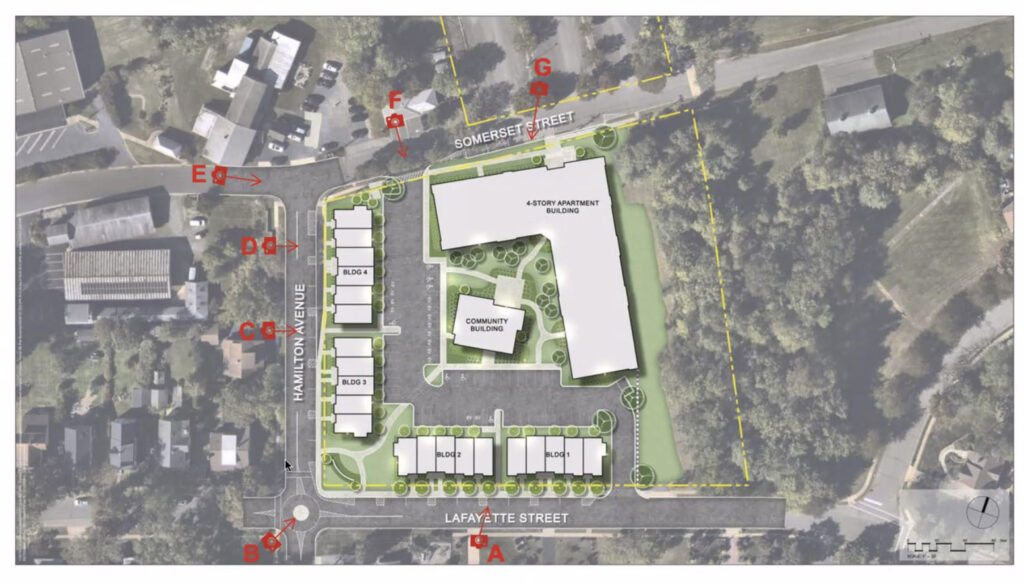
“It looks like the study that was done… was focused on vehicular traffic,” Borough resident Steve Esposito said, raising concerns about pedestrian and bicycle safety in already constrained areas. “There’s just a lot of movements in that intersection,” the Esposito said, describing a mix of vehicles, pedestrians, and cyclists navigating tight turns and limited visibility.
Roundabout dropped in favor of proposed four-way stop
In a notable shift from earlier plans, both the applicant and Planning Board members expressed support for eliminating a proposed roundabout at the intersection of Hamilton Avenue and Lafayette Street, instead favoring a four-way stop configuration.
The change emerged during discussions around traffic flow and safety, with the roundabout—previously considered as part of the project’s traffic mitigation—drawing concern from both residents and officials.
While the Planning Board does not have direct authority over traffic control decisions on borough roads, members indicated that a four-way stop could be a more appropriate and practical solution for the intersection.
The applicant signaled agreement with that approach during the hearing.
Any formal change would ultimately need to be reviewed and approved by Hopewell Borough Council, which has jurisdiction over traffic control measures.
Still, the shift was viewed by those in the room as a meaningful adjustment—one of the first clear indications that aspects of the project’s traffic design could evolve in response to public input and board discussion.
Parking debate highlights broader concerns
Parking emerged as another major point of contention, particularly the project’s reliance on a ratio of approximately 1.5 to 1.6 spaces per unit, consistent with the borough’s redevelopment plan.
Residents questioned whether that standard would be sufficient in practice.
“I did the numbers… and you get two hundred eighteen,” Melissa Cookman said, referencing higher parking estimates based on state guidelines and adding that guest parking requirements could push that number even higher.
The applicant’s team responded that those standards do not apply to the project, which is governed by a redevelopment ordinance adopted by the borough.
“The redevelopment plan has a different parking ratio than the state parking ratio,” the applicant said.
Planning Board representatives emphasized that their role is limited to evaluating whether the project complies with that ordinance—not to rewrite it.
“What we do is… evaluate the application against the code,” the board’s attorney said.
That distinction—between what the board can review and what has already been set by ordinance—frustrated some residents.
“That’s really disappointing,” one speaker said after learning the board could not require additional parking beyond what the redevelopment plan allows.
Questions raised about traffic assumptions
Several residents challenged how the traffic study accounts for everyday conditions, including drivers searching for parking or navigating congested streets.
“Do we take that into consideration?” one resident asked, referring to vehicles circulating in search of parking.
The traffic engineer responded that such behavior is not modeled in standard traffic analysis.
“The short answer is no,” the consultant said, explaining that studies focus on peak-hour conditions rather than every possible movement.
That answer did little to ease concerns from residents who argued that local conditions—particularly narrow streets and existing congestion—require a more nuanced approach.
Safety concerns extend beyond vehicles
Residents also raised concerns about how the development could affect pedestrian and bicycle safety, particularly near intersections already described as difficult to navigate.
One resident highlighted conditions along Hamilton Avenue, where parked cars and limited space already create challenges.
“Hamilton’s already tight,” the resident said, describing how queued vehicles can make turns more dangerous and reduce visibility.
Others questioned whether the study adequately accounted for nearby features, including the Step in Stone shopping center with limited egress and incomplete sidewalk connections.
“Why wasn’t that looked at in the study?” one resident asked.
Environmental and site conditions addressed
In addition to traffic, the applicant provided updates on environmental conditions at the site, including remediation efforts tied to past industrial use.
Project representatives said soil conditions have been remediated to residential standards and approved by the New Jersey Department of Environmental Protection.
Groundwater contamination remains an ongoing issue, though officials said it is being addressed through long-term treatment systems and would not impact future residents due to planned connections to public water and sewer systems.
The applicant also outlined demolition safeguards, including air monitoring and dust control measures.
“There’ll be air monitoring on the entire perimeter of the site,” Jeffrey Albert, of the project partners said, noting that monitoring would occur in real time.
Design changes and additional details presented
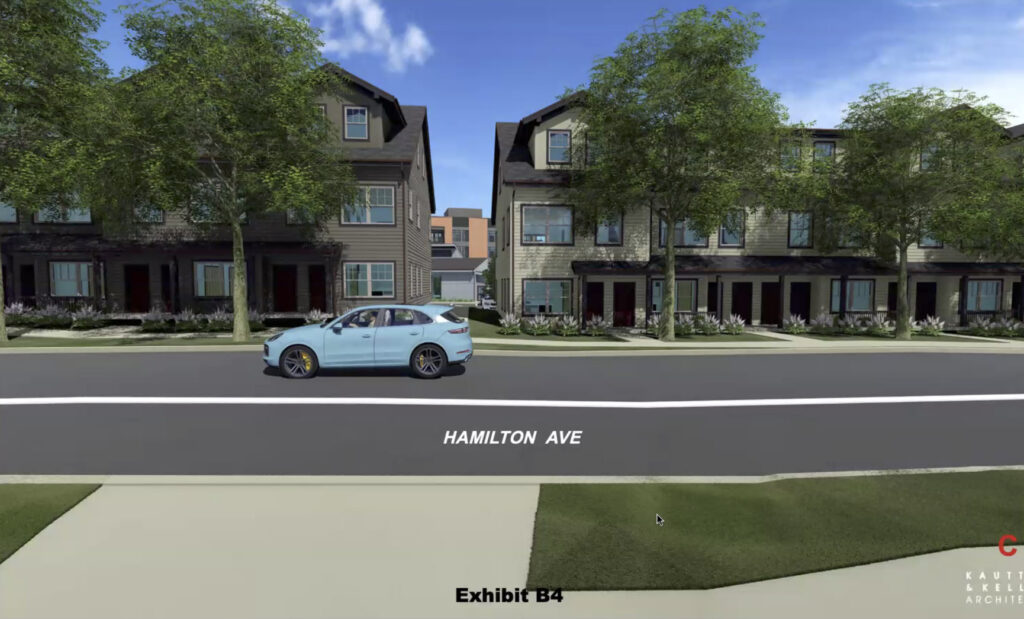
The applicant also presented updated architectural and site details in response to questions raised at earlier hearings.
Among the updates:
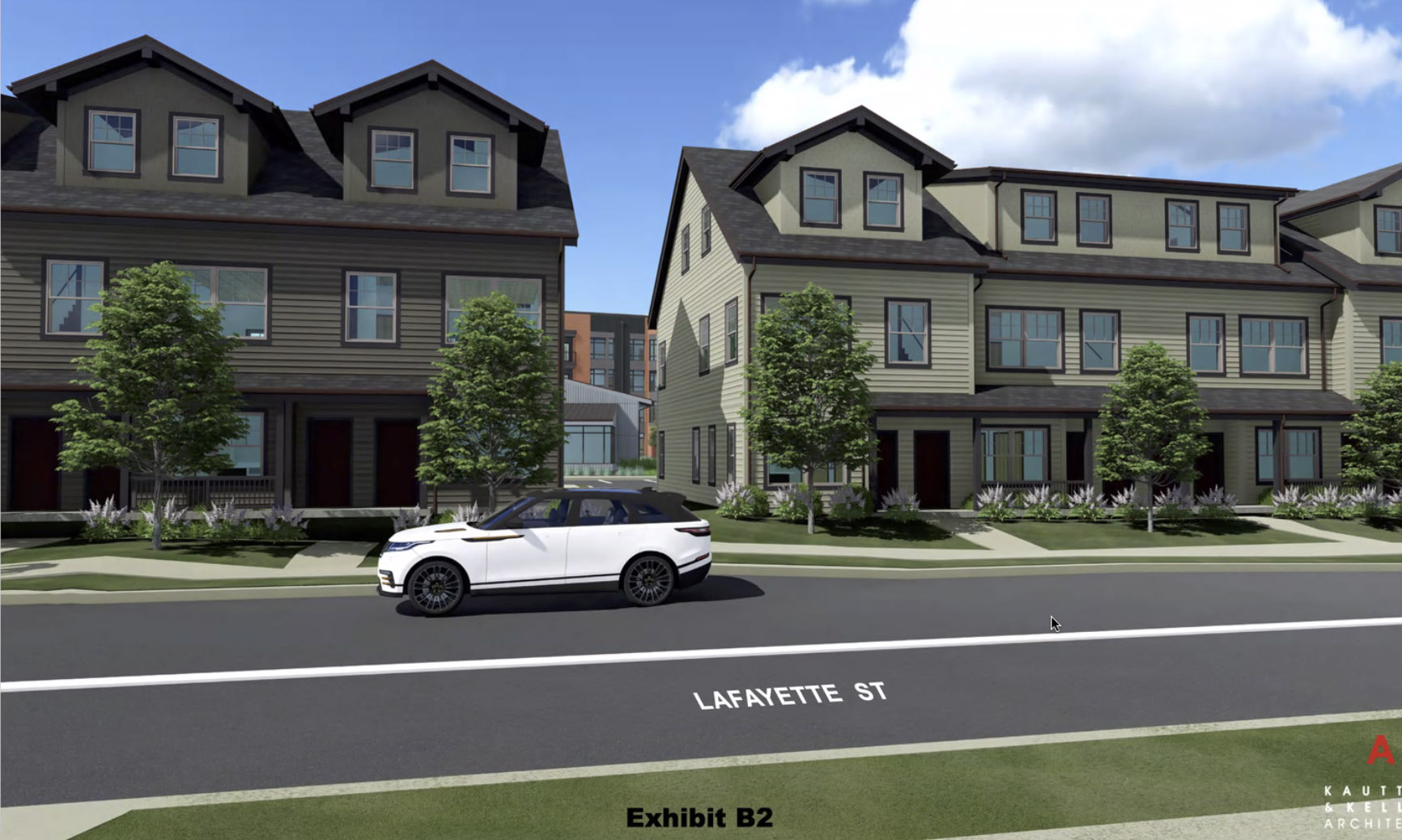
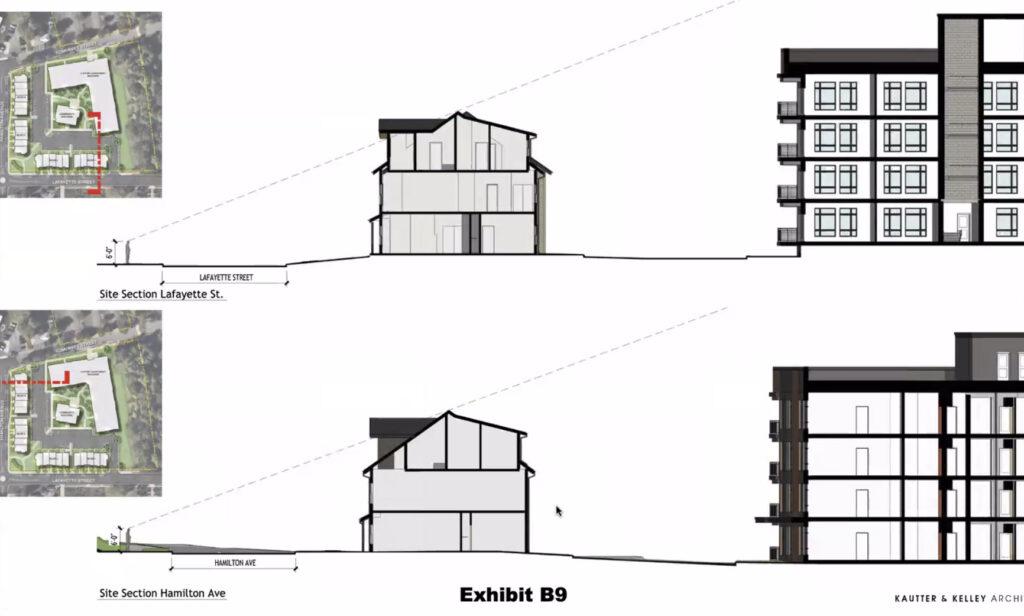
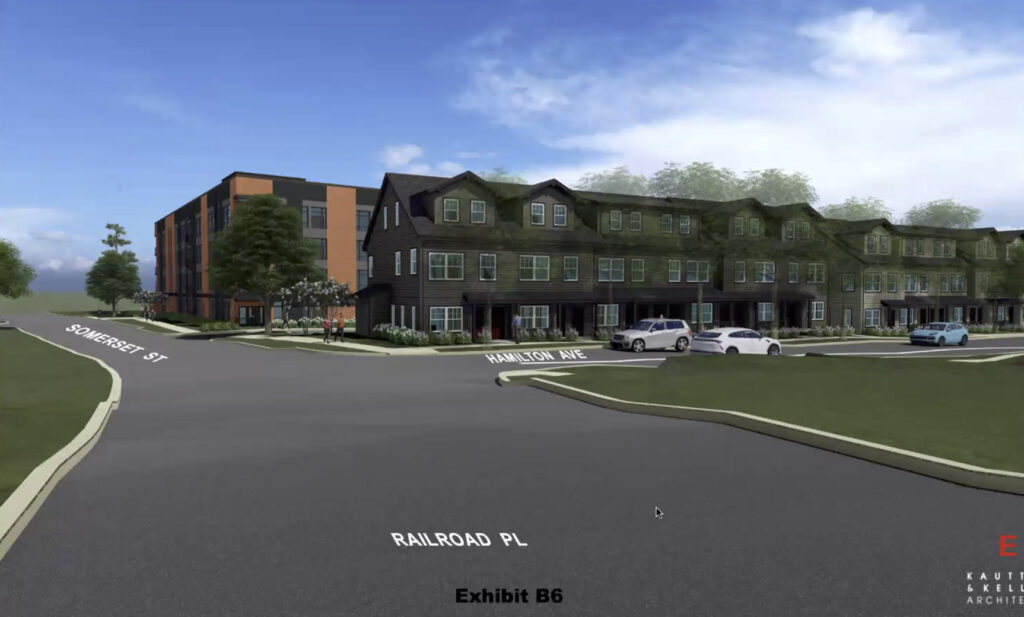
- Visual studies showing limited visibility of the four-story building from surrounding streets
- Confirmation that impervious coverage would decrease from existing conditions
- Open space exceeding minimum requirements
- Elimination of planned rooftop deck activities
Project representatives said the design incorporates setbacks, landscaping, and building placement intended to reduce visual impact and break up building mass.
Procedural tensions and public participation
The meeting also included moments of tension over process and public participation, particularly as residents sought clarity on when and how they could ask questions or provide testimony.
Board officials emphasized that once the applicant completed its presentation, members of the public would have the opportunity to cross-examine witnesses and present their own statements.
“You have the ability to make your own case,” the board’s attorney said.
Still, some residents expressed frustration with the process and the limitations placed on discussion during certain portions of the hearing.
“We feel so totally disrespected,” one resident said during public questioning.
Crowd size forces venue change
Attendance at the meeting underscored the level of public interest—and concern—surrounding the project.
At one point, officials counted attendees to ensure the room did not exceed its posted capacity of 100 people.
Because of continued high turnout, future hearings will be moved to Hopewell Elementary School to accommodate a larger audience.
Next steps
The applicant has finished their presentation but the Planning Board did not complete its review Wednesday night. Additional questions are expected from the community when the meeting continues on April 15 at Hopewell Elementary School..