

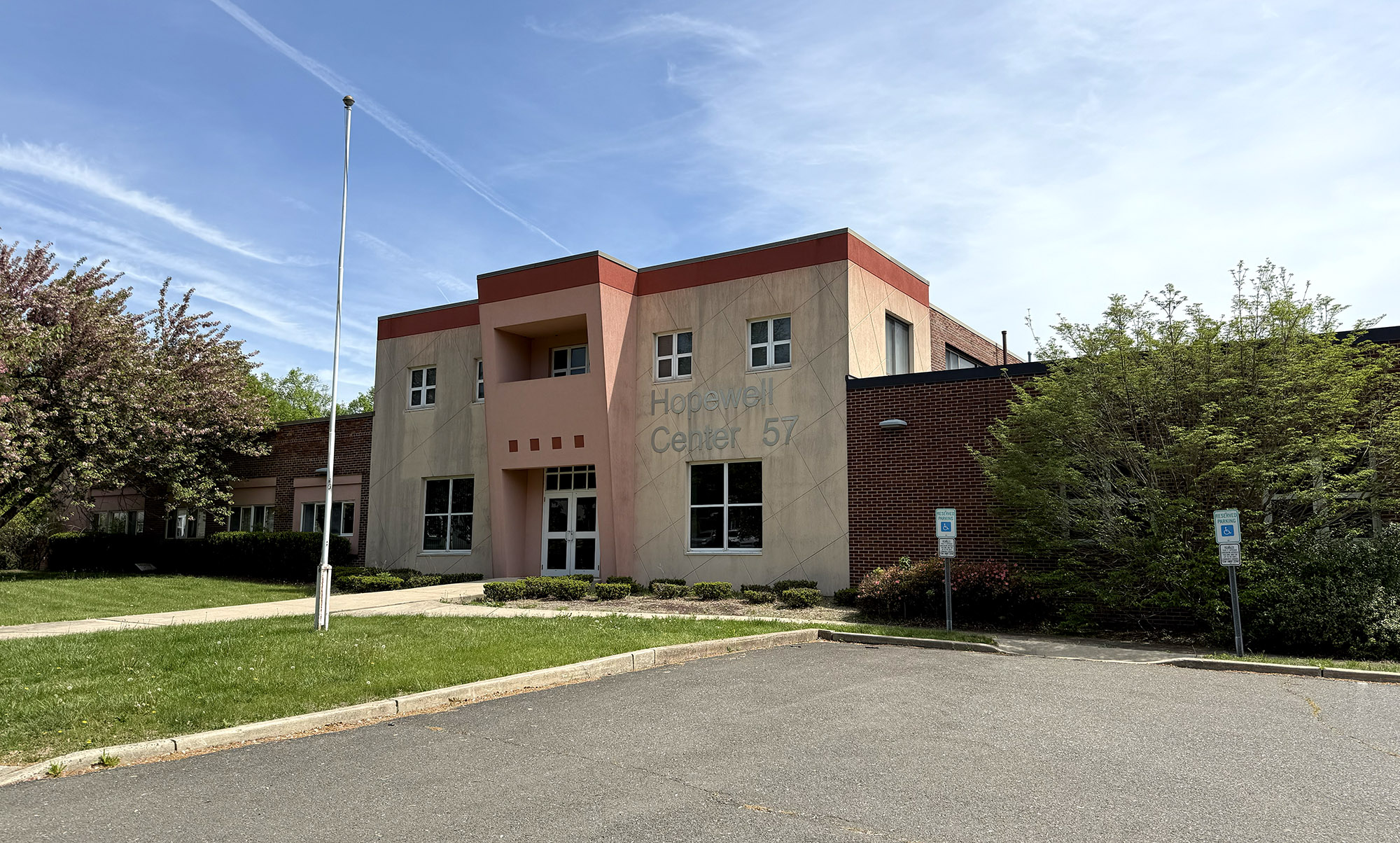
Hopewell Borough Council voted Thursday night to approve a 30-year Payment in Lieu of Taxes (PILOT) agreement for the Hopewell 57 redevelopment on Hamilton Avenue, moving forward one of the most significant redevelopment efforts the Borough has taken up in decades.
The decision advances a project that will bring 120 rental units—96 market-rate apartments and 24 affordable units—to a long-underutilized industrial property near the edge of downtown Hopewell.
Editors note: The story has been updated to reflect the correct number of total units at 120. There are 96 market rate and 24 affordable in the Hopewell 57 project.
A $44 million redevelopment needing extraordinary support
Financial advisor Bryan Morris of Phoenix Advisors walked the council through the economics of the project, explaining that Hopewell 57 carries unusually steep redevelopment costs due to environmental remediation, demolition, flood-mitigation, and structural fill.
“The total cost of the project is about $44 million,” Morris said.
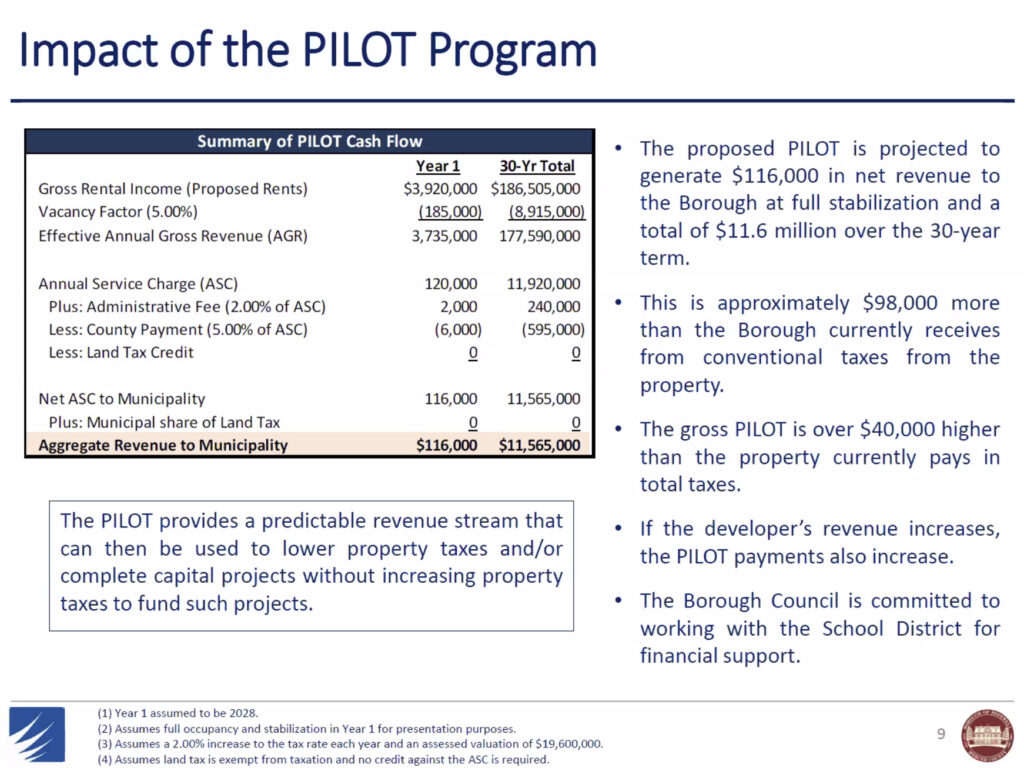
Under current taxation, the site yields about $78,000 per year. If redeveloped to the current proposal without a PILOT, taxes were estimated at roughly $770,000 per year, but Morris emphasized that number was hypothetical: the project cannot be financed or built without a PILOT given the extraordinary development costs.
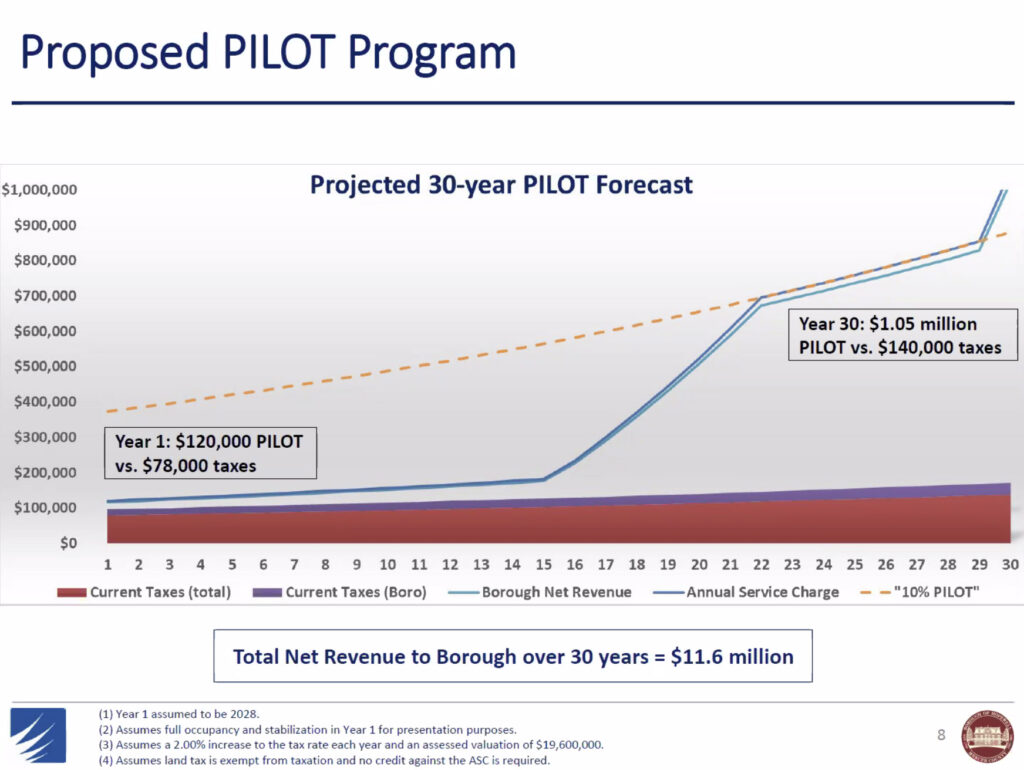
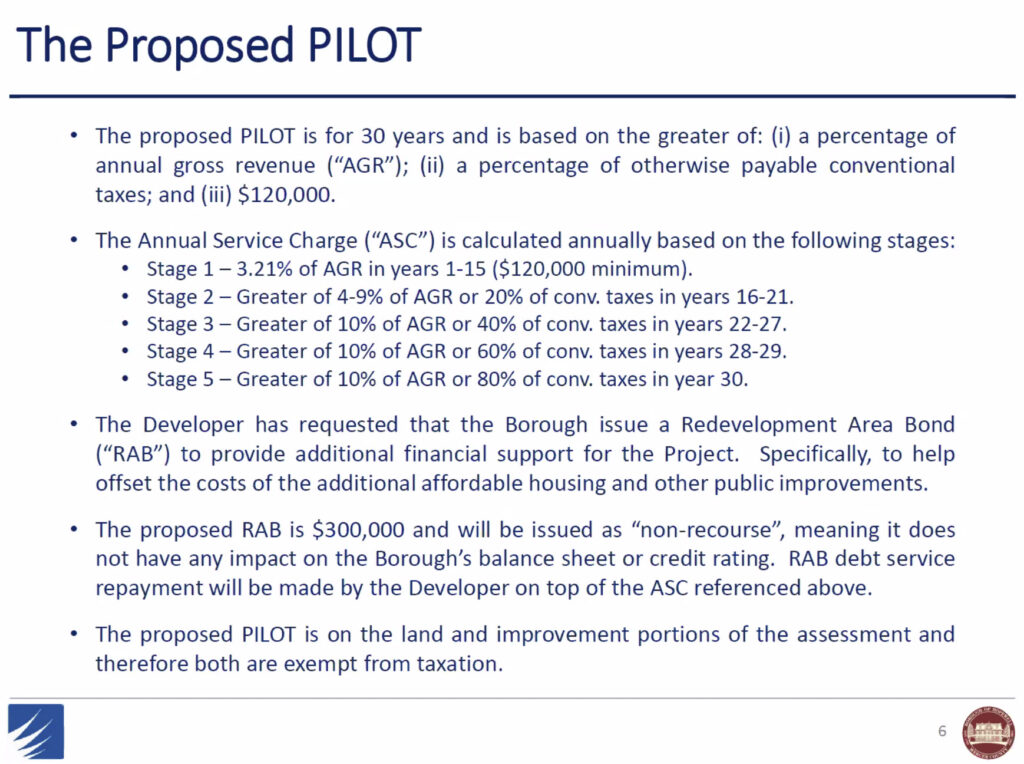
Under the approved PILOT:
- Years 1-15 payment: $120,000 minimum that is adjusted based on the annual gross revenue
- Borough share: 95% of all PILOT revenue (the other 5% goes to Mercer County)
- Total projected Borough revenue: $11.6 million over 30 years
- Year 30 payment: approximately $1.05 million, compared to about $140,000 under conventional taxes at that time
120 rental units: $2,700–$3,200 projected rents; affordable units around $1,100
The redevelopment will include 120 total apartments, with 45% one-bedroom units and 55% two-bedroom units, averaging roughly 1,100 square feet.
Market-rate rents are expected to fall between $2,700 and $3,200 per month.
Council members reacted strongly to the rental pricing.
Councilman Anthony Fuller said it was the first time he had seen the projected rents and questioned whether the regional workforce would be able to support those amounts.
Councilwoman Heidi Wilenius added:
“I was surprised at how high… I wrote it down, too. I think they’ll have no problem securing residents, might not be quite at that rent.”
The 24 affordable units required under the Borough’s redevelopment plan are expected to rent for around $1,100 per month.
School district concerns: “It kind of leaves the schools out of the official loop”
The council devoted substantial time to discussing potential impacts on the Hopewell Valley Regional School District.
Wilenius was particularly direct:
“We’re committed to working with the school district because there will be children enrolled in school. There is no official mechanism… that’s my big concern with pilot programs, is it kind of leaves the schools out of the official loop.”
“I think it would be nice for the council to formally acknowledge… that we intend to take into account the needs of the school.”
The council was reminded that the district’s levy is set independently and money would be raised through taxes that it needs to run the district.
Council members said initial conversations with the district had already begun and would continue but emphasized that Thursday’s vote addressed only the financial agreement before them and that helping the district would come in later conversations.
The Hopewell 57 development is projected to add an additional 20 students to the schools.
Context: A year of tension over PILOTs in the Hopewell Valley
The Hopewell 57 PILOT arrives after a year in which the Hopewell Valley region has been deeply engaged in PILOT-related disputes.
- Hopewell Borough and Pennington Borough had jointly challenged Hopewell Township’s PILOT agreement for the Lennar / Hopewell Parc development.
- Hopewell Borough withdrew from that lawsuit earlier this year.
- Pennington Borough continues the challenge, recently petitioning the New Jersey Supreme Court after the Appellate Division upheld the Township’s PILOT.
- The Hopewell Valley Regional School District Board of Education has repeatedly expressed concern that PILOTs modify new student enrollment and have been working with municipalities to find ways to support the district.
- Hopewell Township has committed $16.1 million dollars to help fund the addition that was approved by voters at Bear Tavern Elementary. The money will be accessible after the pending litigation with Pennington is resolved. It will be used to reduce debt service on the addition when it is available.
Against this regional backdrop—and with heightened public awareness of PILOT mechanisms—council members acknowledged that adopting a PILOT required transparency and discussion with the school district moving forward.
Public comment focused on taxes, infrastructure, and growth
Residents asked about the differences between PILOT revenue and conventional taxes, traffic impacts, stormwater management, long-term traffic impacts, and potential school enrollment.
Council and the professionals noted that infrastructure, stormwater, and site design will be addressed by the Planning Board in early 2026.
Council honors David Mackie in his final meeting

Thursday’s meeting also marked the final session for Council President David Mackie, who attended remotely due to illness. Town Crier, Stanley Saperstein, opened the meeting with a dramatic reading of a proclamation celebrating Mackie’s 26 years of public service — a tribute that blended affection, gratitude, and some humor.
The proclamation described Mackie as “wiser than the old growth of St. Michael’s Preserve” and a public servant “whose calm counsel has steadied the Borough through storms both literal and political.” It also gently teased his well-known thoroughness, noting that while his answers to complicated questions could “span the length of a feature film, they always ended with clarity, context, and the one solution no one else had thought of.”
Mackie was praised for a legacy built on “kindness, dedication, and a bedrock knowledge of the Borough’s infrastructure, thicker than the bedrock upon which Hopewell stands.”
In his remarks, Mayor Ryan Kennedy thanked Mackie for his decades of service, calling it “an honor” to work with him and praising the insight and guidance he brought to the Borough. Council members expressed similar appreciation, noting his deep institutional knowledge, mentorship, and the steady leadership he provided across nearly three decades.
Mackie, moved by the tributes, thanked residents, staff, volunteers, and his colleagues for “the joy of working with people who care deeply about Hopewell Borough.” He reflected on the privilege of public service, saying the most meaningful part of the job was “the community that shows up — not just to meetings, but for each other.”
Holiday events and other business
Council members reminded residents that the Borough’s annual tree lighting will take place on December 6, along with other community holiday activities throughout the month.
Borough Endorses Regional Watershed Protection Efforts With Montgomery
In other business, the Council approved a resolution supporting a regional approach to watershed protection and stormwater management—an initiative brought forward in partnership with The Watershed Institute and neighboring Montgomery Township.
The resolution acknowledges that water resources do not follow municipal boundaries, and that the Stony Brook–Millstone watershed faces growing pressures related to climate change, land development, and increasingly intense storms. The measure affirms Hopewell Borough’s commitment to working collaboratively with regional partners to protect stream corridors, improve water quality, and align long-term planning with science-based watershed data.
According to the resolution, both Hopewell and Montgomery share critical headwaters and interconnected drainage systems, making coordination essential for effective stormwater management. The Borough formally expressed support for Montgomery’s efforts—including applications for state and federal planning grants—and pledged to participate in joint planning and advocacy as opportunities arise. By working together municipalities will be able to save money and resources while also meeting the state requirements on stormwater management.
By adopting the measure, the Borough signals that local decisions—such as redevelopment, stormwater ordinance updates, and infrastructure investments—must be made with a clear understanding of regional hydrology and upstream/downstream impacts. Borough officials described the resolution as a step toward a more unified planning approach that will benefit both municipalities and the broader watershed community.
What’s next
With the PILOT now approved, Hopewell 57 moves to the Planning Board for formal site plan review in early 2026. That process will address architecture, traffic, stormwater, emergency access, and other technical considerations not governed by the PILOT.
Council members said dialogue with the school district and the community will continue as the project advances.