

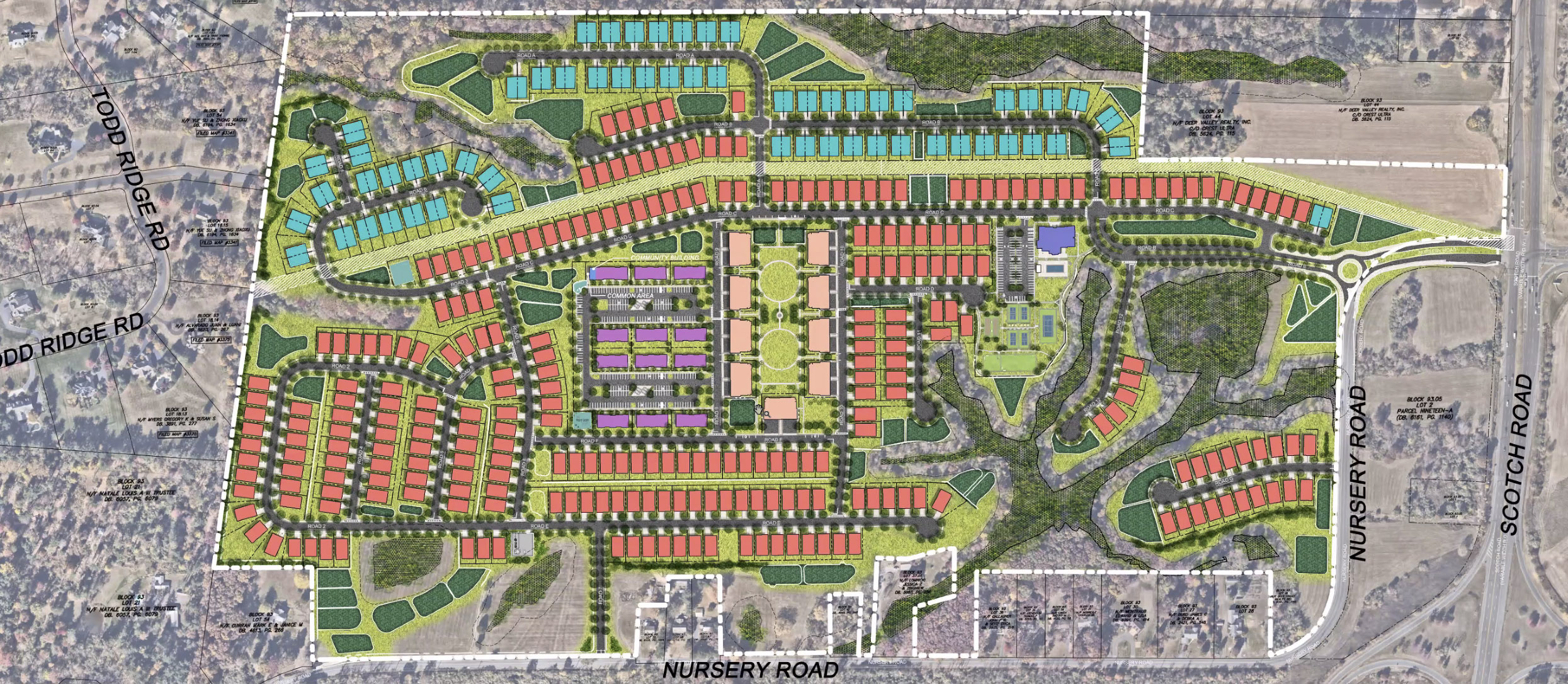
After months of listening to testimony without comment, the Hopewell Township Planning Board on Thursday, Jan. 22, began openly discussing the proposed Venue development, with board members acknowledging community concerns and raising their own questions about density, design, and long-term impacts.
“Okay, so we are going to take this now finally,” said Planning Board Chair Karen Murphy, addressing the Zoom audience after the applicant’s closing arguments. “The board, we’ve been silent for a long time and we have been listening to all the members of the public (and the applicant.) And I know it may have been frustrating for you that we aren’t responding… but we have been listening.”
Murphy added that the board’s silence should not be mistaken for disengagement.
“I think I speak for the entire board when it’s like, okay, finally we get to talk about this,” she said. “We get to discuss this.”
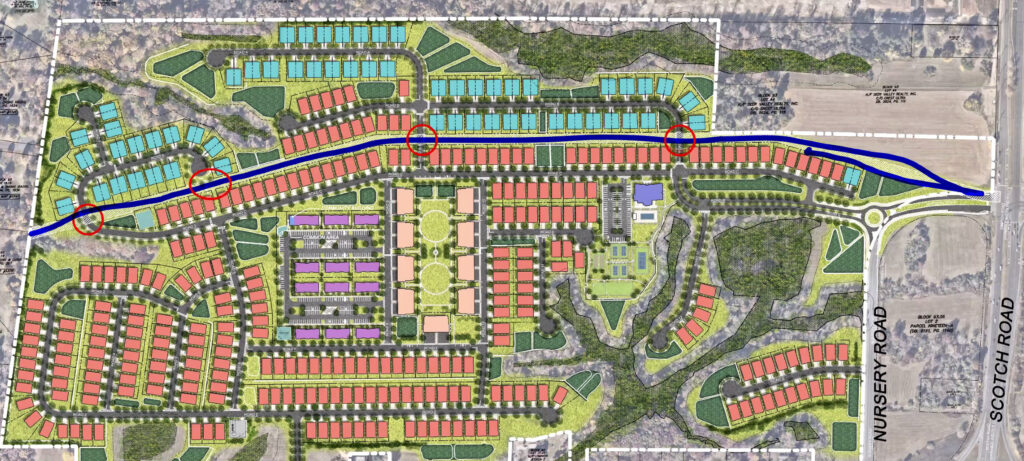
The discussion marked a shift in the long-running review of The Venue, a proposed 600-unit, age-restricted housing development planned along Nursery Road on property bisected by the Twin Oaks jet-fuel pipeline. The development includes affordable housing units and is part of Hopewell Twp.’s court mandated affordable housing obligations.
As deliberations stretched toward 10 p.m., the board agreed additional time would be needed and scheduled a special meeting for Feb. 9. A final decision remains subject to an extended statutory deadline at the end of February, with the board’s regular meeting set for Feb. 26.
Reorganization and Executive Sessions
The Jan. 22 meeting began with the Planning Board’s annual reorganization, including elections and appointments for 2026. Following those actions, the board entered executive session to discuss pending litigation before returning to the public meeting.
Later in the evening, after deliberations and scheduling decisions, the board entered executive session a second time, again citing pending litigation.
Pipeline Oversight and PHMSA Information
After returning from the first executive session, township professionals reviewed updated information related to the Twin Oaks pipeline, including recent communication involving the Pipeline and Hazardous Materials Safety Administration.
Board members were told that inspections and integrity assessments had been completed on the pipeline as part of a consent order issued to pipeline owners Sunoco and Energy Transfer, following a major jet-fuel leak across the Delaware River in Upper Makefield, Pa. Earlier this year, thousands of gallons of jet fuel leaked into groundwater in Bucks County after a decades-old clamp, known as a Type A sleeve, failed. Much of that fuel has not been recovered and continues to migrate through groundwater toward the Delaware River.
As part of the federal response, PHMSA required the identification and evaluation of Type A sleeves along the entire Twin Oaks pipeline, which runs more than 100 miles from outside Philadelphia to Newark. Township officials said PHMSA confirmed that no Type A sleeves were found within Hopewell Township and that inspections did not identify signs of leakage in the township.
The Twin Oaks pipeline is approximately 70 years old, and much of the line remains original. A segment beneath the Delaware River between Bucks County and Hopewell Township was replaced several years ago after erosion exposed the pipeline near Jacobs Creek.
MercerMe independently contacted PHMSA and received the same information presented to the board, confirming that no current integrity concerns have been identified within Hopewell Township.
Throughout the discussion, board members emphasized that pipeline safety and integrity are regulated at the federal level. The Planning Board’s authority, they said, is limited to land-use decisions and the enforceable conditions it may impose as part of site-plan approval.
Density Concerns Introduced
Planning Board member Vanessa Sandom was the first to raise concerns about density, noting that the project had evolved significantly since it was initially presented.
“I want to talk about the density of this project because I think it’s something that has evolved over time,” Sandom said. “And I don’t think what we’re looking at now is what many of us initially understood when this application first came before us.”
Sandom pointed specifically to the affordable housing component.
“When you look at the senior affordable housing component in particular, we’re talking about three-story buildings, and that changes the scale and the feel of this development quite a bit from what was originally discussed,” she said.
She said environmental constraints played a key role in how the project ultimately took shape.
“As the application progressed and more information came in about the wetlands, the buildable area became more constrained,” Sandom said. “And what that has effectively done is push more units into a smaller footprint.”
“So what we’re left with now is a project that feels significantly more dense than what many of us first envisioned,” she added.
Design Impacts and Site Layout
Chair Karen Murphy echoed those concerns, focusing on how density affected site design.
“What surprised me most about the density is what I would call the cliff, the retaining walls on that back southwest corner,” Murphy said. “That really has me a little concerned that there’s only ten feet out your back door and then you’re falling over a ten, fifteen-foot retaining wall.”
Murphy said the design impacts were directly tied to the number of units being accommodated on the site.
“That is a design impact that happened because of the density that we’re talking about in here and trying to cram all the houses onto this property,” she said.
Environmental and Long-Term Impacts
Vice Chair Rex Parker said he shared Sandom’s concerns and framed the discussion in terms of long-term planning.
“I really do share Ms. Sandom’s voiced concern about the high density of this project,” Parker said. “I think it’s just way too dense.”
Parker said he was particularly concerned about the loss of contiguous forested areas and the absence of meaningful environmental buffers.
“We’re not doing enough to preserve some of the land for an environmental buffer, a habitat buffer,” he said. “I would greatly prefer to see more of the contiguous forest land in the far northwest corner be preserved.”
He urged fellow board members to consider the township’s future.
“Think about the future of this township,” Parker said. “It’s not just right now — it’s what are we going to look like in fifty years with the erosion of the habitat we have and the loss of the wildlife.”
Parker said those concerns would affect his vote.
“I am not prepared to vote yes on this application unless I see some way of improving some of the environmental quality,” he said.
Additional Board Perspectives
Planning Board member Andrew Swords said he agreed with the concerns raised by Sandom and Parker and was also concerned about the traffic and designated turn lanes.
“I agree with Ms. Sandom and Mr. Parker about the level of density,” Swords said. “It’s quite dramatic, and I am concerned that we are, as Mr. Parker said, being sort of swept along here.”
Resident Attorney Addresses Board
During the hearing, Eric Goldberg, an attorney representing four local residents, addressed the board and urged caution, questioning whether the existing record was sufficient to support approval without further review.
Goldberg focused on whether conditions could adequately address safety and construction concerns near the pipeline.
Applicant Closing Arguments
Applicant attorney Jason Tuvel delivered closing arguments on behalf of the development team, responding to concerns raised during public testimony and board discussion.
Tuvel emphasized that the project complies with zoning adopted by the township and argued that outstanding issues should be addressed through conditions of approval rather than denial.
Next Steps and Conditions Review
As deliberations continued, Murphy emphasized that the board had not yet begun a detailed review of proposed approval conditions.
“We haven’t even started going through the itemized list of conditions,” she said. “We can come back to our next meeting with a redraft and go through line item by line item.”
The board scheduled a special meeting for Feb. 9 to continue deliberations. A final decision is expected by the end of February, with the board’s regular meeting scheduled for Feb. 26.
The meeting concluded with the board entering executive session for a second time to discuss pending litigation.