

Correction and Update 9/17/25. The story below has been updated removing a portion of Mark Peters’ quote regarding communication with Hopewell Township. Hopewell Township reached out to the school district on Sept. 10 to begin discussions on how the $16.1 million in PILOT monies can be given to the district. Peters’ acknowledged his statement was inaccurate regarding communication from Township attorneys.
The Hopewell Valley Regional School District Board of Education met Monday, Sept. 15, after beginning the evening with a tour of the high school. The building, much of it upgraded in the 2016 referendum, remains in solid condition overall, but its aging HVAC systems and roof sections show why infrastructure repairs are again part of the district’s plans for November’s referendum.
Walking the Halls of Central High
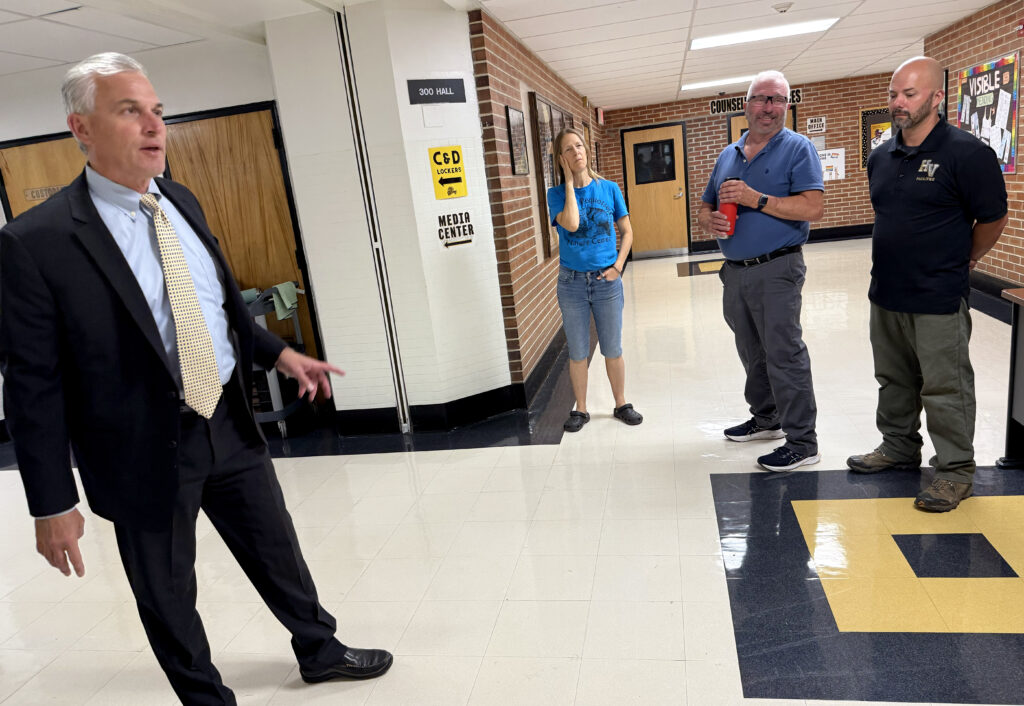
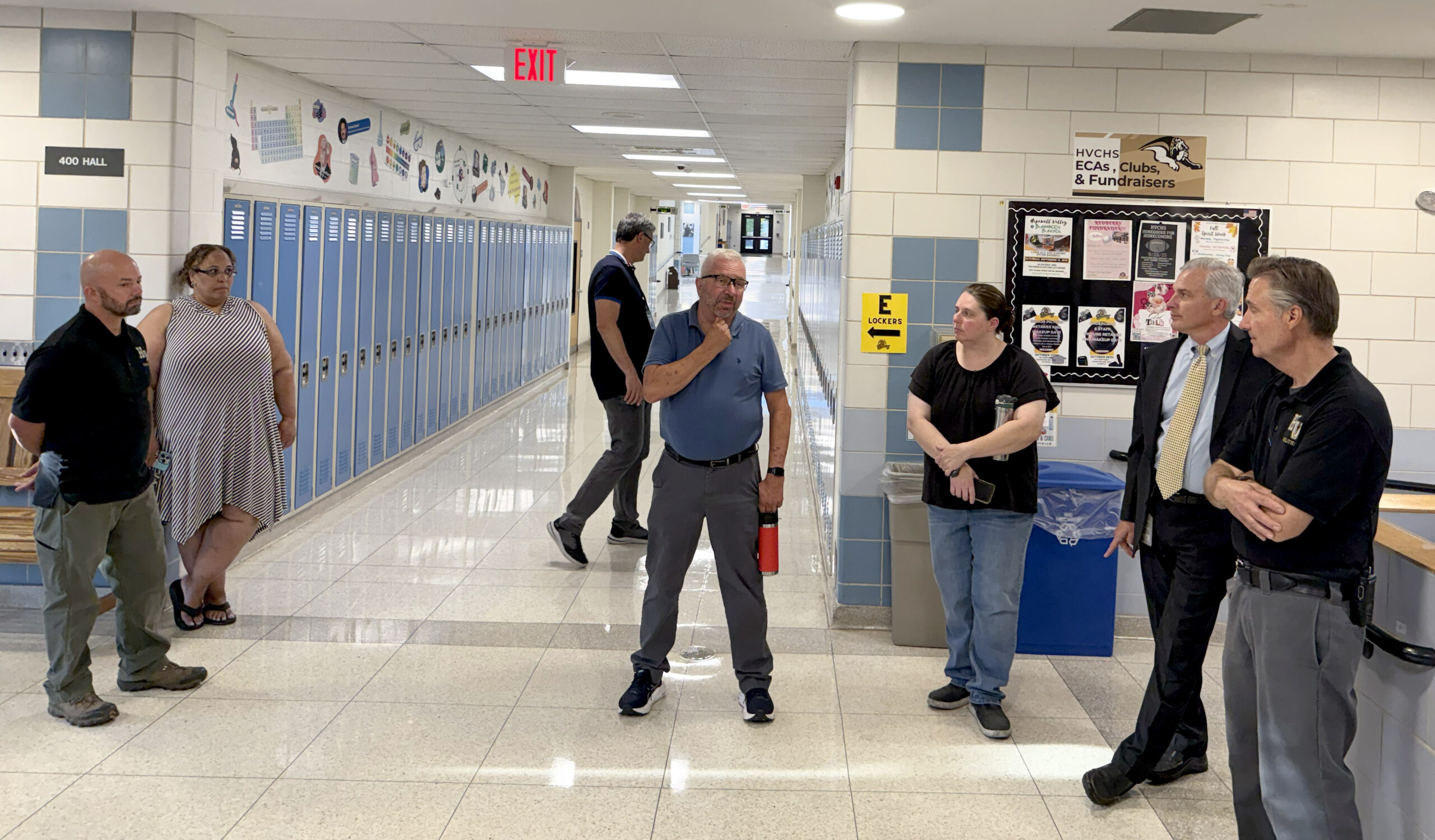
At 5:30 p.m., administrators led the board and community members through the high school’s 400 wing, a stretch of classrooms that looks polished thanks to past renovations but hides critical infrastructure flaws. The HVAC system, original to the late-1990s construction, breaks down regularly. “We’ve had very, very cold rooms or very, very warm rooms,” Director of Facilities Thomas Quinn explained, noting that relocating classes isn’t an option for science labs that require specialized space.
Roofing also remains a concern. With the high school spanning more than 260,000 square feet, officials explained that roofing projects are tackled in sections and not redone all at once. Warranties on the roof have expired or will expire soon, and Quinn explained that even when a roof does have a warranty it only covers manufacturers or installation defects, not wear and tear. “It’s kind of like a tire warranty,” Quinn said. “At 75,000 miles, they’re not going to give you a brand-new tire.”
The Referendum: Two Questions, One Choice
Those needs set the stage for the November 4 referendum. Superintendent Dr. Rosetta Treece laid out the plan in her report: two ballot questions, the first for essential building repairs across all the schools, and the second for classroom expansions at Bear Tavern and Toll Gate elementary schools.
Question 1 covers things like HVAC, roofs, doors, and wells. Most of these projects would be eligible for up to 40 percent reimbursement from the state, an estimated $20 million in taxpayer savings. “The only way you can access the state funding is by going to referendum,” Treece reminded the public.
Question 2 focuses on growth. Trailers used as classrooms for decades would be replaced with permanent space. Eight to ten new classrooms would be added to Bear Tavern and six new classrooms at Toll Gate and could be used for any from kindergarten to fifth, with bathrooms required for the youngest learners. “It’s time for our students to get in the building,” Treece said, recalling that some teachers have been teaching in trailers since their own childhoods.
Treece emphasized that the two questions are linked: the additions cannot proceed without the core infrastructure work. “It would be like adding an addition on your house and you don’t have a water heater, air conditioner, or heat,” she said.
PILOT Funding Dispute Frustrates Board
The referendum discussion often intersects with the issue of municipal PILOT agreements. Finance and Facilities Chair Mark Peters delivered a candid update on negotiations with Hopewell Township over its public pledge of $16.1 million in PILOT funds to support the Bear Tavern expansion.
Editor’s Note: A portion of Mark Peters’ quote has been shown to be inaccurate. The top of the story includes an update.
“As of today, we have not heard from their attorneys despite what may have been heard in the community,” Peters said. Peters described the lack of progress as “disappointing, discouraging,” adding, “It was my hope…that as we move to referendum that we could have done so with this behind us but unfortunately we’re not there.”
Peters called on all municipal leaders to include the district earlier in PILOT discussions, saying the current crisis stems from being left out. “The reason we are dealing with this right now is because the township didn’t get us involved early, plain and simple,” he said.
Health Care Costs Add to Budget Strain
Even if the referendum passes, financial pressures loom. Assistant Superintendent for Business Robert Colavita reported that the district’s health care costs, budgeted at more than $20 million annually, are consuming about $2 million per month. While HVRSD benefits from being self-insured—avoiding a projected 38% increase hitting districts in the state health plan—costs continue to climb.
“We no longer can negotiate benefit rates as we had in the past,” Colavita explained. “The government took that away.” He warned that health care inflation, combined with New Jersey’s 2% cap on school budgets, leaves little flexibility without cuts.
Treece agreed, saying that without relief, larger class sizes and reduced programming are inevitable. “We are literally running out of space in the building. We are running out of budget,” she said. “If we’re going to release this pressure valve, we need this (the referendum) to pass.”
Other Business
The board approved the first reading of a refinancing ordinance for 2016 bonds, expected to save the district money over the next decade. Retirements were announced for occupational therapist Kim Black and longtime facilities director Thomas Quinn, who is credited with keeping the district on track with all of the facilities since 2015.
The board also reviewed a research proposal from ETS to study AI tools in eighth grade math classrooms. Members raised concerns about time commitments, privacy, and the need to guarantee that results are shared with the district. Treece noted that AI is already embedded in many education platforms and that the district is updating its acceptable use policies accordingly.
Bear Tavern Playground Funding Secured
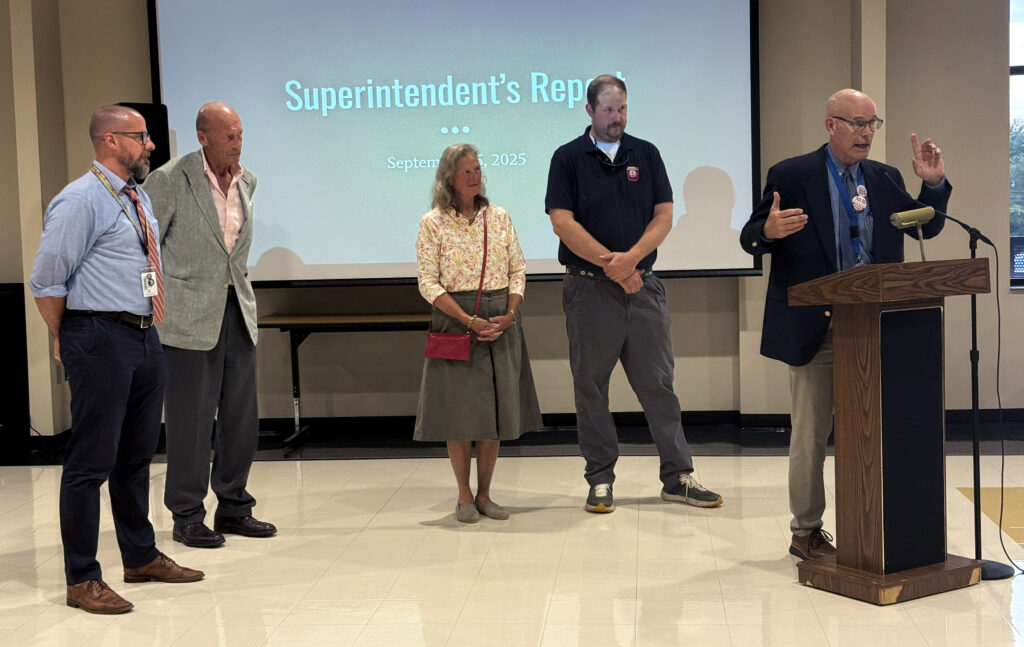
The meeting also included a celebration of new funding for an accessible playground at Bear Tavern Elementary School. Superintendent Dr. Rosetta Treece introduced the announcement, noting that board member Dhruv Kapadia worked with Senator Shirley Turner and the rest of the state legislature to secure a $125,000 state appropriation for the project.
Community generosity will cover the rest of the cost of the playground. The George and Elizabeth D. Smith Foundation pledged $30,000, while the Morehouse family contributed $45,000. Additional support came from the Waller family through the First Day of School Foundation.
“This community is so amazing,” Treece said, adding that Bear Tavern parents and donors will be directly involved in designing the playground to ensure it meets the needs of children with disabilities. The project is expected to move forward this school year, with hopes of a ribbon-cutting in the spring.
High School Graduation Policy Update
The board held a second reading of a revised Policy 5460: High School Graduation. The updated policy aligns with state requirements under N.J.A.C. 6A:8-5.1 and maintains the 120-credit minimum, with specific course requirements in English, math, science, social studies, and world languages.
A notable addition for the class of 2030 and beyond is a 2.5-credit requirement in a course promoting intercultural sensitivity and competence or service learning, reflecting the district’s commitment to preparing students for civic responsibility and global engagement. The policy was passed and adopted.
Curriculum and Instruction Budget Presentation
Assistant Superintendent of Curriculum and Instruction Dr. Vicky Pilitsis presented an overview of her office’s responsibilities and budget priorities. She highlighted goals for 2025–26 that include:
- Responsive practices through social-emotional learning and professional development, including the Character Strong program.
- Data-driven instruction, with initiatives like LinkIt data warehousing at the elementary level and structured data chats to identify trends.
- Strengthening Tier 1 instruction and Multi-Tiered Systems of Support (MTSS) through coaching, consultants, and expanded training.
Pilitsis also flagged potential upcoming costs tied to a new K–5 English Language Arts program, expected to roll out over three years with annual implementation costs of $100,000–$200,000.
These presentations and discussion marked the beginning of the budget discussions for the 2026-27 year.
Climate Action Committee Report
The board also heard an update from the district’s Climate Action Committee, co-chaired by Dr. Scott Brettell and high school teacher Carolyn McGrath. The committee outlined progress across its five working groups: Education, Transportation, Food & Waste, Resilience, and Facilities.
Highlights included:
- Curriculum integration: Teachers have embedded climate change education into elementary through high school science classes, with new ecology electives at the high school and expanded Green Week programming across all schools.
- Professional development: Teachers participated in training led by NJDEP curriculum specialists, and a Climate Change Education Cohort developed interdisciplinary activities.
- Student leadership: High school YES Club students launched the Climate Corps website to connect peers with green volunteering opportunities.
- Transportation: The district was awarded participation in the federal Clean School Bus Planning program, laying groundwork for future zero-emission buses. Walk/Bike/Roll days continue at several schools, with plans to expand initiatives and enforce anti-idling rules.
- Food and waste: The committee presented options for on-site composting, discussed reducing cafeteria waste stream contamination, and is planning a student food survey to expand plant-based meal options.
Looking Ahead
Treece said the district will continue its referendum outreach through community events in and out of school, and a virtual town hall on Oct. 9 at 6 p.m. She urged residents to get the facts from district sources, not social media. You can learn more and register for the town hall on the district’s website hvrsd.org/vote.
“We try to put it in lay terms so that you can understand the very complicated way that we have to operate, purchase, and plan for things in school districts,” she said.