
New Jersey lawmakers are touting $6.8 million in new state funding to keep food flowing from local farms to schools and pantries after federal cuts gutted two key programs. But farmers and food security advocates warn the state’s stopgap falls far short of the more than $26 million pulled by the U.S. Department of Agriculture earlier this year — and questions remain about how and when the replacement money will reach the ground.
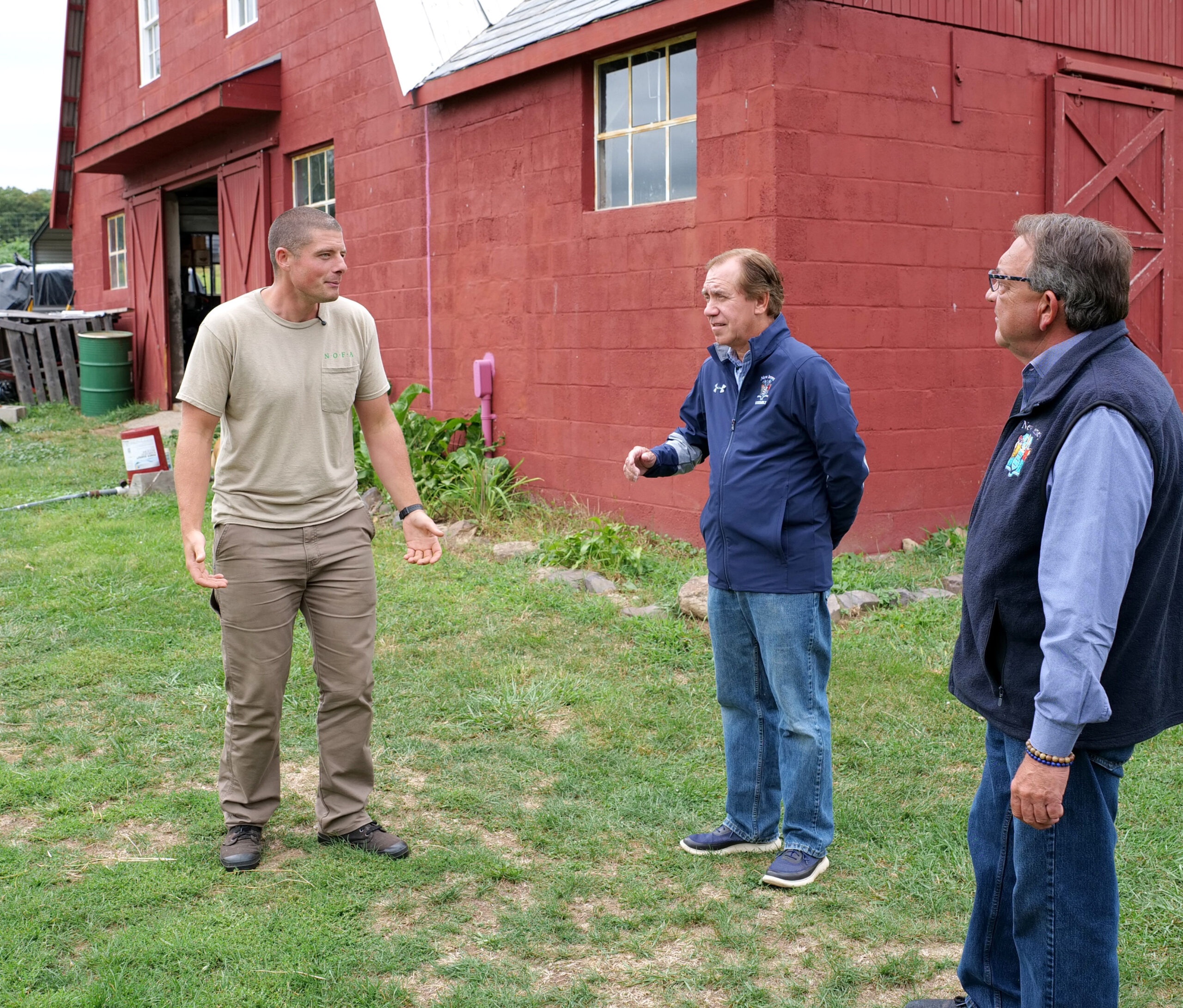
Assembly Speaker Craig Coughlin (D-Middlesex) and Assemblyman Anthony Verrelli (D-Mercer, Hunterdon) announced the funding last week during a tour of Hungry Work Organic Farm in Stockton, calling it a critical investment in both farmers and food-insecure families.

“Food security is one of the greatest challenges we face, and our visit underscores why New Jersey’s investment in local agriculture is critical in this fight,” Coughlin said in a statement. “When the federal government cut funding for programs that connect farms to schools and food banks, it left both farmers and families in a difficult position. In New Jersey, we recognized the impact and made sure those programs have the resources to continue strong for years to come.”
The $6.8 million, tucked into the budget for the New Jersey Department of Agriculture in the FY26 state budget, is designed to keep alive initiatives modeled on the federal Local Food Purchase Assistance Program (LFPA) and the Local Food for Schools (LFS) program. Both had been launched with pandemic recovery dollars to give farmers stable local markets for their crops while supplying fresh, local produce to schools, food banks and pantries.
Federal cuts hit hard
In March, USDA abruptly canceled New Jersey’s share of LFPA and LFS, a combined $26 million commitment. The programs are set to expire at the end of October.
The loss was especially significant in a state where farming is expensive and land costs are high. By providing targeted funds for food banks and schools to purchase from New Jersey farmers, LFPA and LFS helped ensure that local produce reached families in need. Without those subsidies, pantries often have little choice but to buy cheaper food shipped from elsewhere in the country or even overseas — leaving local farms to search for buyers for their goods from CSAs, markets and other outlets.
A smaller state stopgap
The $6.8 million announced last week restores only a fraction of the lost federal dollars. Advocates welcomed the intervention but stressed the math doesn’t add up.
“This isn’t a one-to-one replacement,” said Devin Cornia, executive director of the Northeast Organic Farming Association of New Jersey and owner of Hungry Work Organic Farm. “LFPA created opportunities for smaller farms to connect with local pantries and schools in a way that really worked. We’re grateful the state stepped in, but the details matter. We don’t yet know if this money will truly reach smaller operations or just funnel to a handful of big players.”
Cornia said he hopes the Department of Agriculture will create an open, competitive grant process that lets farms and community nonprofits apply directly for support. “In a perfect world, I’d like to see a request for proposals based on need, impact, and proven partnerships,” he said.
At Fairgrown Farm in Hopewell, James Klett said the announcement provides optimism but not certainty.
“It means that there’s hope that we could reinstate some of our programs, but it’s not going to be a one-to-one replacement,” Klett said. “The LFPA infrastructure mostly been dissolved already, so the new funding will require building new frameworks from scratch under whatever parameters the state creates.”
Klett emphasized that public dollars remain essential to sustain farm-to-food pipelines. “Relationships between New Jersey farms and food security organizations require some form of outside subsidy to make it work,” he said. “Without that, pantries will buy food wherever it’s cheapest, and that often means importing produce from outside New Jersey.”
Farmers brace for a gap
LFPA contracts officially expire Oct. 31, creating what farmers expect will be a funding gap. Even with money appropriated in the budget, the Department of Agriculture still must design the program, draft contracts or grant rules, and issue awards — a process that could take months.
That means some farm-to-food bank partnerships may grind to a halt this winter before restarting under a new framework. “We’ve been donating and delivering food for years, and LFPA just formalized that relationship,” Cornia said. “If the new process gets bogged down, we’ll have to pivot. That might mean private fundraising or community sponsorships to keep product flowing.”
Cornia and other small farmers have already tested creative models: asking businesses or event-goers to “sponsor” produce donations, tying suggested donations at NOFA events directly to local food purchases, and exploring partnerships with local breweries or restaurants. “Food security and local procurement can be baked into everyday community life,” he said.
Klett noted another line in the state budget could also bolster local markets: $85 million allocated for emergency food assistance, with a requirement that 10 percent be spent on New Jersey-grown produce. “That $8.5 million could actually end up being bigger than LFPA in terms of impact for local farms,” he said.
A broader food security push

The funding announcement came days before the 2nd Annual Garden State Conference on Food Security, hosted by the New Jersey Office of the Food Security Advocate (OFSA). The daylong gathering brought together more than 150 advocates, farmers, nonprofits and lawmakers to chart next steps in addressing hunger.
Gov. Phil Murphy, in a video address, hailed New Jersey as the only state with a dedicated food security office and urged participants to keep pushing. “Making sure every member of our nine-and-a-half-million-strong New Jersey family has enough to eat is one of the most urgent and unifying challenges we face,” Murphy said.
OFSA Director Mark Dinglasen closed the summit with what he called three tenets for the work ahead: “dream ferociously, love gratefully, give unceasingly.” Earlier sessions examined New Jersey’s emerging strategic plan, county-level food security offices, and partnerships that keep “Jersey-grown food in Jersey.”
Lawmakers highlighted other major FY26 budget allocations, including:
- $85 million for emergency food assistance;
- $20 million for the Working Class Families School Meals Program;
- $7.95 million for community-based food security projects;
- $1.2 million for the Hunger-Free Campus program.
Coughlin said those numbers prove New Jersey has made food security a top priority: “Don’t tell me about your priorities, show me your budget,” he said at the conference.
Unanswered questions
Still, advocates and farmers have questions about the transition. LFPA built infrastructure — staff, systems, distribution networks — that disappears when the federal program ends. Rebuilding under a new state program may take time.
For now, the state’s $6.8 million commitment signals a political will to preserve farm-to-food pipelines. Whether that money arrives quickly enough, and reaches broadly enough, will determine if families and farmers feel the benefit.