

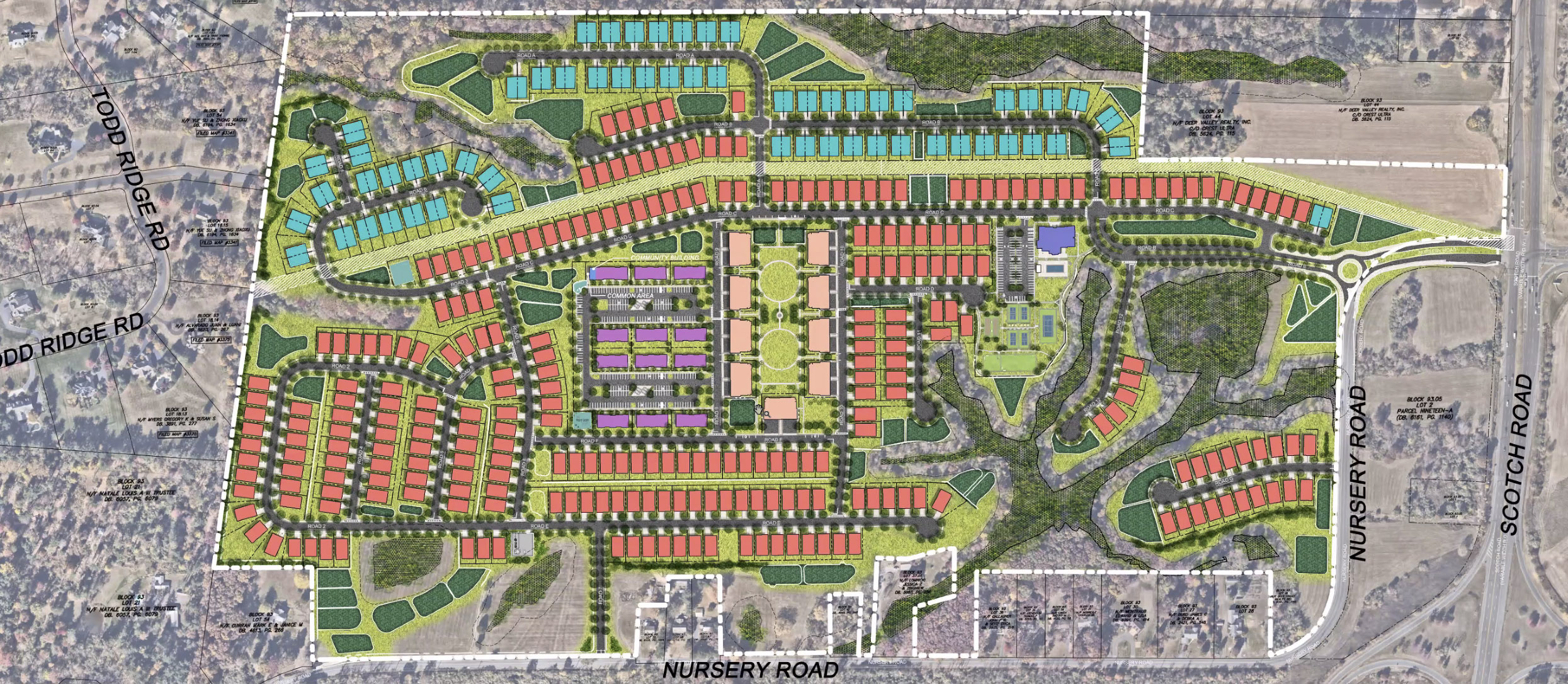
Residents from Hopewell Township and Ewing Township delivered more than two hours of intense, wide-ranging testimony at the Nov. 20 Hopewell Township Planning Board meeting, pressing officials to consider the interconnected safety, environmental, traffic, and equity issues tied to the proposed 600-unit “The Venue” senior housing development.
The applicant, Lennar/US Home, had rested its case earlier in the evening, giving residents their first opportunity to speak. With more people still waiting to testify, the board paused the public hearing at 10 p.m. and will continue taking comments at a Dec. 11 special meeting.
Pipeline Safety Dominates a Region Already on Alert
Pipeline safety emerged as one of the most urgent concerns of the night. The Venue is slated to be built on either side of the Twin Oaks pipeline, a mixed use petroleum pipeline that leaked thousands of gallons of jet fuel in Upper Makefield Twp., Pennsylvania earlier this year, triggering a federal investigation by the Pipeline and Hazardous Materials Safety Administration (PHMSA) and creating years of clean-up that has ruined private wells and degraded property values in the town. The pipeline runs over 100 miles from Philadelphia to Newark, NJ passing through Hopewell Twp. and the site of The Venue.
Several speakers described the pipeline as the single greatest risk associated with the project. Former mayor and planning board member, Jim Burd of 115 Nursery Road, recalled the installation of the line during his childhood on Scotch Road in the 1950s and said it was never intended for long-term operation at today’s pressures.
“Life expectancy of the pipeline is approximately 50 years,” Burd said, warning that the line running under the Venue site is roughly 68 years old. He noted that in Upper Makefield, residents had been noticing issues in their community for years before it was finally noticed. “And lo and behold, it was a leak, and a major problem.”
“It just amazes me that the board is considering having The Venue built over the same fragile pipeline,” said Raphael Matarese a Nursey Rd resident in Ewing. “How can the board even consider this project without any further investigation? We need to look at the integrity of the pipe, the integrity of the sleeves, the integrity of the joints — how decayed they are, the state that they’re in right now — before they even put a shovel in the ground.”
“This failed in other communities,” Matarese added. “Communities that didn’t have the ground being disturbed, that didn’t have trucks running over the land weighing 50 or 60 tons.”
“I understand the board may have legal protection in approving this project, but legal protection or immunity is not the same as immunity from consequences,” said Geetanjali Belum a Todd Ridge Rd. resident in Hopewell. “When a development proceeds over known environmental risks like a leaky fuel pipeline, the responsibility shifts from legal to moral, practical and reputational. I’d urge the board to consider what happens if there’s an incident years from now.”
Others underscored that pipeline risk does not end at Township boundaries. Both Hopewell and Ewing residents live along the easement, and many expressed frustration that those outside Hopewell Township’s jurisdiction will nevertheless bear the consequences if something goes wrong.
John Nicolai of 49 Nursery Road urged Lennar to fund routine water testing for nearby homes, telling the board, “We’re the canary in the coal mine.” He said well users are the first to notice subtle changes in taste or odor and warned that early signs of contamination often go overlooked until the damage is extensive.
Other residents said the cost of regular well testing — and the uncertainty involved — places a disproportionate burden on private homeowners. Some noted that Ewing Creek and Jacobs Creek flow across municipal lines, meaning any changes to soil hydrology or runoff could affect downstream users in multiple communities.
Traffic Headaches at Nursery and Scotch
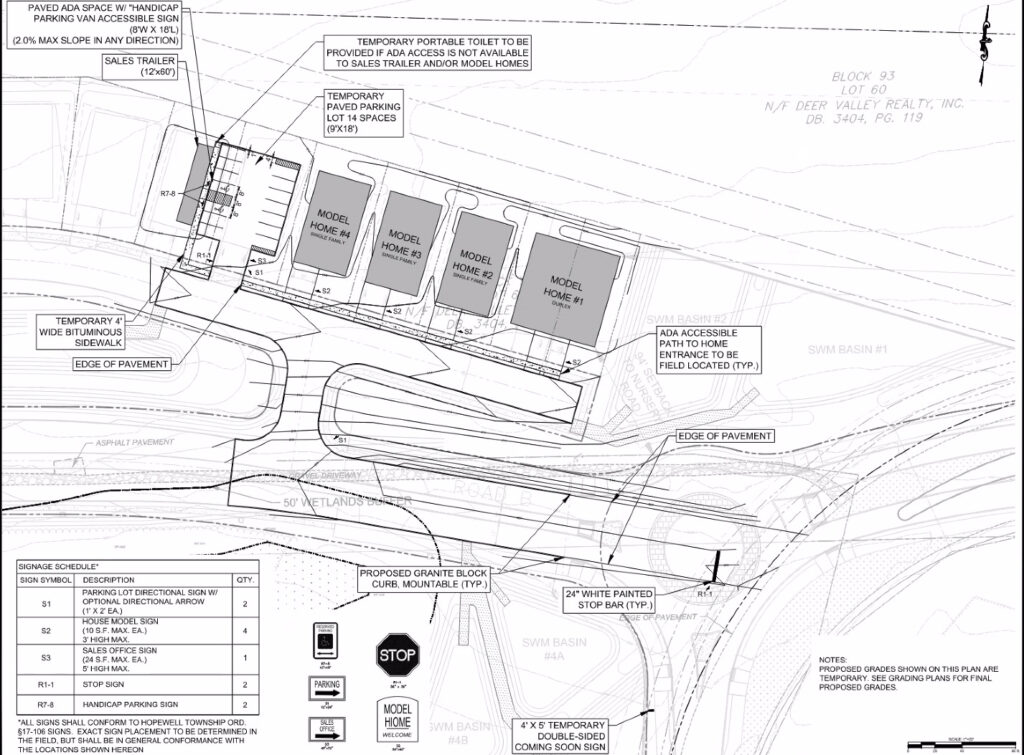
Traffic concerns were raised repeatedly by residents who described the Nursery Road–Scotch Road intersection as already overwhelmed.
Lauren Angeles of 109 Nursery Road said the applicant’s traffic testimony failed to reassure her. “The traffic lights at Nursery and Scotch is already a bottleneck… I really did not find the traffic experts to be very impressive… nor do I find it to be very reassuring it’s going to be okay,” she said.
“The residents of the new community are going to have to go down a two-lane road, and then they’re going to have to navigate through a one-lane roundabout at the end of that,” said Ewing resident Tom Wilkinson. “And after they navigate through the roundabout, they go out onto a two-lane road. Instead of accessing Scotch Road directly, 600 homes and something like 900 cars a day will have to work their way through that bottleneck.”
Others warned that without a right-turn lane on Nursery Rd. turning onto Scotch Rd., drivers will increasingly cut through Nursery Road to bypass congestion. Several residents emphasized that Scotch Road serves as a regional connector, moving traffic from multiple municipalities to I-295. One neighbor said bluntly that the road system in this area “was not built for 600 units worth of vehicles.”
Lighting, Glare, and a Changing Night Sky
The potential for extensive nighttime lighting across the Venue site — including streetlights, porch fixtures, security lights, and internal circulation lighting — prompted concerns about the loss of dark skies.
Angeles, who lives directly downhill from the site, noted that even existing recreational lighting has changed nighttime conditions. “You can see that even at Hopewell Parc… the amount of lights… affects your view of the night sky,” she said.
Other residents said the cumulative glow of hundreds of units could permanently alter the rural character of the area, especially in winter when trees lose their leaves. Some described the project as a catalyst for township-wide light pollution unless stronger lighting restrictions are imposed.
Forest Loss, Habitat Disruption, and Environmental Change
For many residents, the Venue represents not just a development project but a profound shift in the ecological identity of eastern Hopewell Township.
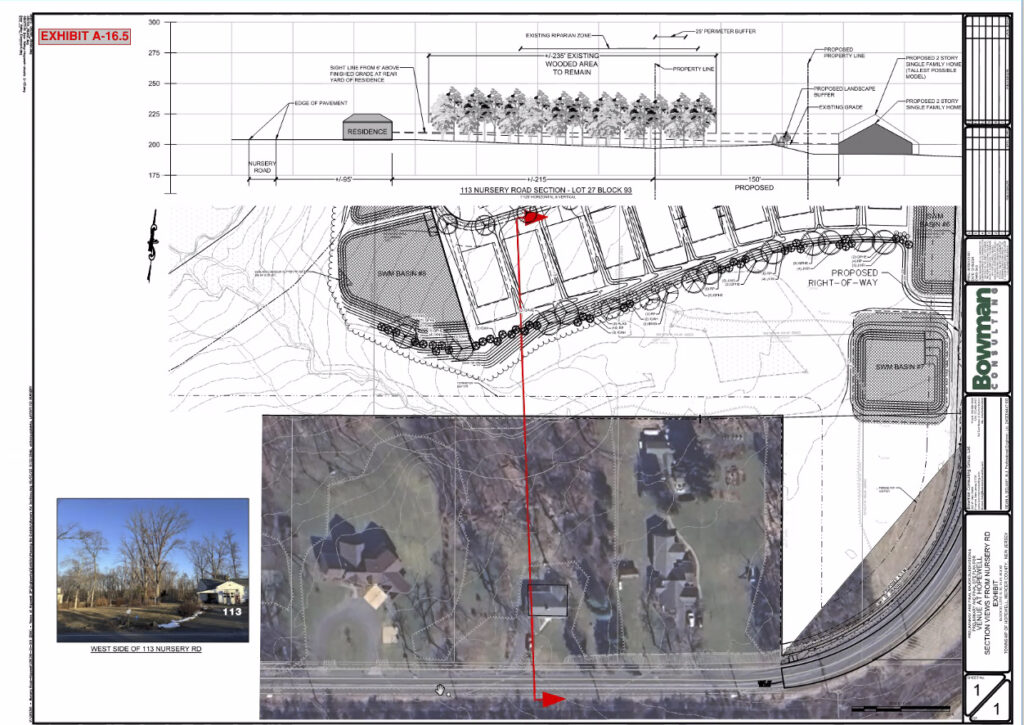
Gayle Kidman of 57 Nursery Road testified that the woods behind her home serve as habitat for deer, foxes, and other wildlife. She said the Venue would “get rid of all of their habitats,” expressing frustration that the impacts on wildlife corridors were not more fully addressed.
Several residents described the woods as an important buffer against storms, noise, and erosion. Brian Millen, another Nursery Road resident, said removing a “two-and-a-half-acre old growth forest” behind his home would cause immediate harm to the wildlife and the environment.
“When you take down this forest, it’s going to create a wind shear that’s going to impact my forest and create havoc on my land,” Nicolai said.
Speakers also raised concerns about downstream erosion along the Ewing Creek/Jacobs Creek corridor, suggesting that the Venue’s impervious surface area could intensify already severe stormwater impacts.
Affordable Housing, Integration, and Fears of “Othering”
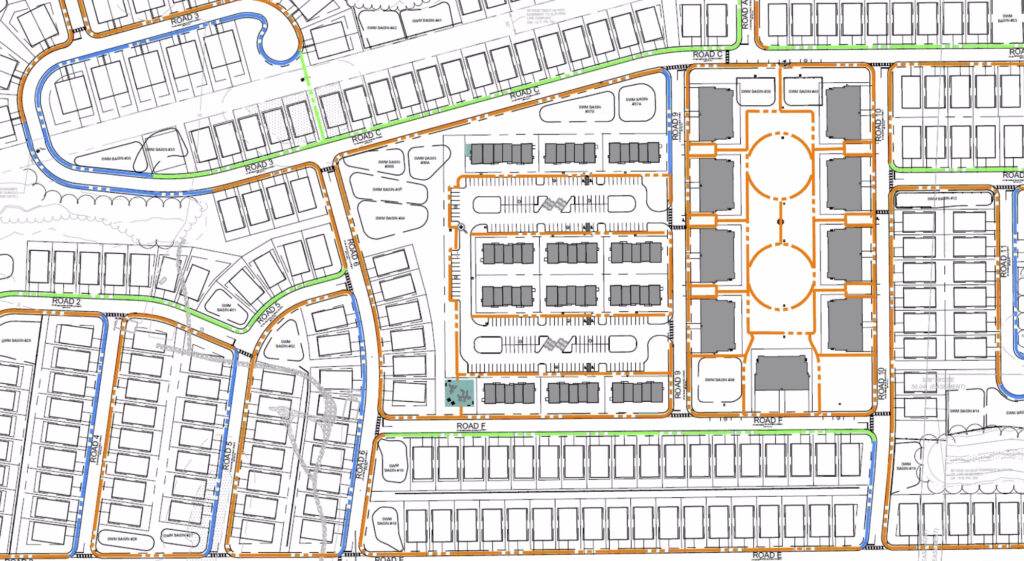
A number of residents questioned the Venue’s affordable housing design, particularly the physical separation of the 120 affordable units from the market-rate rentals.
Kyla Donnelly of Nursery Road joined several speakers in arguing that Hopewell has historically supported integratedaffordable housing, where lower-income residents live among and alongside market-rate residents. She said the Venue’s layout which puts the affordable housing separate from other housing risks reinforcing social and physical divides.
Donnelly said the project’s configuration sends a message that affordable senior renters “belong over there,” rather than as full participants in the community. She warned that clustering units limits social integration, walkability, and access to amenities, and that the design feels like a departure from the values Hopewell residents typically expect in new development.
Others agreed, calling the separation a missed opportunity to create an equitable, inclusive senior community where all residents enjoy similar access to shared spaces.
Regional Impacts and Border-Community Concerns
Many speakers pointed out that the Venue sits near the border of Ewing Township and close to neighborhoods in a different municipality. Residents stressed that the consequences of the development — traffic, stormwater, pipeline safety, and emergency response — will be felt in all of these communities.
Matarese noted that many of the homes most affected by the pipeline and construction activity are “not even in the Township making this decision,” underscoring the regional nature of the project’s impact. Others said the waterways that define this area — Ewing Creek, Jacobs Creek, and the Delaware River tributaries — connect multiple municipalities, meaning erosion or contamination does not stop at political boundaries.
A Ewing resident commented that dense development at the Township’s edge “changes conditions for all of us who live just across the line,” especially in areas already dealing with cut-through traffic from commuters.
Frustration Over Development Concentration in the South End
Beyond the specifics of the Venue, several residents expressed fatigue with the concentration of large projects in the southern and eastern sections of Hopewell Township. They described a pattern in which warehouses, corporate expansions, airport-related pressures, and new housing obligations disproportionately affect one corner of the community.
Donnelly said residents on this side of town feel “dumped on,” pointing to the cumulative layering of projects along the Scotch Road corridor. Others described a sense of imbalance: while much of Hopewell retains its rural character, the southern end is experiencing rapid transformation.
One resident said the change is visible from his backyard: “I can hear the airport, see the traffic, watch the forest line recede, and soon watch 600 units go up.”
Several urged the Township to evaluate development comprehensively, not as isolated applications but as a cluster of changes reshaping the region.
What Comes Next
Public comment on the Venue will resume at a Dec. 11 special Planning Board meeting at 7 p.m. on Zoom. More residents are expected to speak and after the public comment the planning board will make its decision.