

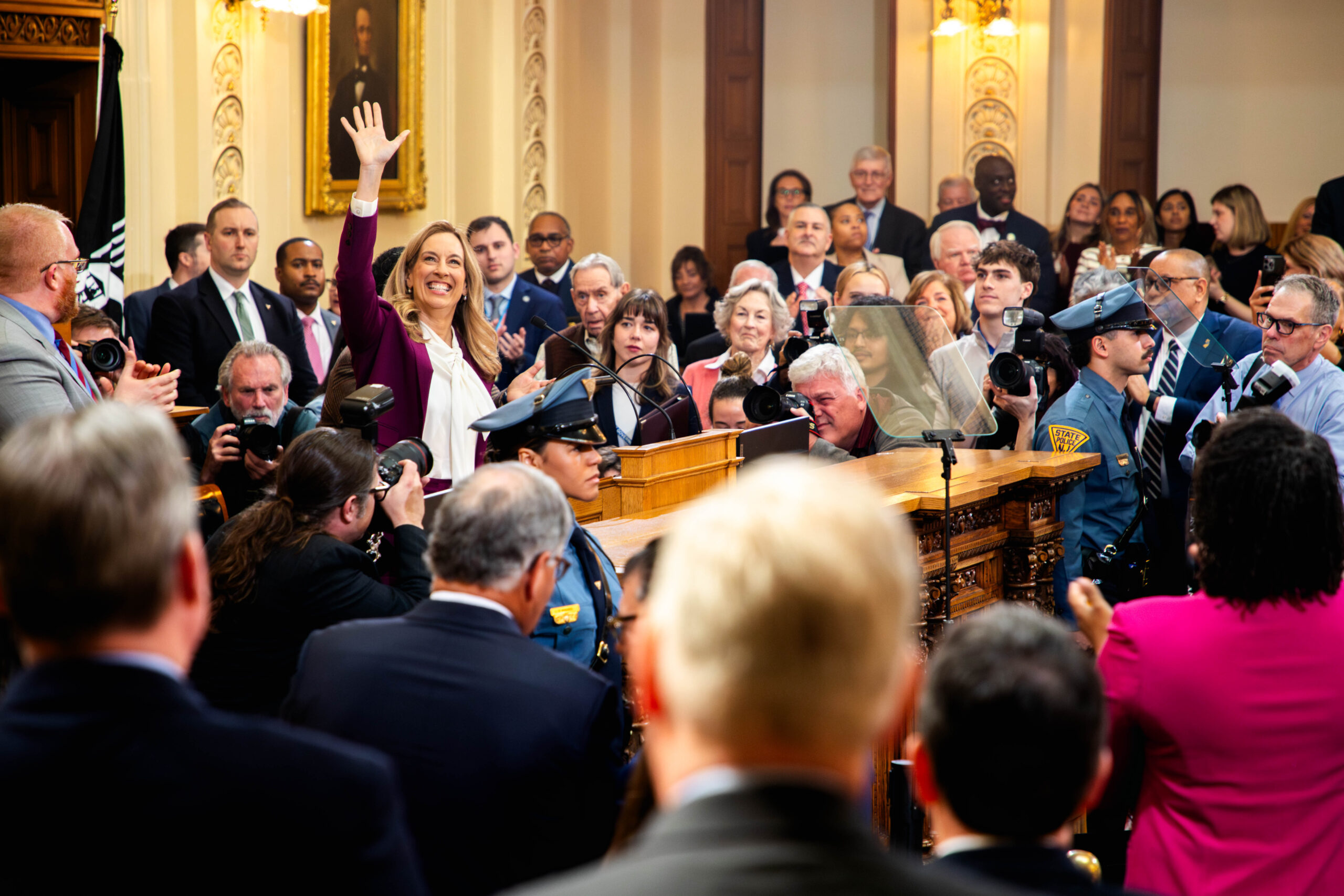
Gov. Mikie Sherrill laid out a record $60.7 billion budget on Tuesday that would provide modest increases in a few key areas balanced by more than $2 billion in cuts to other programs, including property tax relief.
“Today, I’m submitting to this legislature the most fiscally responsible budget that our state has seen in years,” Sherrill said. “It fully funds our pension system. It does not raise taxes on individual New Jerseyans. And it does include $2.6 billion in budget solutions.“
Assembly Republicans were immediately critical of the Democratic governor’s plan. “It’s the same old story being repeated again,” Assemblyman Brian Rumpf of Manahawkin said. It’s just more of the same and we’re disappointed.”
Senate Minority Leader Anthony Bucco, of Boonton, was especially critical of Sherrill’s proposal to eliminate some business tax deductions.
“This budget is already started out heading in the wrong direction, so that’s concerning to us.” Bucco said. “There’s the business deductions that are being eliminated. That’s in essence a tax … that revenue that’s going to be raised is going to be borne not only by the businesses, but by the consumers that those businesses sell to. Because businesses don’t just eat those expenses, they pass them on in the products and services.”
Sherrill’s inaugural budget for the fiscal year that begins July 1 will also test her commitment to campaign promises to make New Jersey more affordable and responsible.
Her proposal includes a $372 million bump in funding for K-12 public schools, $213 million more for public transportation and a cap on regulatory fees to offset energy price increases — priorities that were central to her campaign.
The $2 billion in cuts are across numerous programs. The largest is a $500 million slice out of the newly enacted $1.3 billion StayNJ senior property tax relief program.
“StayNJ is a great program – it keeps seniors, so often living on a fixed income, in their homes. But it benefits households that make as much as $500,000 a year,” Sherrill said. “I’m changing that, to safeguard StayNJ for middle class seniors. If you make $250,000 or less, your tax relief is in this budget.”
But Republican Sen. Declan O’Scanlon Jr., said, “The last thing that should be cut is property tax relief … it is a tax increase, so I’m not accepting that that’s a fair offer here of responsible budgeting.”’’
Other cuts include $362 million in one-time appropriations, as well as nearly $1 billion in smaller programs such as the gubernatorial election fund, the merger of Kean University and NJ City University, summer tuition aid grants, and funds to support international events, including the FIFA World Cup, according to the Budget in Brief released just before Sherrill spoke.
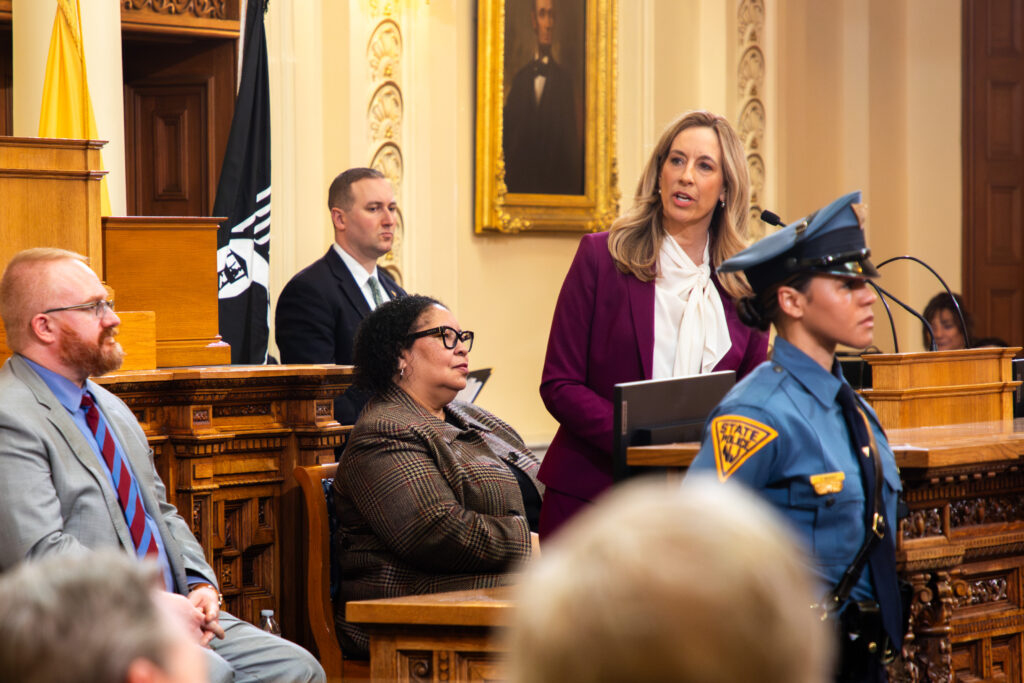
Even with the cuts, the budget proposal represents a 1.6% increase over the current budget, a bump Sherrill touts as lower than the average increases in each of the past nine budgets.
Optimistic revenue predictions
The budget forecasts $59 billion in tax revenue collections, a 2.7% increase over revised revenue forecasts for the current fiscal year.
The somewhat sunny projection comes with several uncertainties, including the effect from federal tariffs and the economic impact of military activity in the Middle East, especially volatility in oil prices.
About half the expected increase in state revenue relies on a continuation of the Corporate Transit Fee, first enacted last year. And substantial growth in corporate business tax collections. The state tax on corporations is expected to generate $4 billion, a 24.5% increase from the current fiscal year, by closing what Sherrill described as tax loopholes such as capping deductions for net operating losses.
Revenue from income tax is forecast at $22.9 billion, a modest 2% increase, while sales tax revenues are forecast at $14.7 billion, a 3.7% increase.
Because the budget spends more than projected revenues, Sherrill will spend down about a third of the state budget surplus, dropping the fund to $5.3 billion from the current $7.2 billion.
School funding increased
Sherrill’s budget allocates $12.4 billion for K-12 formula aid, the highest level of state funding of public education ever and represents a 3.1% increase of formula aid.
Sherrill’s team signaled that there is a willingness to work with the Legislature to modernize and change the current school funding formula, a bit of a concession to Republicans who have been insistent for several years that a review is necessary.
Aside from formula aid, the budget spends $1.4 billion on aid for pre-K education. It also includes $15 million for high-impact tutoring for 10,000 students, aimed at addressing academic gaps lingering from the COVID-19 pandemic, as well as a $33 million for grants in the SPARKS program, which provides school-based mental health services to students.
Fully funds pension
The budget includes a full $7.3 billion payment into the state pension system, which covers over 800,000 retired teachers and state workers. Failure to fully fund the state’s pension obligation has been a point of contention all the way back to Gov. Christie Whitman thirty years ago.
Had the state met its previous obligations, Sherrill claims that pension funding obligation would be roughly $1 billion annually.
Transportation funding protected
Sherrill’s budget provides continuing robust support for New Jersey’s public transit system, including $1 billion in subsidies for NJTransit, a $215.3 million increase over this year. Administration sources said the funding is intended to help stabilize the agency’s finances and maintain service without fare increases.
The budget proposal also provides $2.1 billion for a range of capital projects to rebuild roads, bridges and transit infrastructure.
Bottom line
Sherrill characterized her budget as one of tough choices balanced against important needs.
“This is the budget we can afford. If there are things you think we need to add – come to me with places we can cut. It’s simple math: additions require subtractions,” she said.
“This is an affordability budget … It answers first to people around their kitchen tables, not in the boardroom or the backroom. It lays the groundwork to expand opportunity, and tackle even harder problems in the years ahead.”
This story was reported and written by Andre Paras, Sarah Shockey, and Katie Thorn.