
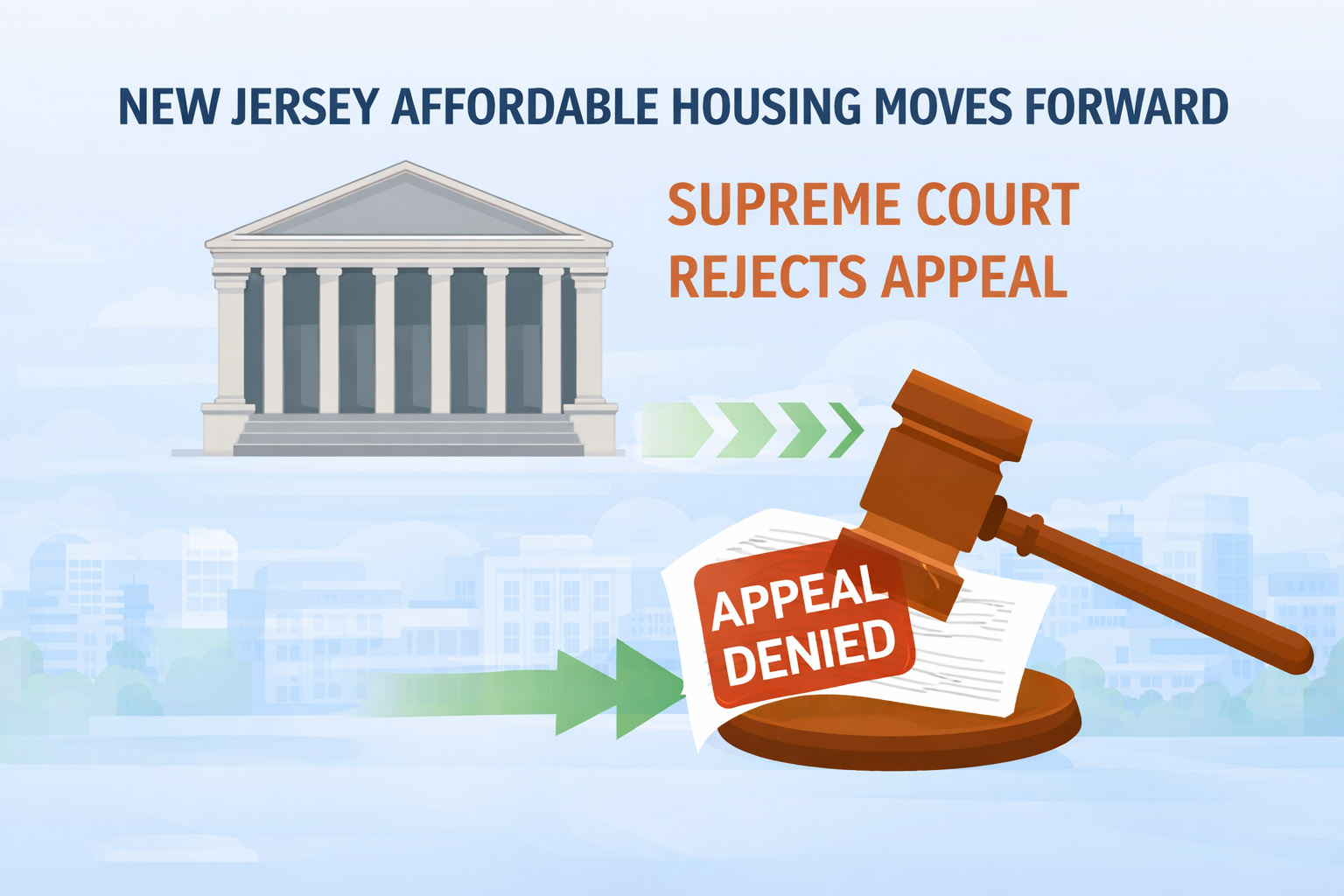
The U.S. Supreme Court has declined to hear a challenge to New Jersey’s 2024 affordable housing law, marking the latest in a string of court decisions upholding the state’s revamped framework for determining municipal housing obligations.
Justice Samuel A. Alito Jr. denied an emergency request by a coalition of municipalities seeking to delay implementation of the law, known as A4/S50, effectively leaving the statute fully in force.
The decision follows earlier losses for the municipalities in federal district court, the U.S. Court of Appeals for the Third Circuit, and New Jersey state courts — including a September 2025 ruling by Mercer County Superior Court Assignment Judge Robert Lougy dismissing with prejudice a parallel state lawsuit brought by the same group of towns.
That case, led by the Borough of Montvale and joined by more than two dozen municipalities statewide — including West Amwell in Hunterdon County — argued the law violated constitutional separation-of-powers principles and imposed unfunded mandates on local governments. Lougy rejected those claims and upheld the statute as a permissible legislative effort to enforce New Jersey’s longstanding Mount Laurel affordable housing doctrine.
Municipal coalition criticized law’s structure
The municipal coalition, known as Local Leaders for Responsible Planning, has argued that the Fourth Round law unfairly shifts affordable housing obligations onto suburban communities while exempting so-called “urban aid” municipalities from certain future housing requirements. The group also contends the dispute-resolution system gives too much authority to court-appointed experts rather than elected officials and encourages high-density development that strains local infrastructure and schools.
State courts and federal courts have repeatedly rejected those claims in dismissing the municipalities’ lawsuits.
Courts consistently uphold the law
The federal litigation followed similar arguments and was likewise dismissed by U.S. District Judge Zahid N. Quraishi. The Third Circuit denied an emergency appeal in January, and the Supreme Court’s action this week represents the final rejection of the municipalities’ effort to halt the law through federal courts.
Advocates for the statute said the outcome confirms the legal foundation of New Jersey’s new affordable housing system.
“This was a far-fetched effort to undermine and delay a law that is already working,” said Joshua Bauers, director of exclusionary zoning litigation at the Fair Share Housing Center. “At every level — state courts, federal district court, the Third Circuit, and now the U.S. Supreme Court — these arguments have been rejected.”
A new framework for housing obligations
Signed by Gov. Phil Murphy in March 2024, the law replaced the long-dormant Council on Affordable Housing with a court-supervised process for calculating and resolving municipal obligations in the Fourth Round of Mount Laurel housing planning.
The statute requires every municipality to adopt a housing element and fair-share plan outlining how it will meet its affordable housing obligation over the coming decade and establishes mediation through an Affordable Housing Dispute Resolution Program administered by the judiciary. NJs-New-Affordable-Housing-Law_…
Supporters say the overhaul was designed to end decades of litigation gridlock and accelerate production of homes affordable to low- and moderate-income households.
Assembly Speaker Craig Coughlin, a prime sponsor, said the Supreme Court’s action confirms the law’s durability.
“Once again, efforts to stall implementation through the courts and undermine our constitutional obligations under Mount Laurel have been soundly rejected at every level of the judiciary,” Coughlin said in a statement. “The courts have spoken clearly and consistently, and New Jersey families cannot afford further slowdowns in addressing our housing shortage.”
Municipal planning already underway
The decision comes as municipalities statewide — including those in the Hopewell Valley — are in the midst of preparing or revising Fourth Round housing plans under the new system. The latest deadlines are in mid March for plans to get to the state.
According to Fair Share Housing Center, roughly 380 municipalities have already developed compliant plans following the Dec. 31 mediation deadline, an unprecedented level of participation in New Jersey’s affordable housing process.
With the Supreme Court declining review, no further federal challenges remain pending, and New Jersey’s new affordable housing framework continues moving forward toward 2026 statutory deadlines for final municipal plan adoption.