


In the Hopewell Valley Regional School District, one number stands out more than most: per-pupil spending.
Depending on the source, the district’s reported cost per student ranges from about $26,000 to more than $30,000 — the highest in Mercer County by several measures, and a frequent point of contention in board meetings, public comment, and a recent editorial by two former Hopewell Township mayors. But district officials say comparisons to other districts are rarely straightforward — and often misleading.

“The numbers are all over the place,” said Superintendent Dr. Rosetta Treece. “Depending on what website you go to, you’ll get a different number for per pupil.”
That’s because different reports include — or exclude — different categories of spending. Some omit special education tuition, out-of-district placements, or one-on-one nursing support. Others exclude building maintenance, transportation, or capital investments. Even within New Jersey Department of Education datasets, definitions vary.
Assistant Superintendent for Finance Robert Colavita said this lack of consistency causes confusion, especially when residents try to compare Hopewell Valley to districts that operate at different scales, with different programming, and under different constraints.
District officials say that Hopewell Valley’s spending reflects community values: small class sizes, a high ratio of support staff to students, and a breadth of services that other districts don’t necessarily offer.
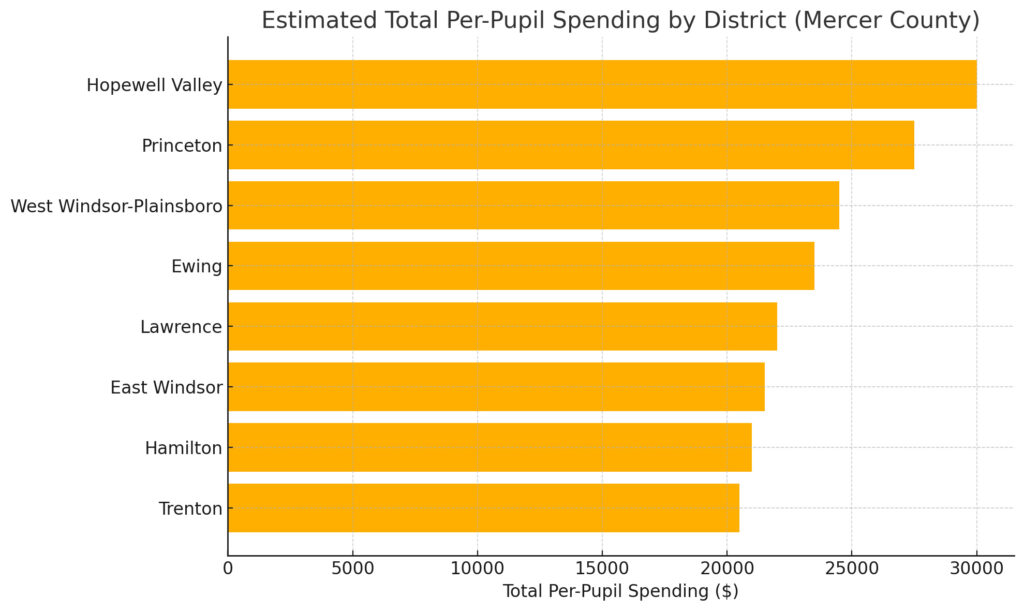
“Our per-pupil cost is higher than a lot of other districts in the area because of our extremely small class size,” Treece said. “It’s directly related to the number of staff members who have direct contact with kids — teachers, paraprofessionals, counselors, therapists, nurses — including situations where a student may need a one-on-one nurse in addition to the nurse already in the building.”
Those services include accommodations for students with significant behavioral or medical needs, out-of-district placements, and transportation — all of which carry costs that vary from year to year.
In addition to special education and support staffing, district leaders say Hopewell has built a model that prioritizes in-district delivery of a wide range of services, including mental health support, calming rooms, expanded early childhood programs, and a robust catalog of electives. Where other districts may rely more heavily on external placements or limit offerings based on cost, Hopewell’s structure reflects long-standing community expectations for comprehensive, student-centered programming.
While some districts may see staffing reductions as a way to manage costs, Hopewell Valley has intentionally maintained high student-facing staff levels as part of its educational philosophy — a choice that school leaders acknowledge comes with a higher per-student price tag.
A Regional District With a Complex Formula
Hopewell Valley is one of only a handful of K–12 regional school districts in New Jersey. It serves students from Hopewell Township, Pennington Borough, and Hopewell Borough — and that regional structure shapes how taxes are raised and shared.
Most regional districts in the state serve only middle and high school students, while individual towns operate their own elementary schools. Hopewell is unusual in that it provides education from kindergarten through 12th grade under a single unified system and budget, spanning three municipalities.
Under state law, regional school districts apportion their local tax levy based on the equalized property values of their constituent towns. That means even if the total school tax levy remains flat, individual homeowners may still see increases if their town’s share of total property value rises relative to the others.
In recent years, Hopewell Township’s growing ratable base has meant the township pays an increasingly larger share of the total school levy — a dynamic that has led to confusion and frustration, especially when residents try to link their tax bills directly to school spending levels.
This year, that tension became more public when the Hopewell Township Committee voted to allocate up to $16.1 million in PILOT funds to help the district construct a 10-classroom addition at Bear Tavern Elementary. Leaders from Pennington and Hopewell Borough later raised concerns about the fairness and timing of the funding decision. The money has not yet been allocated to Bear Tavern because a lawsuit between the township and Pennington Borough is still pending.
District officials say the Bear Tavern project is only one piece of a broader set of long-term facility needs.
“There’s $120 million of work on our long-range plan,” Colavita said. “The PILOT money helps with one project. It doesn’t solve the bigger problem.”
What Comes Next
A potential $87 million referendum is currently under discussion and could be presented to voters as early as this fall. The Board of Education has until July to decide what the proposal will include.
According to district officials, the majority of the funding under consideration would be directed toward critical infrastructure repairs across all six school buildings — not just new classroom additions.
The district’s long-range facilities plan identifies widespread building needs, including aging HVAC systems, roof replacements, plumbing repairs, and upgrades to electrical and structural systems. Many of those systems are decades old and can no longer be repaired easily.
The proposal also includes targeted expansions at Bear Tavern and Toll Gate Grammar School, where temporary trailer classrooms are currently being used to accommodate students. The planned additions would eliminate the trailers and ensure all students and staff are housed within the main buildings, allowing both schools to better serve students today and into the future.
District leaders say that under current state law, referenda are the only viable path to fund large-scale improvements like these. New Jersey imposes a 2% annual cap on local tax levy increases, which limits a district’s ability to budget for major capital work through its regular operating budget. At the same time, state facilities aid — which usually helps cover 30–40% of the approved construction costs — is only available for voter-approved referendum projects, making community approval essential.
The district is expected to continue conversations around the potential referendum at the next Board of Education meeting on June 16 at 6:30 p.m. For a referendum to appear on the November ballot, final language must be submitted in July.
While debate continues over how much the district spends and how it should prioritize future investments, school officials say the potential referendum is focused on ensuring that Hopewell Valley’s schools remain safe, functional, and prepared to serve students for the long term.