

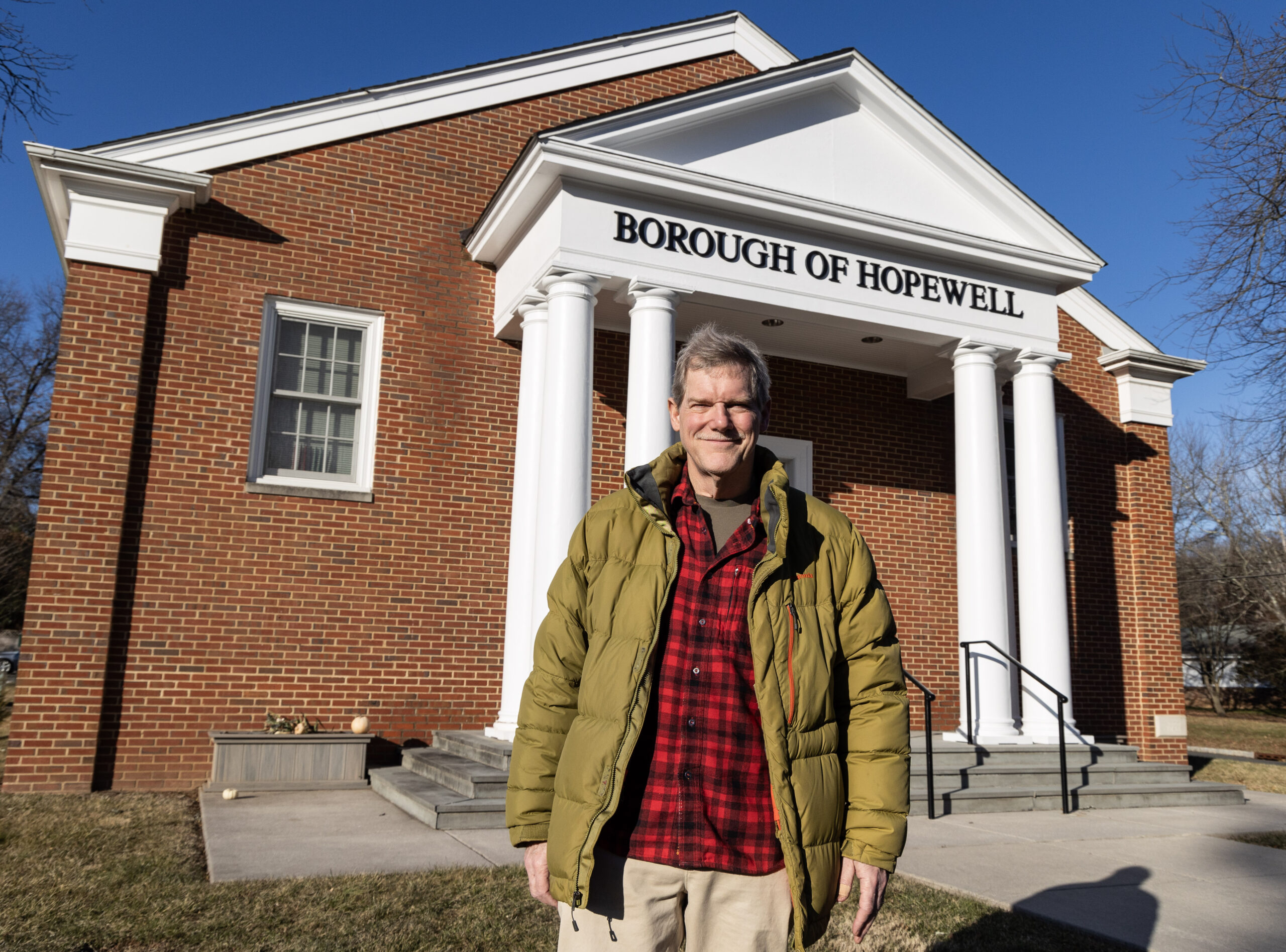
Hopewell Borough Councilman David Mackie has spent 27 years helping guide the town through decisions that often stretched far beyond a single meeting agenda. Known for his patience, analytical style, and tendency to answer complex questions with historical context rather than quick conclusions, Mackie has been a steady presence through eras of growth, preservation battles, redevelopment debates, and long-running infrastructure challenges.

Earlier this month, the Borough honored Mackie with a proclamation marking his final meeting — a session he attended remotely due to illness. Town Crier Stanley Saperstein read the proclamation aloud, praising Mackie as a geologist by training and a public servant by dedication, someone “whose calm counsel has steadied the Borough through storms both literal and political.” Colleagues highlighted his deep institutional knowledge, his mentorship, and his decades-long commitment to understanding not just what decisions the Borough faced, but why they mattered.
Last week, Mackie sat down for lunch to reflect on the work, the lessons, and the community he has served for nearly three decades.
“None of us individually has the answer”
One theme surfaced repeatedly in Mackie’s reflections: public service, especially at the local level, works only when people approach problems collectively.
“I don’t have the answers,” he said. “None of us individually has the answer.”
He described his long tenure as a process of learning to ask better questions, understanding what is beneath the surface of residents’ concerns, and recognizing that progress is rarely linear.
“You learn that people’s concerns come from real places,” he said. “If you take the time to understand what someone is worried about, you often find they’re not actually that far from trying to get to the same place you are.”
Mackie said the most productive moments on council often came not from agreement, but from a willingness to listen long enough to understand the concern behind the concern — and then to build solutions around that.
A career shaped by land use, planning, and long-range thinking
Mackie joined the council in the late 1990s, at a time when Hopewell Borough was navigating questions about growth and preservation that would define the next 20 years. His work on the Planning Board — highlighted in the Borough proclamation — shaped conversations around the Ruhland Tract, business-district redevelopment, and the scale of future growth.
During lunch, Mackie noted that the community has not always had a broad, forward-looking conversation about development.
“I don’t think we really have had a broad conversation as a community about what level of development we need,” he said. “When I first came here things were really sleepy, and then we had a lot of, I think, mostly very welcome development. But how far do you want that to go?”
He said much of the public engagement around land use happens only when a proposal is already on the table.
“Usually people respond to a proposal for something,” he said. “They don’t sit down and say, ‘Here’s what we need as a community.’”
Those dynamics, he said, make planning work both challenging and essential.
Years of work behind a defining decision
Mackie’s role in the Borough’s water system stretched across much of his time in office and was shaped by his professional background. As a geologist and longtime environmental consultant, he spent decades immersed in groundwater, soil science, and NJDEP and federal regulatory frameworks — experience he brought directly into municipal decision-making.
“A lot of it is immersed in NJDEP regulations for 30 years,”he said.“Wherever I could fill in and help, particularly on the regulatory stuff, I got involved. I even write the public notices around PFAS notifications and all that.”
That technical grounding, paired with years of municipal work on infrastructure, meant that when the Borough began examining the future of the water utility, Mackie became one of the council’s most involved members. The proclamation honoring him highlighted this directly, noting that he “worked tirelessly on critical infrastructure issues, most notably dedicating immense effort and countless hours to the Borough’s Water Utility, especially during the past two years of complex decisions regarding its future.”
He spoke candidly about his connection to the system.
“The water system’s great — I’m going to miss it,” he said. “But we have a lot of other things we need to be doing.”
When a legal challenge was filed against the referendum process, years of work suddenly turned into a rapid sprint.
“It was crazy,” Mackie said. “It was like 10 days from the time they filed it to the time we had to be in court. I’ve worked on litigation stuff for over a year. I’ve never seen anything like it.”
He recalled the judge reviewing the record with precision.
“So much of it was just stuff that we’d done that was completely objective,”he said.
When the decision was handed down, Mackie saw it as confirmation that the Borough had handled its responsibilities carefully.
“I felt that it was a resounding affirmation of everything,” he said.
But even in describing the process, he returned to the sense of duty that guided him.
“I felt like not only did we have an obligation to do it, but if we didn’t do a good enough job and the thing failed, that was on us,” he said.
Hopewell 57, redevelopment, and the work still ahead
Although he is stepping away from elected office, Mackie was clear that he intends to remain engaged — particularly as several major redevelopment projects move into decisive stages.
The long-stalled Hopewell 57 property, a condemned building that he described as “the biggest opportunity for affordable housing I think we’re ever going to have,” remains at a critical turning point.
Similarly, the Castoro’s property and other key business-district parcels will require sustained guidance as proposals take shape.Mackie said he expects to stay attentive to these issues, attending meetings when he can and offering perspective if asked — especially given the years he has invested in understanding their constraints.He laughed as he said he won’t be sitting silently on the sidelines.“I’m probably going to be waving my hands a little bit, seeing if I can help with that,” he said during a discussion of ongoing grant and planning work.
He noted that the sale of the water system will continue to require coordination and oversight as the transition is finalized, and he plans to remain informed and supportive however possible.
What he hopes for Hopewell
Mackie did not frame his departure in terms of unfinished business, but rather in terms of the ongoing work that local government requires. He expressed hope that the Borough continues to engage residents early and often, and that future conversations about development, infrastructure, and planning will be shaped by the same steady attention he tried to bring to the table.
He also emphasized that government functions best when residents understand not just the outcome of a vote, but the context behind it — noting the impact when community members attend only for a single issue.
He said he and the rest of council often looks at, research, and debate issues for months (or longer) before decisions that seem quick to the public in the room for a final vote.
A long chapter ends, but not his connection to the town
Though the proclamation and council tributes marked a formal farewell, Mackie made clear that he is not disappearing from Hopewell’s civic life.
He intends to stay involved “in the background,” to keep showing up, and to continue caring about the place he has called home for decades.
For him, stepping off the council is less an ending than a shift in role — a transition from elected official to engaged neighbor.
Asked what he takes away from 27 years of service, Mackie returned, once again, to the idea that guided him from the beginning:
“I don’t have the answers…none of us individually has the answer.”
It is a sentiment that has shaped his tenure, and one he hopes continues to shape Hopewell Borough long after his final vote.