


Long before the American Revolution reached the Delaware River, the Hopewell Valley was already fighting a rebellion of its own.
Settlers in the region battled wealthy land speculators, corrupt colonial officials, and even militias sent to enforce disputed property claims. Homes were burned. Leaders were jailed. Armed groups formed to resist eviction.
According to public historian Rick Durham, the conflict unfolded decades before the Revolution — and may have helped prepare local residents to challenge British authority.
“It’s a story about a paradise found — a Quaker paradise — and a paradise lost,” Durham told an audience during a March 8 lecture hosted by the Ewing Township Historic Preservation Society. “A story about vision, freedom… and opportunistic greed and corruption.”
A colony built on freedom
In the late 1600s, West New Jersey was envisioned as a haven for religious freedom and fair governance.
Quaker leaders including William Penn helped establish the colony with a governing framework called the Concessions and Agreements, a document outlining protections for property rights, trial by jury, and self-government.
Durham described it as something close to a proto-constitution.
“They wrote what was essentially the first New Jersey constitution,” he said.
The system relied on a body known as the Society of Proprietors, who oversaw land sales and ensured settlers could legally acquire property.
For decades the arrangement worked.
Quaker settlers spread across the region, establishing farms and communities in places like Burlington, Maidenhead — now Lawrence Township — and the Hopewell Valley.
But that fragile balance would not last.
The speculator
Enter Daniel Coxe.
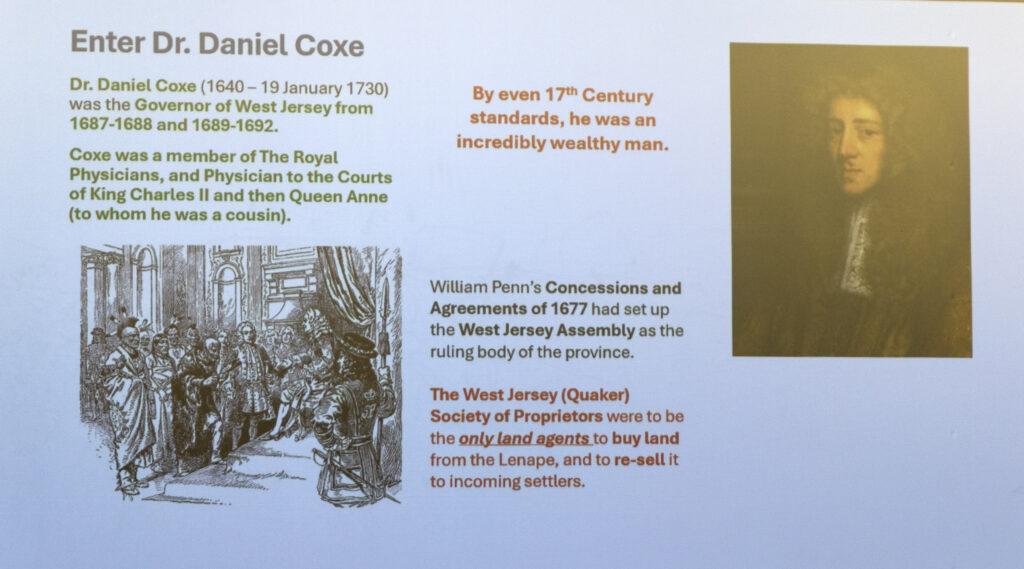
Durham described Coxe as extraordinarily wealthy by colonial standards, with business interests across the Atlantic.
“He was a billionaire by seventeenth-century standards,” Durham said.
Coxe purchased enormous tracts of land in New Jersey, including forests for timber and coastal areas near Cape May intended for whaling enterprises.
But he also began bypassing the established Quaker system that regulated land ownership.
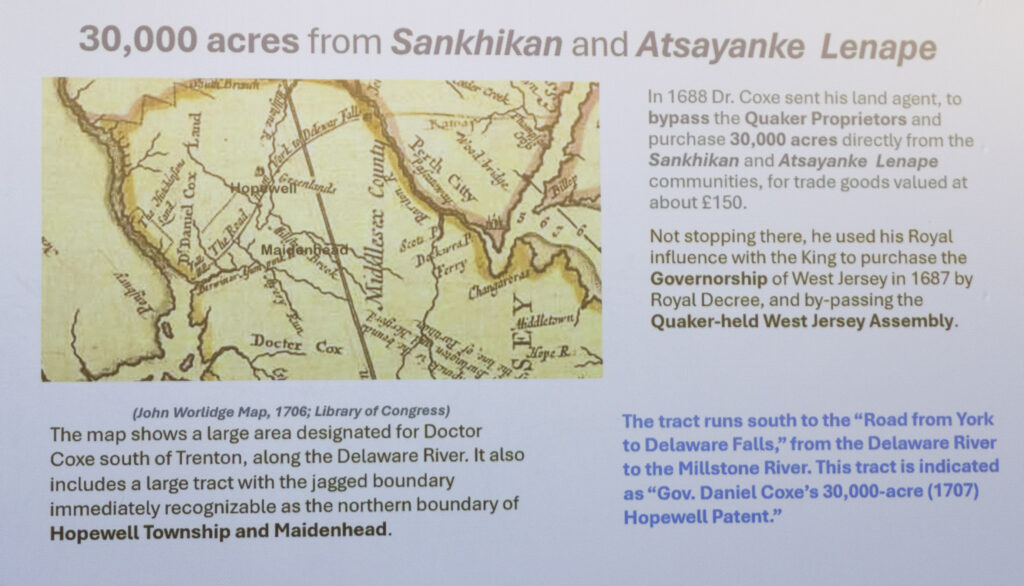
In one controversial move, Coxe negotiated directly with Lenape leaders to acquire roughly 30,000 acres of land — territory that included parts of the present-day Hopewell Valley.
The deal bypassed the Quaker authorities who had originally been granted the right to oversee land sales.
“This was land the Quaker proprietors said he had no authority to purchase,” Durham said.
Political turmoil in England only made matters worse.
As royal control of the colonies shifted, legal authority in New Jersey became increasingly unclear — opening the door for land speculators to expand their influence.
The missing deeds
The dispute reached a crisis point when colonial land records disappeared.
According to historical accounts, key property records from West New Jersey, including those from the Hopewell Valley, were shipped to Boston during political upheaval in the late 1600s.
They never returned.
Without those documents, many settlers suddenly had no legal proof of land they had owned and farmed for decades.
Coxe’s heirs seized the opportunity.
Families across the Hopewell Valley were told they no longer owned their farms.
Instead, they were now tenants.
“They were told, ‘You’re tenants now,’” Durham said. “You can repurchase the land, rent it, or leave.”
For many settlers who had cleared forests and built farms with their own labor, the demand felt like outright theft.
The valley fights back
In 1731, about 50 Hopewell Valley settlers filed a class-action lawsuit against the Coxe family.
The names of the plaintiffs read like a roll call of early Hopewell families: Anderson, Blackwell, Stout, Titus, Bainbridge and others whose names still appear on local maps and roads.
At first, the settlers won.
Local courts ruled in their favor.
But the Coxe faction appealed to the New Jersey Supreme Court — where Daniel Coxe (the son) sat as a justice.
The court overturned the earlier rulings.
Durham noted the remarkable conflict of interest.
“It’s conceivable that Colonel Coxe, now Judge Coxe, adjudicated his own case,” he said.
The decision effectively ended any legal avenue for the settlers.
Militias and jail breaks
Without help from the courts, tensions exploded.
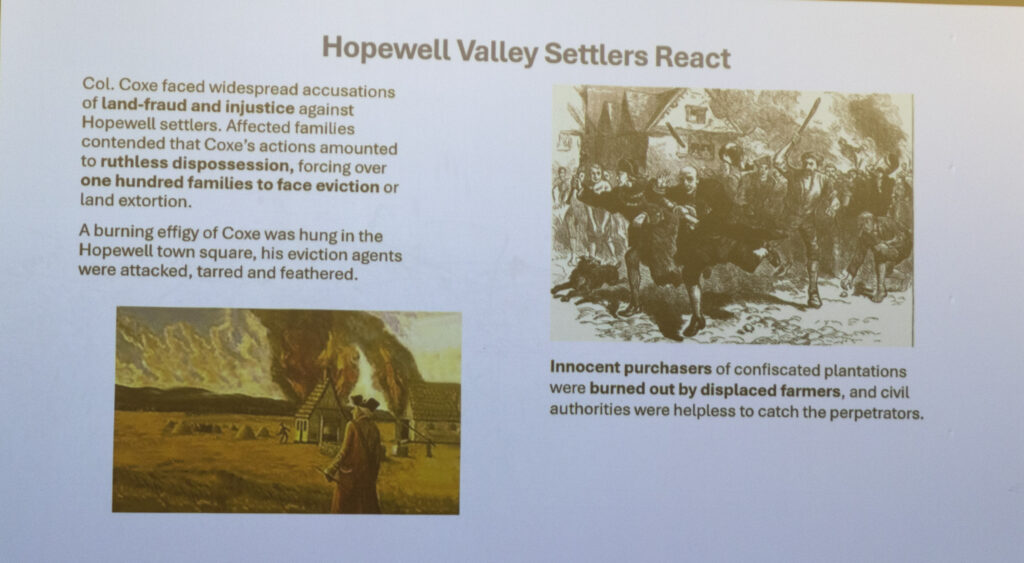
Settlers formed vigilante committees to resist evictions and defend their farms.
Royal authorities responded by sending militia forces to enforce property claims.
For several years, the valley was gripped by violent confrontations.
Durham described a region sliding toward open conflict.
“Hopewell Valley was becoming a state of open warfare,” he said.
At one point, mobs stormed local jails to free imprisoned community leaders.
Authorities threatened to send British troops to restore order.
Governor Jonathan Belcher ultimately stepped in to pardon several of the arrested settlers, fearing the violence could spiral further out of control.
The long arc of justice
The conflict simmered for decades.
When the American Revolution began, the Coxe family remained loyal to the British crown.
After the war, their vast land holdings were confiscated by the new American government and sold.
In a twist of historical irony, many of those lands ended up back in the hands of descendants of the settlers who had originally been forced off them.
“It took fifty or sixty years,” Durham said. “But justice came back around.”
A forgotten prelude to revolution
Durham said the Hopewell Valley land conflicts reveal how colonial tensions were already reshaping American society long before independence.
Fights over land, representation, and authority created the same frustrations that would later drive the Revolutionary movement.
“In places like the Hopewell Valley,” he said, “people were already learning how to stand up to power.”