

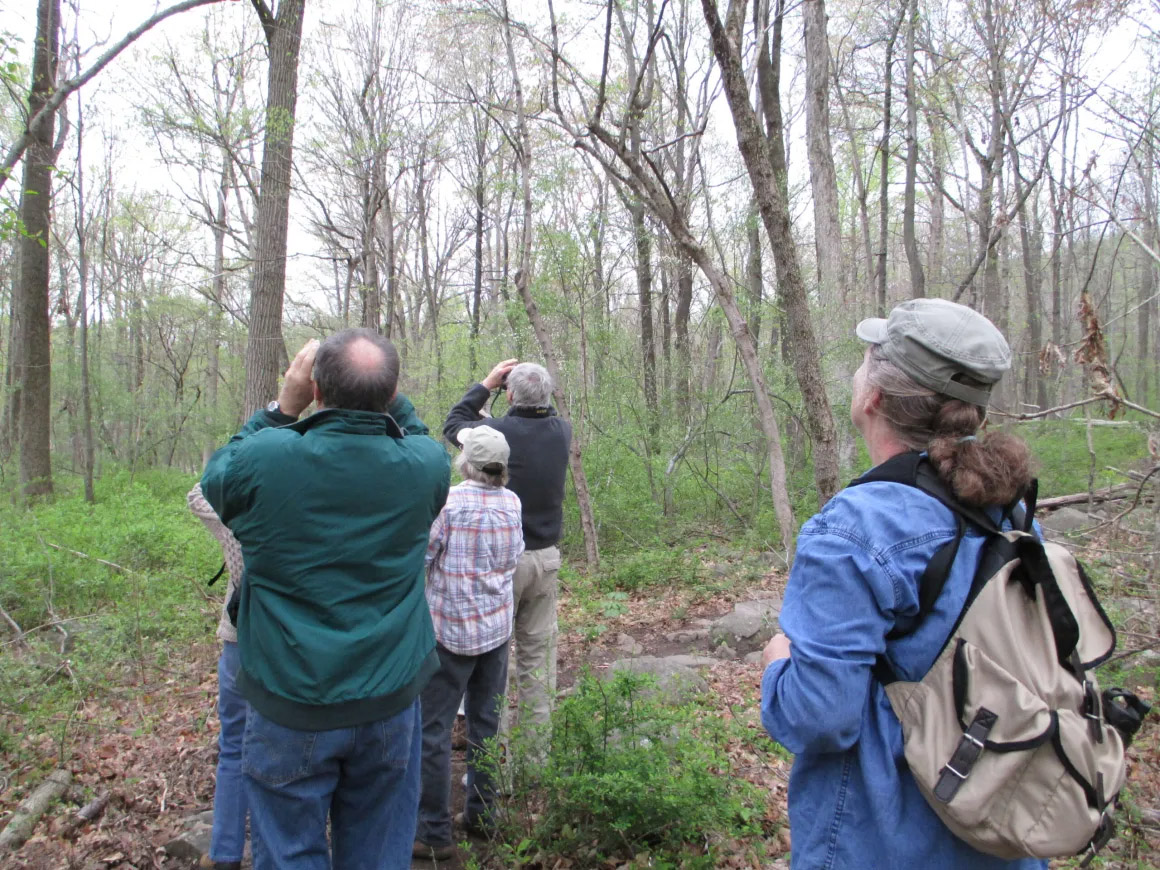
Written by FoHVos volunteer Jack Hagan. Jack and FoHVos Executive Director Jenn Rogers been birding together for 10 years and will be leading a hike on June 7.
Here in Mercer County there’s no better month for birding than May. That’s when some of our most colorful avian friends return from their lengthy sojourns in the Caribbean or Central and South America. Suddenly, the woods and fields that have been so quiet all winter resound with the songs of grosbeaks, tanagers, vireos, buntings, orioles and towhees. And most beloved of all, warblers!
Due to its location in the Atlantic Flyway, more than thirty species of warblers can pass through Mercer County in a typical May, all of the males decked out in their eye-catching breeding plumage. Many of the warblers we see are simply passing through on their way farther north. Cape May, Blackburnian and Bay-Breasted Warblers, among others, are dropping in for a few day’s rest and a meal or two before continuing their journey. But for a surprising number of warblers, Mercer County looks like a great place to settle down and raise a family. And no neighborhood is more inviting than Baldpate Mountain and its environs.
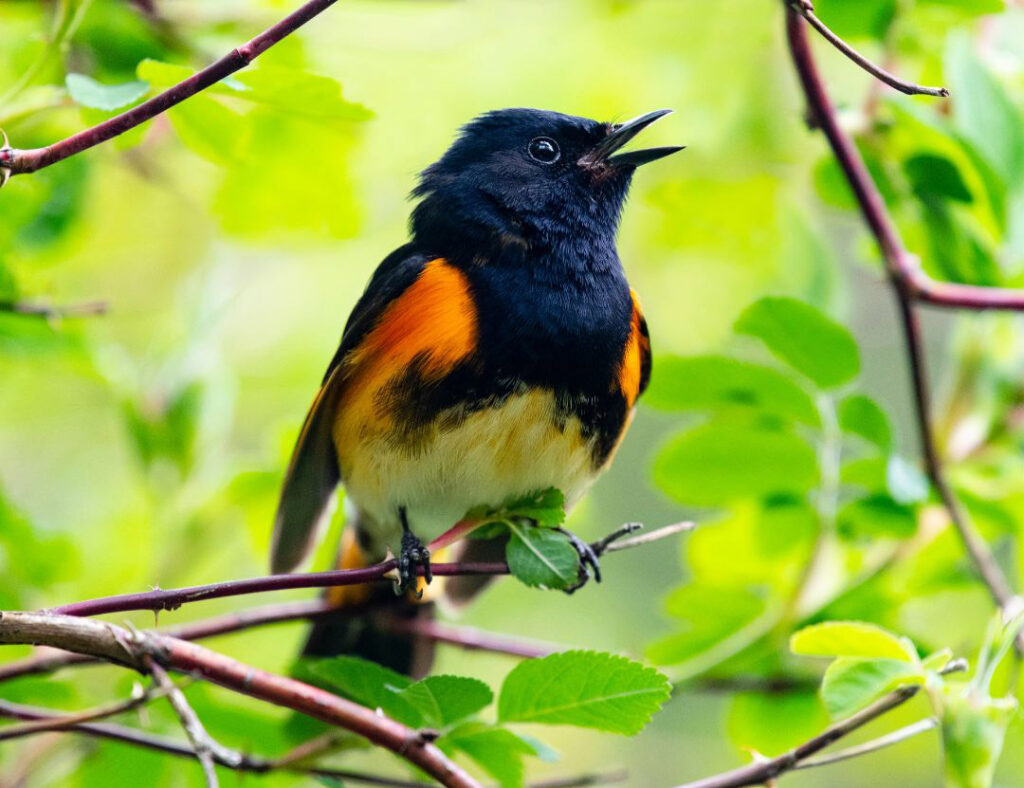
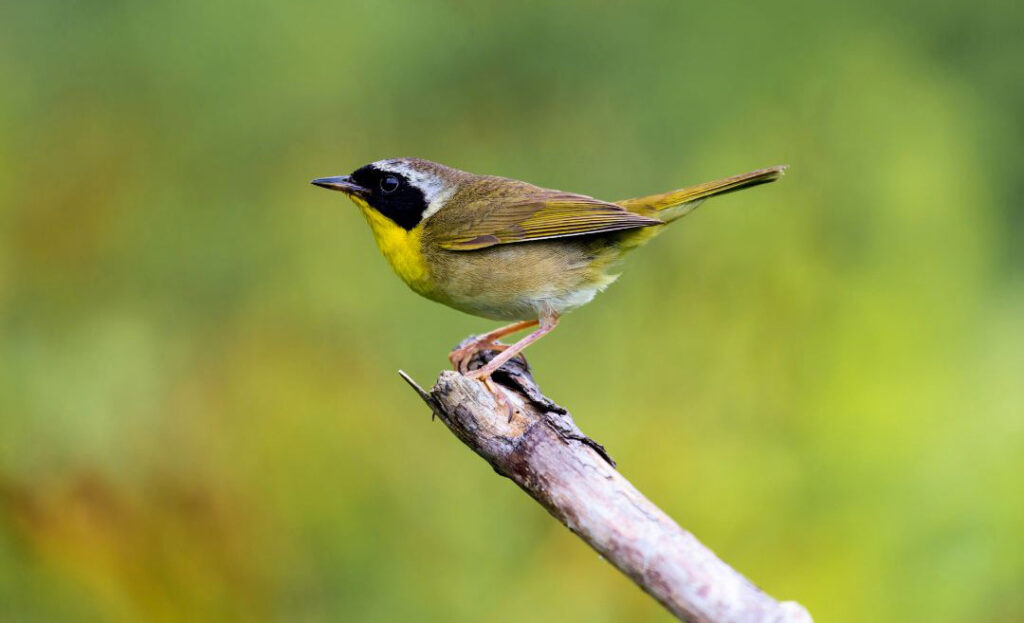
A walk up the driveway at Baldpate can be an aural feast for a birder. Ovenbirds sing “TEA-cher, TEA-cher, TEA-cher” on both sides, their song confounding the listener’s attempt to echolocate their exact position. Are they singing from the tops of the trees? Or are they low in the underbrush? American Redstarts, black with red/orange trim on their chests, wings and tails, are equally present, mostly in the upper levels of the canopy. Most ubiquitous of all is the “Witchity, Witchity, Witchity” of the unfortunately-named Common Yellowthroats. Sure, they are the most common in numbers, but there’s nothing common about their looks, with their yellow throats, chests and under tail coverts, and sporting a black mask trimmed in white.
Black-and-White Warblers cling to the trunks of trees, nuthatch-like, probing with their thin bills for spiders and insects. Near the top of the driveway, where the slope of the hill is a little steeper, you can often hear the insect-like trill of a Worm-Eating Warbler, a rather nondescript olive-colored bird with a striped head that might remind you of a University of Michigan football helmet. Or perhaps you might find a Hooded Warbler, bright yellow with a black cowl on its head. And if you’re having a good day, you might hear the loud and insistent song of a Kentucky Warbler. Baldpate is on of the only local areas where these southern warblers are known to breed.
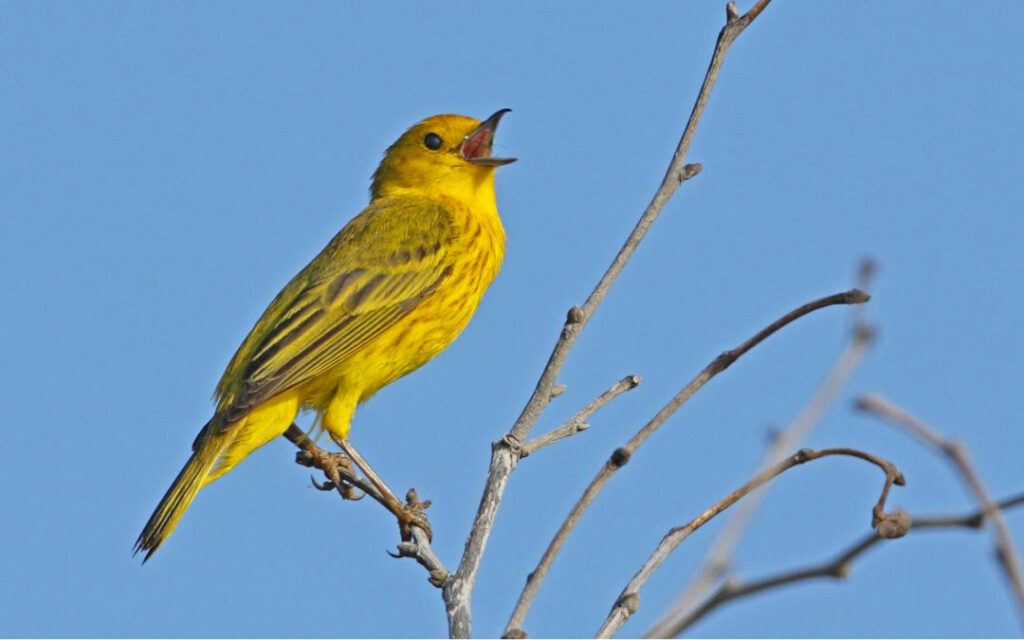
By the time you’ve reached the summit you may think that you have reached the limit of breeding warblers that Baldpate has to offer, but there’s still more to come! Male Yellow Warblers, with their red-streaked chests, sing “Sweet! Sweet! Give me sweet!” Their close cousins, Chestnut-Sided Warblers, gaudily decked out with Yellow crowns, black masks and white breasts flanked with chestnut, sing “Pleased to meetcha. Pleased, pleased to meetcha!” Prairie Warblers, delicate little yellow birds with black streaks on their side and face, and surprising chestnut spotting on their backs, sing their distinctive buzzy song that rises through the scale. Another buzzy two-note song, “Bee BUZZ” alerts the birder to the presence of a Blue-Winged Warbler. Inhabitants of successional habitats, Prairie Warblers have become rarer on Baldpate as the summit becomes more forested. Early in May, you may even discover Pine Warblers among the White Pines at the very crest of the mountain.
If you’ve been keeping count, that’s an even dozen species of warbler that have been known to breed on Baldpate. Not bad for perhaps a 90-minute walk. And if you’re itching to turn that into a baker’s dozen, head over to the nearby Fiddler’s Creek Preserve, located at the base of Baldpate. Walk through the fields, where you will see and hear more Prairie, Yellow, Blue-Winged Warblers and Common Yellowthroats. When you reach the woods, continue into the ravine. Follow the trail as it descends to the creek. Listen for a loud and insistent song and a harsh call. Then look into the creek where the water is free flowing and you may see a brown and white plumaged thrush-like bird with a bold white eyebrow marking, bobbing its tail as it forages in the water. The bird you have discovered is a Louisiana Waterthrush, and Fiddler’s Creek is one of the only places in Central Jersey where this warbler is known to consistently breed.
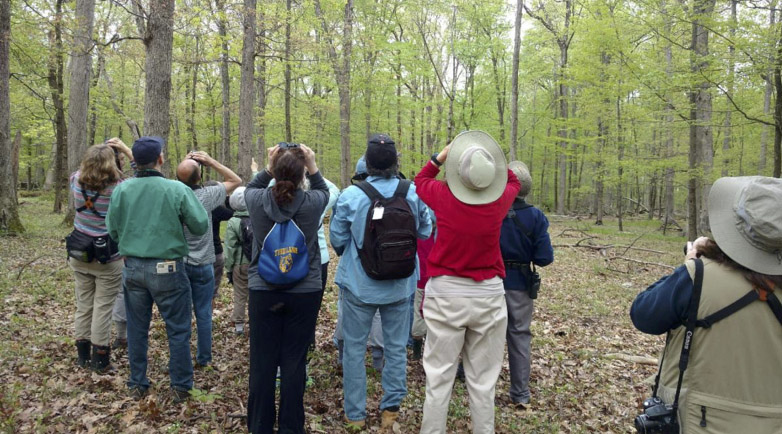
On June 7, join myself and Jenn Rogers for “Just Birds” walk at Fiddler’s Creek Preserve. This hike is hosted through FoHVOS and is part of the 2025 Hopewell Valley Come Out and Play weekend. These hikes are open to all interest and ability levels but are specially geared towards newer birdwatchers. We just ask that you bring your patience and a pair of binoculars. The registration link for this program is here.