

Standing in front of nearly 200 elementary school students last fall, Fairgrown Farm owner James Klett turned a simple apple cider press into something much bigger.
As he cranked fresh apples through the press, the third- and fourth-graders broke into a song they had prepared just for him.
“Press Those Apples, Farmer James.”
“It was the sweetest moment in my entire career,” Klett recalled. “I still get emotional when I think about it. It was the highlight of my entire career.”
Moments earlier, however, the school representative who organized the event had quietly reminded him just how fragile opportunities like that could be.
“Make this count, because this is the only time we will be able to do this. It’s a one-off grant; we only have one shot; make it count.”
Driving the two hours back to Hopewell Township afterward, Klett couldn’t stop thinking about what she had said.
“Why is that the only time that this gets to happen?” he said. “This is such a valuable thing. It impacted the kids. It was so fun for me… But it’s a program that makes sense that we have to find funding for somehow.”
That drive home eventually led to Friday’s gathering at Fairgrown Farm.
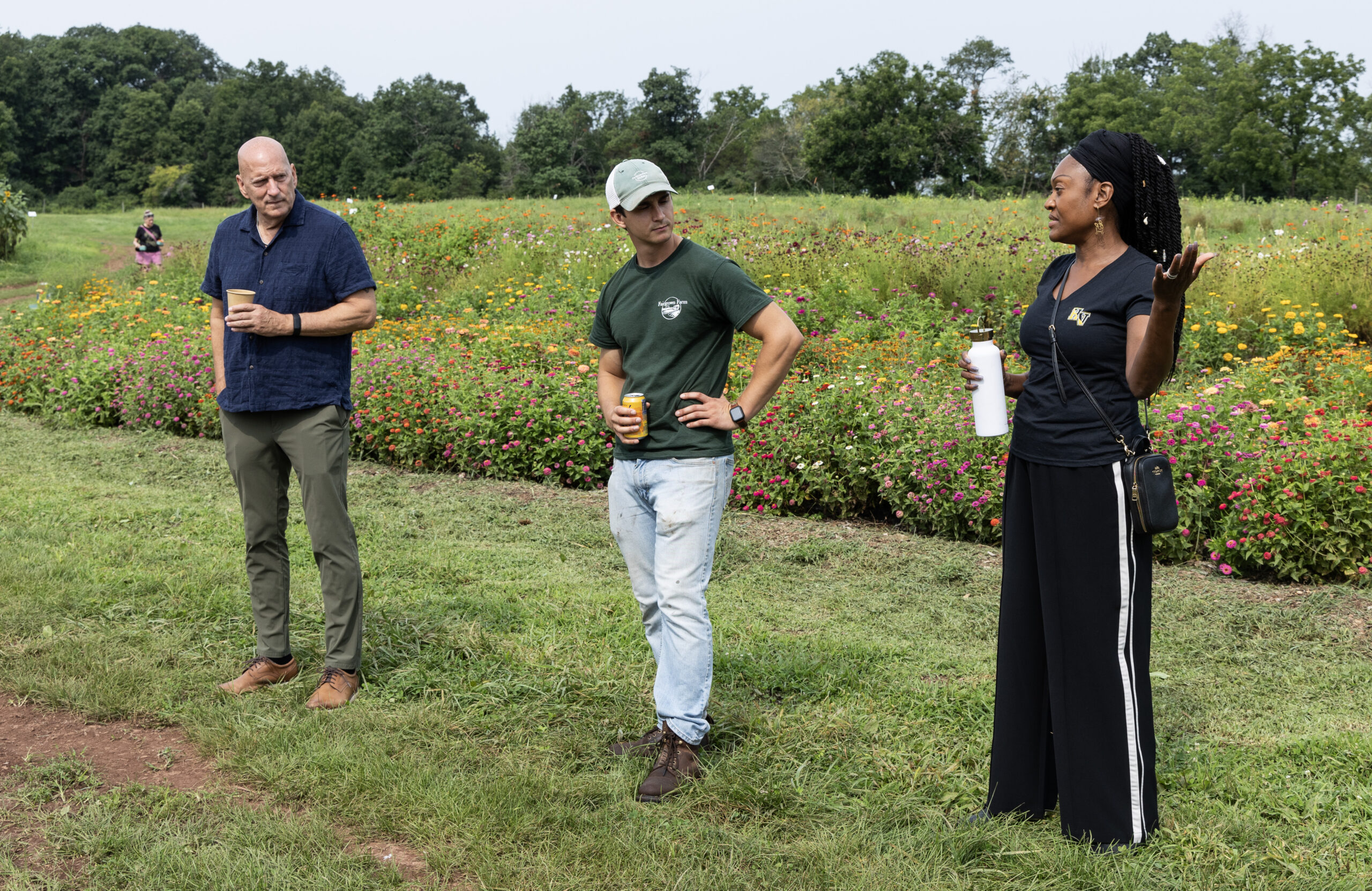
Walking through rows of towering sunflowers, tomatoes, flowers and late-summer vegetables ready for harvest, New Jersey Secretary of Agriculture Ed Wengryn, Department of Agriculture staff, school superintendents, food service directors, Rutgers Cooperative Extension staff, nonprofit leaders and farmers toured the Hopewell Township farm before settling in for a working session.
The discussion wasn’t simply about vegetables.
It was about whether New Jersey can continue connecting local farms with school cafeterias—and with students themselves—as the grant funding that helped launch many farm-to-school initiatives becomes increasingly uncertain.
A farm that’s about more than farming
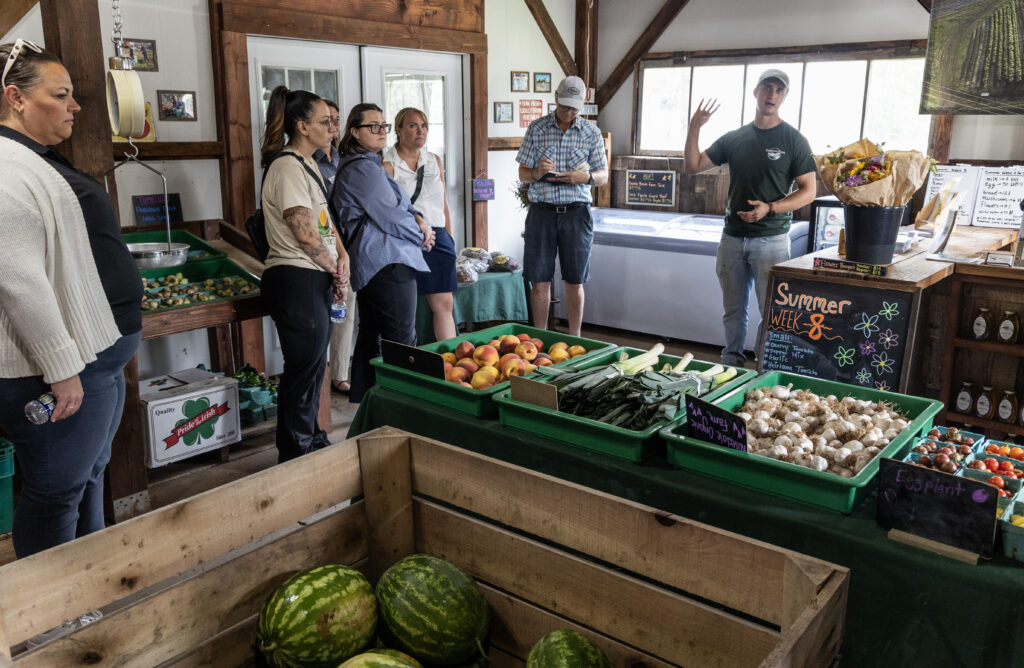
Fairgrown Farm has grown into much more than a small farm with a pick-your-own field.
The farm serves more than 700 CSA families while operating as a regional food hub that works with 45 partner farms throughout New Jersey and eastern Pennsylvania. In addition to distributing food through their CSA, the farm distributes tens of thousands of pounds of produce to food security organizations throughout the region.
For Klett, however, the mission extends well beyond growing vegetables.
“Our role is more than just selling vegetables,” he explained during the tour, describing how children visit the farm to pull carrots from the ground, pick strawberries and begin building a relationship with where their food comes from.
“If we see ourselves as competing in providing a direct farm relationship, where people know where their food comes from, that’s kind of something only we can do,” he said.
That philosophy ultimately led to a new idea.
From one apple press to a pilot program

After returning home from the cider pressing demonstration, Klett began thinking about how schools and farms could build lasting partnerships instead of relying on one-time grants.
Fairgrown’s answer is a pilot community-supported agriculture (CSA) program with the Hopewell Valley, Princeton and Montgomery school districts.
Families purchase weekly boxes of locally grown produce through the program and pick them up at participating schools. In Hopewell Valley, the pickup location is Hopewell Elementary School.
But the program is designed to do much more than sell vegetables.
“We give ten percent back to the school to support any type of farm-to-school relationship that they need,” Klett said. That support could fund classroom demonstrations, school gardens, field trips or purchases of fresh produce for cafeterias.
The original plan depended on a Farm-to-School grant.
When that funding didn’t materialize, Fairgrown decided to move ahead anyway.
“We’ve been trying to figure out how to build sustainable economic bridges between schools and agriculture,” Klett said.
The biggest restaurant in town

Rose Chamberlain, director of New Jersey’s Division of Food and Nutrition, said schools represent one of the greatest opportunities to introduce children to fresh, local food.
School cafeterias, she noted during the discussion, are often the largest restaurants in their communities, serving hundreds or even thousands of meals every day.
She recalled being asked during her interview for the Farm to School position how she would get New Jersey produce into schools.
What began as a small initiative has since evolved into a statewide effort involving food service professionals, educators, farmers and state agencies.
Still, challenges remain.
Food service directors participating in Friday’s discussion talked about introducing students to foods like kiwi berries and fresh apple salsa, while also wrestling with seasonal availability, processing requirements and the logistics of serving fresh local products throughout the school year.
Keeping local food local
For Wengryn, the issue extends well beyond schools.

Wengryn explained that the food and nutrition program oversees everything from school breakfast and lunch to childcare meals, adult day care nutrition and emergency feeding programs, he explained.
“We’re the Garden State,” he said. “We have a bunch of farms that produce great products, and they don’t easily fit in the institutional buying programs.”
Organizations like Fairgrown, he said, help bridge that gap by aggregating products from multiple farms into a dependable supply schools can count on.
But dependable supply requires dependable funding.
“There was no money for that in this year’s budget,” Wengryn said, referring to state incentives that had helped schools purchase local food. While New Jersey has used state dollars to keep some programs alive, he said a new Farm Bill will be needed to restore longer-term support.
He also noted another reality schools face.
“The school meal planners need to know they have a continuous supply of food, when they need it.”
Hopewell Valley builds on existing work

Hopewell Valley Regional School District Superintendent Dr. Rosetta Treece said the district has already spent years incorporating agriculture into student learning.
Students have grown vegetables in raised beds and through hydroponic systems that supplied school cafeterias, participated in composting programs and worked on initiatives designed to teach food sustainability.
Now, the district is participating in Fairgrown’s CSA partnership.
Treece said she’d like to see local food become the norm rather than the exception.
“Farm-to-table stuff is considered premium food on the menu,” she said. “It shouldn’t be. It should be the main thing we’re doing. I would love to do that, but it’s expensive.”
She said school districts depend heavily on their food service providers while trying to increase the amount of locally grown food they serve.
“What we need is the subsidy… for them to supply us with local fresh vegetables as much as possible,” Treece said. “Why are you shipping me something from Mexico when we have vegetables right here?”
A working session, not a conference
Unlike a traditional conference, Friday’s gathering was built around problem-solving.
Participants exchanged ideas about working with PTOs, after-school programs, athletic departments and environmental clubs. They discussed transportation, volunteer coordination, cafeteria schedules, vendor requirements and even what happens when families forget to pick up CSA boxes after school.
The conversation underscored why farm-to-school initiatives are often easier to imagine than to implement.
As one participant observed, every school district operates differently, meaning there is no one-size-fits-all model.
Building relationships that last
By the end of the afternoon, no formal action had been taken.
Instead, participants left with new contacts, new ideas and a shared understanding that keeping local food in schools requires more than grants.
It requires partnerships.
“Farm-to-school is a really common-sense thing that we all know should happen,” Klett said after the session. “But it’s a surprisingly complex issue.”
He said bringing everyone together allows participants to “see every end of the supply chain and talk through what our needs are and how we can work towards a common solution.”
For Klett, the hope is that one unforgettable morning pressing apples for a room full of children will become something much larger—a model for helping New Jersey students build lasting connections with the farms, farmers and food that surround them.