

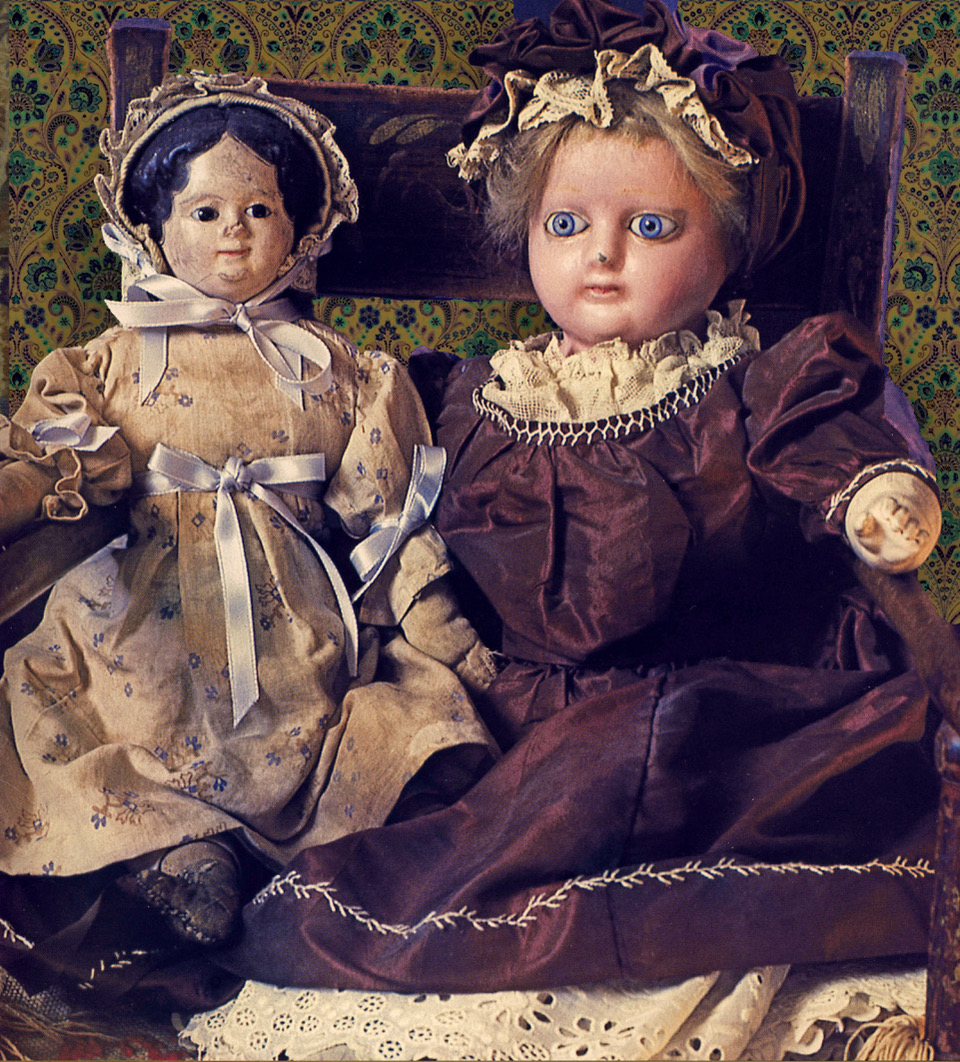
While the Hopewell Museum remains closed to the public during its ongoing renovation, a quiet portion of its collection has become the unexpected keeper of institutional memory: dozens of carefully wrapped dolls, resting in temperature-controlled storage, waiting to be seen again. And in an era when Labubu dolls dominate pop culture with their mischievous, wide-eyed charm, the museum’s older companions offer a gentler kind of charisma—stitched by hand, worn by time, and rich with the stories that shaped Hopewell Valley.
These dolls — some more than 150 years old, others mid-century works of couture-level craftsmanship — reflect not only the history of play, fashion, and craft, but also the personal histories of families who lived in Hopewell Valley. As the museum moves toward its anticipated 2026 reopening, they serve as a window into the kinds of stories that will help reconnect visitors with the reimagined space.
The rediscovery of the collection comes at a time when institutions everywhere are reassessing what it means to preserve material culture. For Hopewell Museum, founded in 1922, these objects do more than survive. They remember.
A long human tradition of dolls — from symbol to companion
Dolls are nearly as old as civilization itself. As the museum notes in its interpretive materials, “In 2025 BCE, tattooed Egyptian paddle dolls were entombed with the deceased, serving as helpmeets for rebirth in the afterlife.”
Across cultures and centuries, dolls have functioned as spiritual intermediaries, teaching tools, or heirlooms — sometimes admired at a distance, other times cherished through play. Whether carved of wood or shaped from porcelain, they have always been deeply human objects, meant to stand in for someone beloved, imaginary, aspirational, or divine.
Dolls arrive in Hopewell Valley — and tell a story of girlhood, class, and taste
The Hopewell Museum began receiving doll donations soon after its founding, many from local families who had preserved them over generations. Several of the finest examples in its collection trace to the late 19th century, when European dollmakers were at the height of their craft.
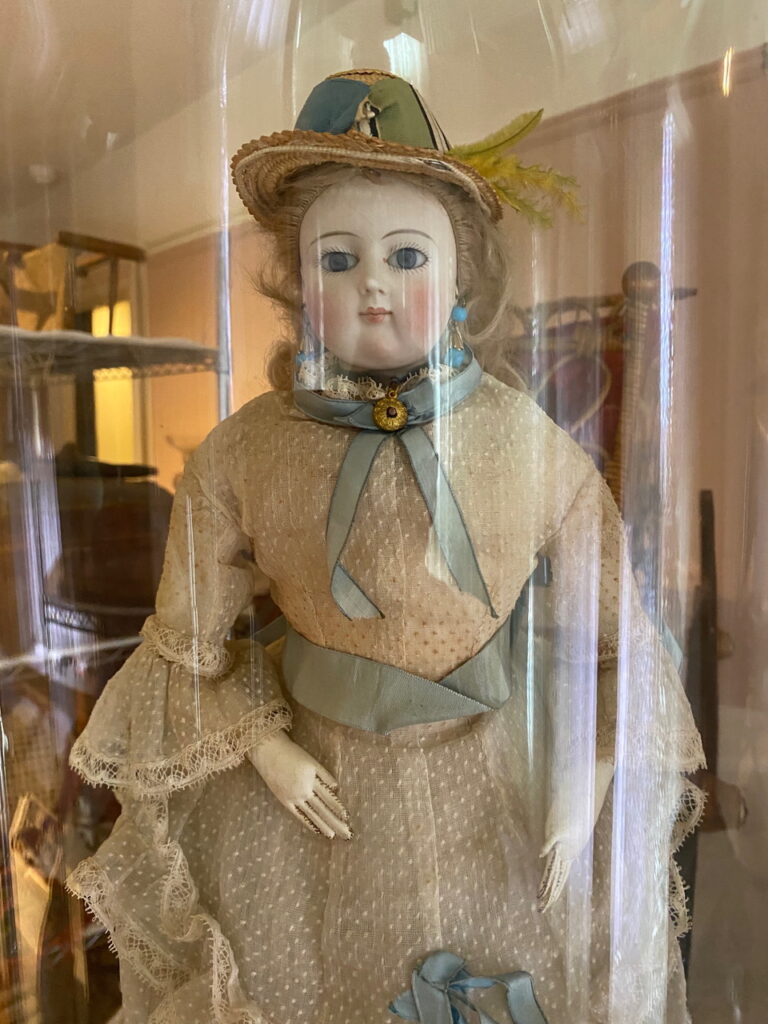
One highlight is a French fashion doll (or poupée) manufactured by the prestigious Jumeau Doll Company around 1887. It was donated by Hopewell resident Catherine (Stout) Van Doren, who received it as a child from a family friend returning from Paris. Such dolls were designed less for play than display — miniature symbols of sophistication and the latest French couture.
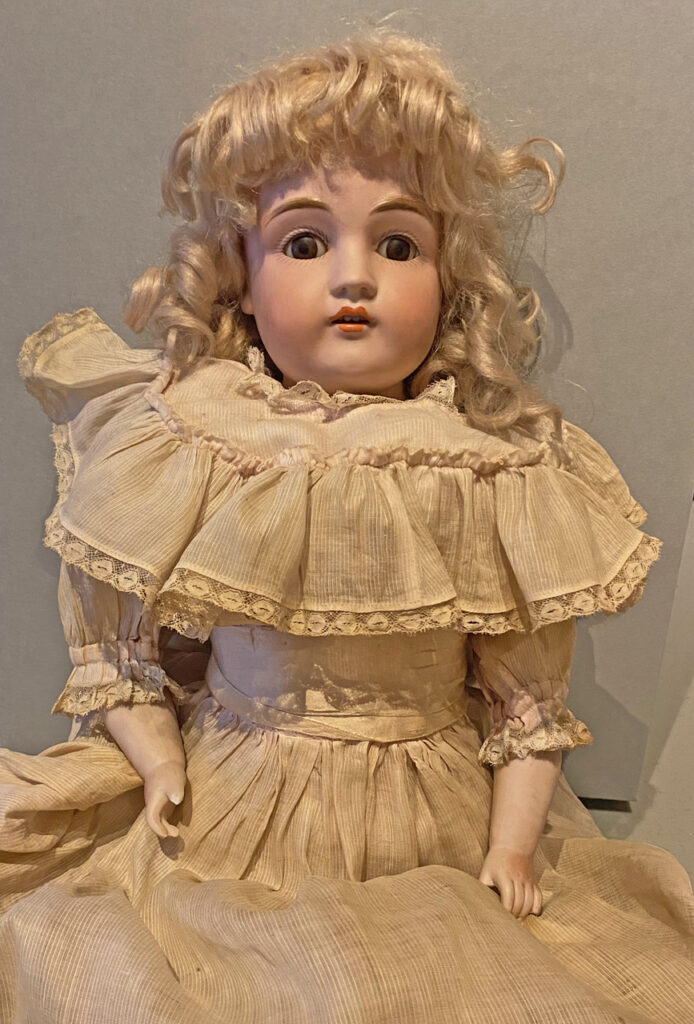
But by the 1870s, social and economic change gave rise to a new kind of doll: the bébé — more childlike, emotionally expressive, and meant to be held. Their realism made them companions, not just objects. As the museum’s historical notes describe, “Bébés’ large striking eyes, soft blushing complexions, and realistic dress and demeanor endow them with subjectivity.”
This shift reflected something deeper: parents, and especially mothers, had begun to view dolls as a way to model nurture, care, and domestic imagination for young girls. In an era when girls rarely had paths of agency outside the home, dolls offered one of the earliest forms of self-fashioning.
German craftsmanship reshapes the market
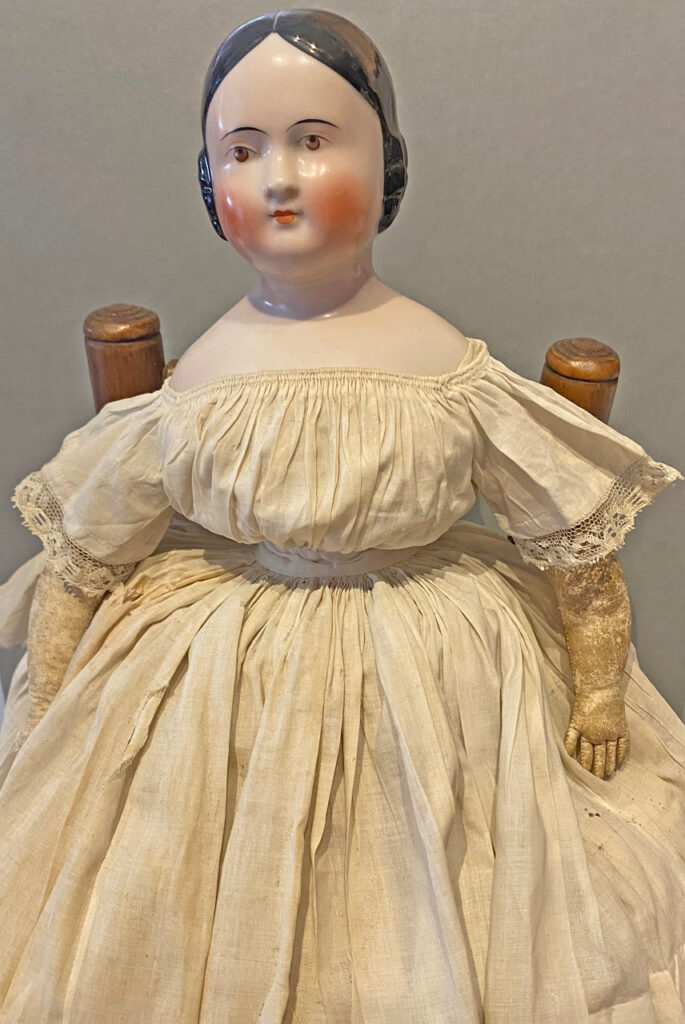
By the late 19th century, mass production made dolls more widely accessible. German manufacturers excelled in creating shoulder-head dolls — porcelain or bisque heads attached to cloth bodies — with detailed hairstyles and painted features. These were both beautiful and durable enough for daily play.
The museum’s collection includes several notable shoulder-head dolls, as well as a remarkably well-preserved example of a Parian-type doll, whose matte white bisque finish evokes sculpted marble. These details place Hopewell’s collection squarely within the broader transatlantic history of how girls learned social roles, skills, and self-presentation through what they held in their hands.
A couture tribute in miniature: The “12 Fashion Lady Mannequins”
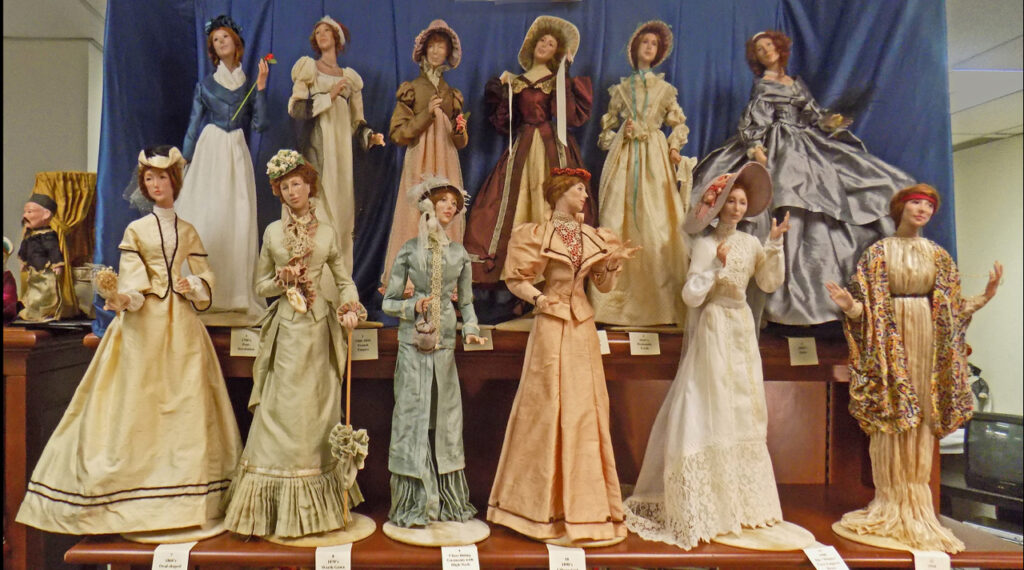
Perhaps the most extraordinary objects in the collection are not antiques at all, but a mid-20th-century artistic series: Lorraine Alippe’s “12 Fashion Lady Mannequins.”
Alippe — once a leading New York fashion illustrator for Dior, Schiaparelli, and Cassini — turned to dollmaking after the decline of fashion illustration in the 1960s. Each mannequin, roughly two feet tall, wears a meticulously researched costume representing a distinct decade between 1790 and 1910. Hand-sewn garments, miniature shoes and handbags, even carefully styled wigs transform these works from costume replicas into sculptural interpretations of women’s lives over time.
The set was donated to the Hopewell Museum by Frank Mahood, an expert doll restorer and longtime board member of the former Princeton Doll & Toy Museum, which once operated in Hopewell.
Slumbering for now — but central to the museum’s future
The doll collection is currently catalogued, wrapped, and boxed in storage while the museum proceeds with its $1.5 million Reimagination renovation project. When the museum reopens — expected in 2026 — curators anticipate a new interpretive approach that will reconnect objects to the lived experiences of Hopewell Valley residents and families who once cherished them. Plans for the dolls’ placement are still in development as part of a broader exhibition strategy.
What is certain is that they are poised to become among the most personally resonant objects in the museum’s revived galleries — bridging global history with the deeply local.