

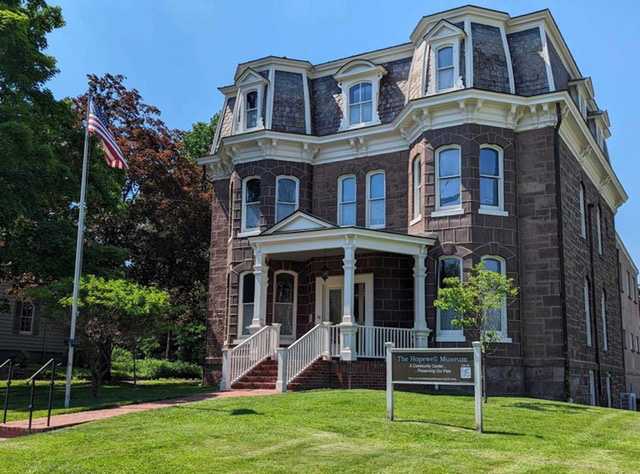
The Hopewell Museum has entered Phase Two of its multi-year Reimagination Project, moving from collection relocation to implementing a new design and developing future programs as it targets a reopening aligned with the United States’ 250th anniversary in the fall of 2026.
The new phase follows three years of cataloging, conservation, packing, and transporting artifacts and archives to secure off-site storage.
Incorporated in 1922 as the Hopewell Free Public Library and Museum Funding and Building Association, the organization formed to raise funds for a building to house a collection of antiques offered by Miss Sarah D. Stout. That collection became the nucleus of today’s Hopewell Museum. After its formation, the museum purchased the red brick bank building that now houses the Hopewell Borough Public Library. In 1965, the library and museum moved across the street to 28 East Broad Street, a Second Empire–style building constructed in 1877 by the Stout family. The building closed to the public in 2020 to begin a multi-phase renovation to modernize galleries, improve collections care, and expand accessibility.
What Phase One accomplished
Phase One focused on collections care: item-by-item cataloging and conservation, specialized packing, and moving the museum’s full holdings into climate-controlled storage. With the building cleared, it now serves as a clean slate for architects and exhibition planners.
- 2021: Building exterior restoration.
- 2022: Assessment of archaeology objects (Lenape/Delaware and early American); restoration of 18th- and 19th-century fine clocks.
- 2023: Cataloging of the ceramics collection; appointment of the museum’s first-ever executive director, Asher Lurie.
- 2024: Cataloging and remediation of the Hopewell Valley textiles collection (250-plus-year-old materials).
What Phase Two includes
Phase Two centers on installing the new interior plan and building out future programming. The museum plans to share updates as work progresses and as exhibition and public-event plans are finalized.
Artifact spotlight: two tall-case clocks
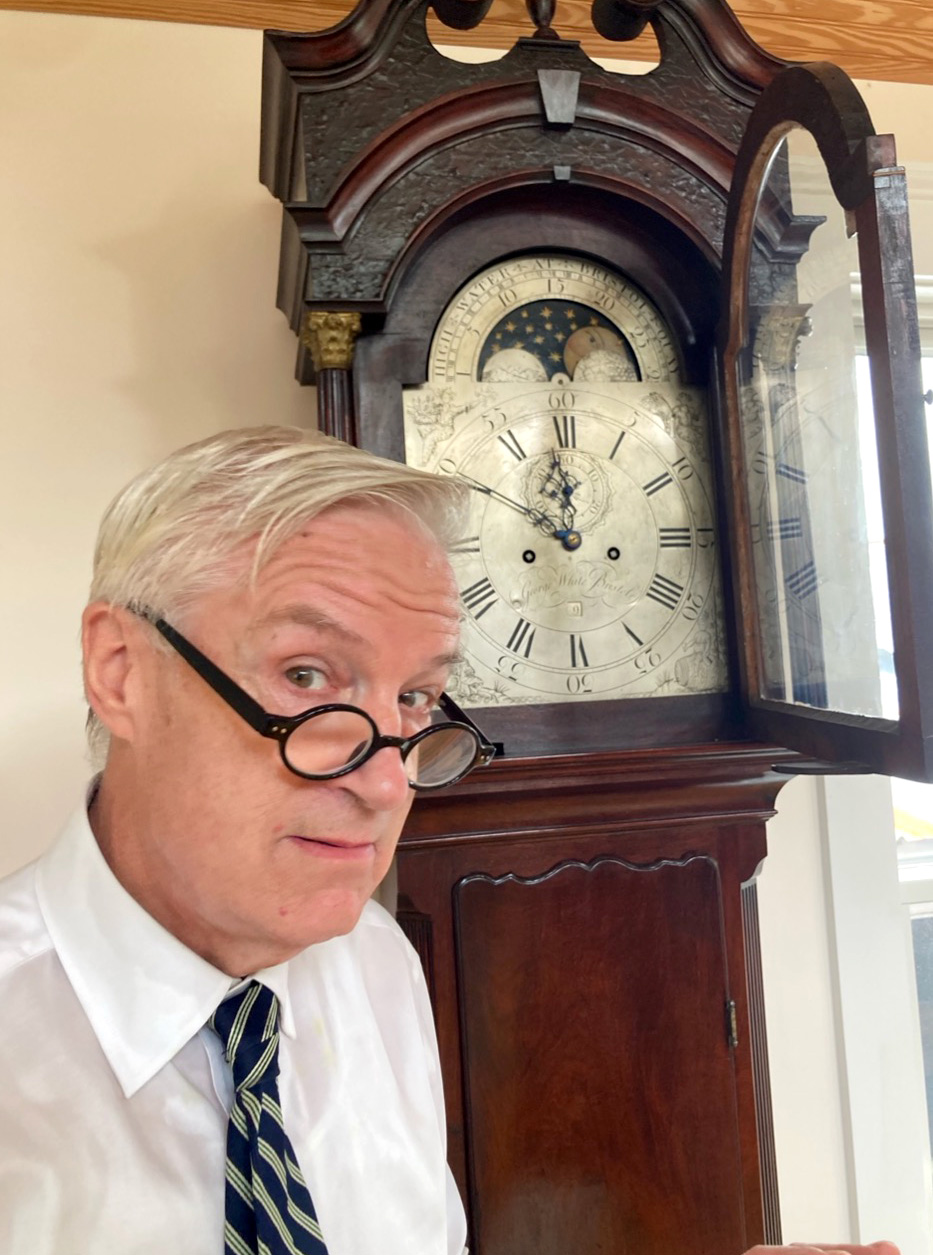
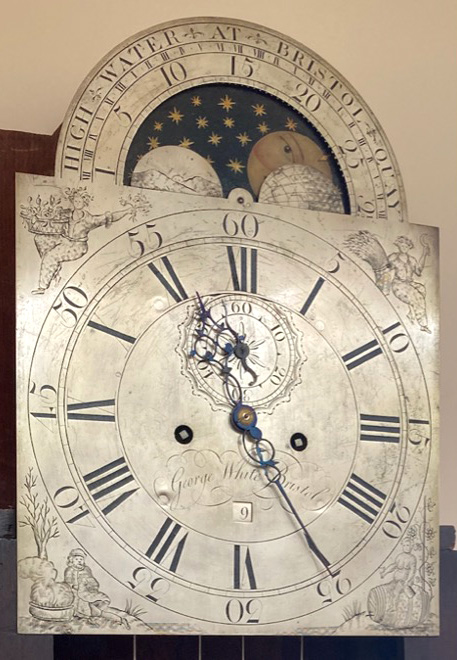
Ahead of the reopening, the museum is highlighting notable objects from the collection, including two tall-case clocks—one crafted in Bristol, England, around 1780 by clockmaker George White, and another from early-19th-century New Jersey by Flemington clockmaker Joakim Hill with a cabinet crafted by John Scudder of Westfield.
Of the Bristol clock’s circular moon-phase and tide dial, antiquarian horologist John Metcalfe said: “Knowing what phase the moon was in affected country life. For example: when to sow your crops. Or when you conceive a child—we’re all dependent on the moon phases. Tide dials, too. These were mostly done in clocks made by seaports. That was vital information, to know when you could sail or not. And that of course is related to the moon’s phases.”
Metcalfe noted the silvered brass dial—meant to be legible in candlelit rooms. “These 18th-century clocks have brass dials with silver overlay to make them legible in the dimly lit rooms of colonial America… That silvering effect you see on the face is done by a very thin chemical deposit of reflecting silver, which is then lacquered to stop it tarnishing. It was essential because otherwise you couldn’t read the time in the evening. We forget how dark everything was in the country, especially in an agrarian state like New Jersey.”
As for how the English clock came to New Jersey, possibilities include direct export around 1800, when Bristol’s port traded actively with America, or later importation during the American vogue for English antiques in the 1920s.
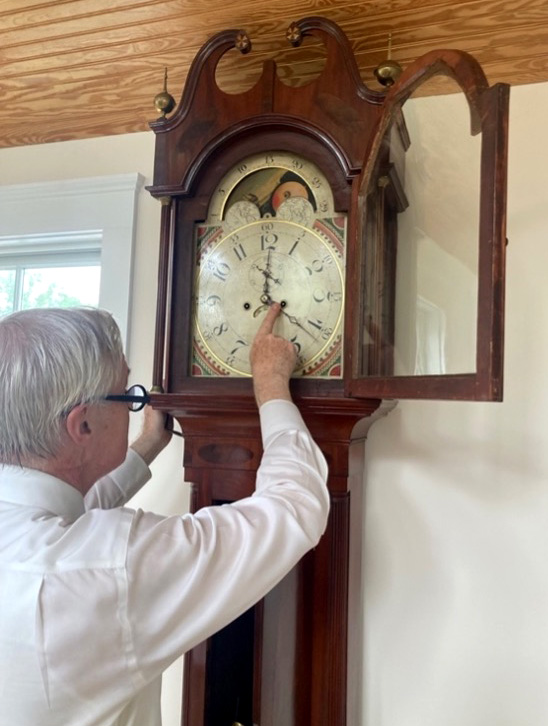
The New Jersey tall-case clock—owned by Elder John Boggs of the Old School Baptist Church in Hopewell—reflects the Sheraton style popular in the early 1800s, with a broken-arch swan-neck pediment and brass finials, an arched glass door with fluted columns, and inlaid mahogany work attributed to Scudder. “Curiously enough, New Jersey was far more of a clockmaking center than its neighboring states, far more than New York,” Metcalfe said. “Flemington’s Joakim Hill was very prolific, hugely successful, and his are all in the latest Sheraton style of that period.”
Why time once differed from town to town
Metcalfe offered a primer on standard time: “Of course, there was no time standard then. The time standard is a recent idea. You could set your clock, perhaps by a sundial. But then that was your local time… That all changed with telegraphic communication and the railways—and then it became important because there were a number of crashes. And that made America see they had to establish a time standard.” He pointed to a clock on the façade of Bristol’s Corn Exchange with two minute hands—one showing local solar time, the other railway (London) time—until standardization made dual readings unnecessary.
Craft and mechanism
Both clocks use a weight-driven movement regulated by a pendulum and an anchor escapement that “beats” seconds. “That was the formula that has endured to this day in making of these things,” Metcalfe said. “Up until the early 20th century—with the development of quartz clock technology—pendulum clockworks offered the most accurate timekeeping in the world.”
Recent conservation work
Metcalfe repaired the clocks’ mechanicals between March 28 and Oct. 22, 2022, then installed the mechanicals and got them in running order in conserved cases on May 27, 2023. Because tall-case clock conservation involves different materials, cabinetmaker David Duggan of Duggan Furniture in Marriottsville, Md., conserved the mahogany cases. On June 28, 2025, Metcalfe directed their careful disassembly, transport, and reassembly in storage, preserving hallmark details while preparing the pieces for future exhibition.
The museum is planning future updates and previews of other artifacts in the collection as the construction continues. Learn more about the museum at https://thehopewellmuseum.org/.