

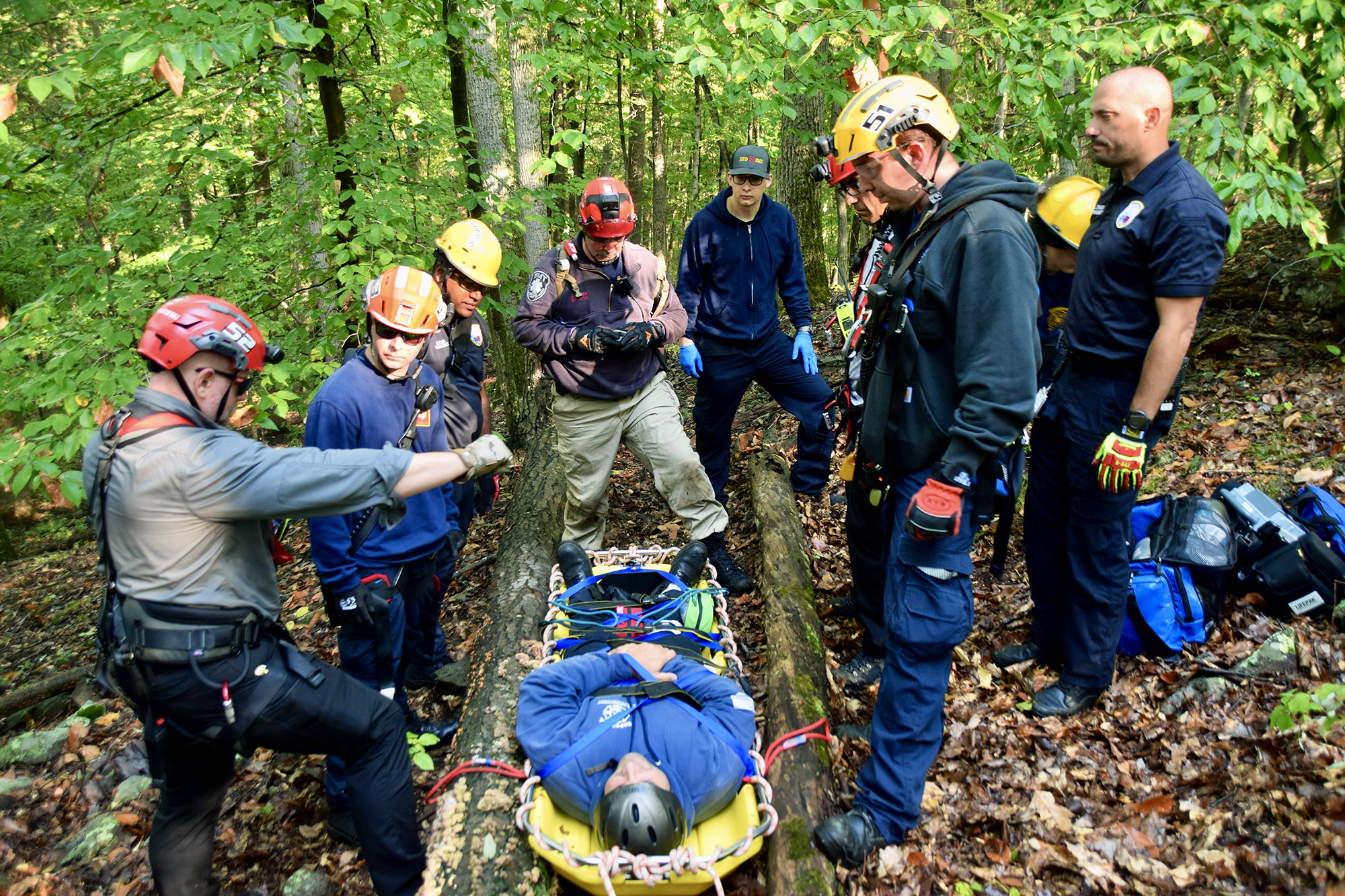

More than 60 members of Hopewell Valley’s Fire, EMS, Emergency Management, and Police agencies conducted a scenario-based search and rescue drill at the Woosamonsa Ridge Preserve last weekend.
The preserve simulated rescuing a hiker who had gone off the trail and suffered an injury, as well as a secondary scenario in which a rescuer also became injured. Both situations were successfully managed and were part of a broader training effort to prepare for rare but high-risk emergencies.
Building the Task Force
Since October 2021, a group of members from all Hopewell Valley Fire/EMS organizations has worked toward a common goal to improve water rescue operations. The effort grew out of lessons from major storms — including hurricanes Irene, Sandy, and Ida — that caused widespread flooding and water-related emergencies in the region.
That initiative has become the Hopewell Valley Technical Rescue Task Force (HVTRT), which provides highly trained personnel for water, ice, rope, and boat-based search, rescue, and recovery. With Sunday’s drill, the HVTRT is moving into its next phase: land-based search and rescue.
All Agencies at the Table
“The HVTRT is a task force composed of members and assets from all Hopewell Valley emergency services organizations working together,” explained Lt. Robert Bailey, from Hopewell Valley Emergency Services. The participating agencies include the Hopewell Fire Department and Emergency Medical Unit, the Pennington Fire Company, the Union Fire Company & Rescue Squad, and the Hopewell Valley Emergency Services Unit.
“Members of the task force work, train, and respond together when requested,” Bailey said. “The team approach has allowed us interoperability of personnel from different organizations — from using similar equipment to following joint guidelines when operating on incidents.”

Why Expand to Land-Based Search and Rescue?
Bailey said the expansion was a logical step, given the Hopewell Valley’s geography and trail system.
“Land-based search and rescue was originally identified as a discipline the task force should perform due to the vast amount of trails within Hopewell Valley and previous cases of lost, disoriented, and injured citizens on them,” he said. “We found it was also the discipline the task force organizations had the least amount of personnel trained in when the task force was first started. Now that knowledge, skills, and abilities in the other disciplines have been accomplished by a majority of personnel, we have started to work towards proficiency in land search and rescue.”
The Importance of Training Together

Bailey noted that technical rescues are considered “low frequency, high risk” — they don’t happen often, but when they do, they can be extremely dangerous. That makes joint training critical.
“It is important for personnel to train in these disciplines for a couple reasons,” Bailey said. “One, to provide effective, efficient, and quality services to the community to ensure the best possible outcome in emergency situations. Secondly, to ensure the safety of the rescue personnel operating at these incidents. Since it is not something rescue personnel are performing routinely, they must train to be proficient so they can perform operations in a safe and effective manner.”
Getting Involved
The HVTRT continues to grow, expanding both its capabilities and its membership. Anyone interested in supporting the initiative is encouraged to reach out to their local Fire/EMS organization. Learn more at https://penningtonfire.org/,https://www.ufcrs.org/, https://www.hopewellfire.com/.