

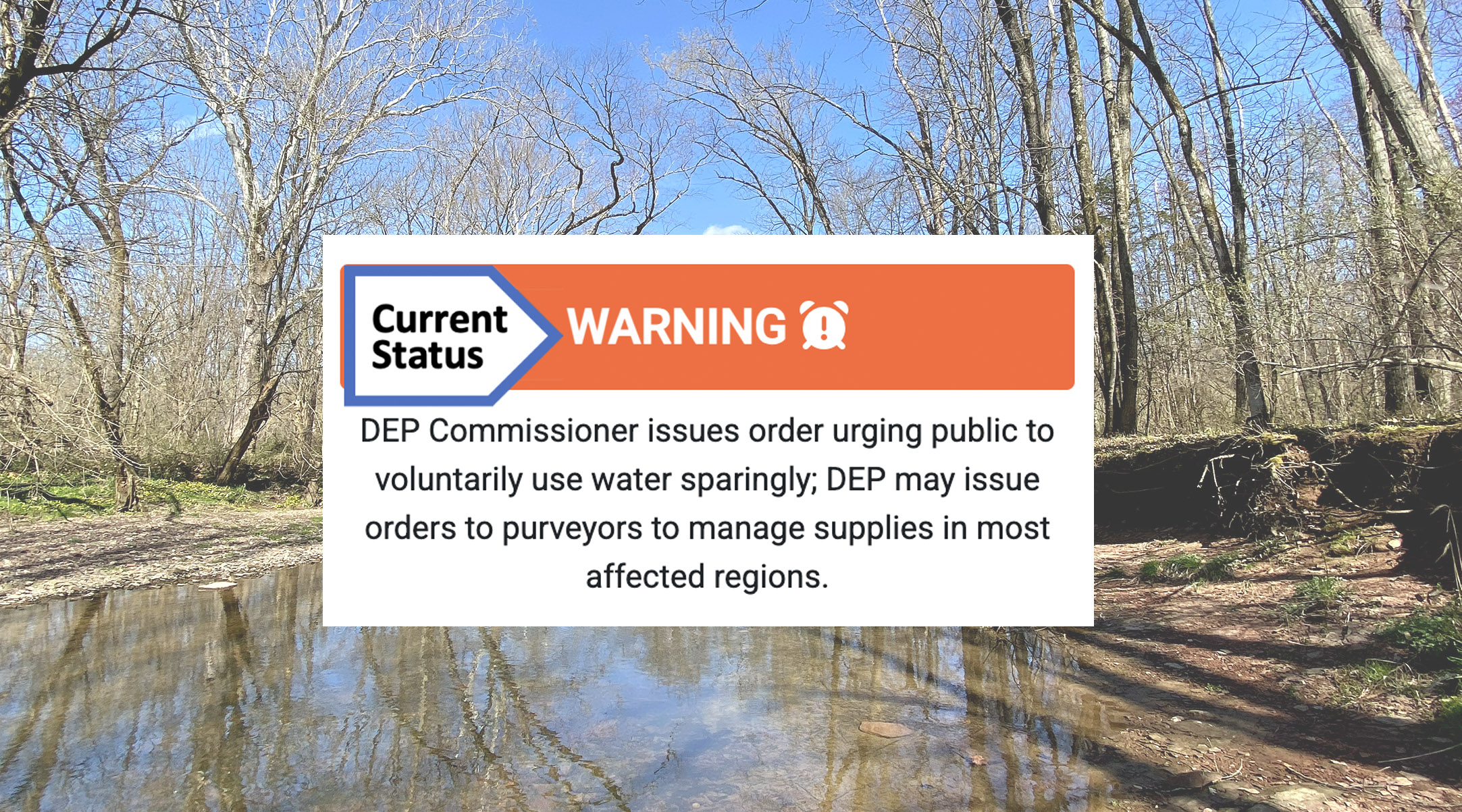
One day after state officials fielded testimony from water suppliers, environmental groups, and residents warning that drought conditions were worsening across New Jersey, the Murphy Administration on Friday formally declared a statewide Drought Warning, asking residents and businesses to immediately reduce nonessential water use.
The move elevates the state from the Drought Watch issued Oct. 1 and gives the Department of Environmental Protection (DEP) expanded authority to coordinate water transfers, manage reservoir releases, and step in if any region faces a supply shortfall.
There are no mandatory restrictions yet, but officials emphasized that voluntary conservation now may help avoid stricter measures later.
DEP: Indicators Have Turned “Severely or Extremely Dry” Statewide
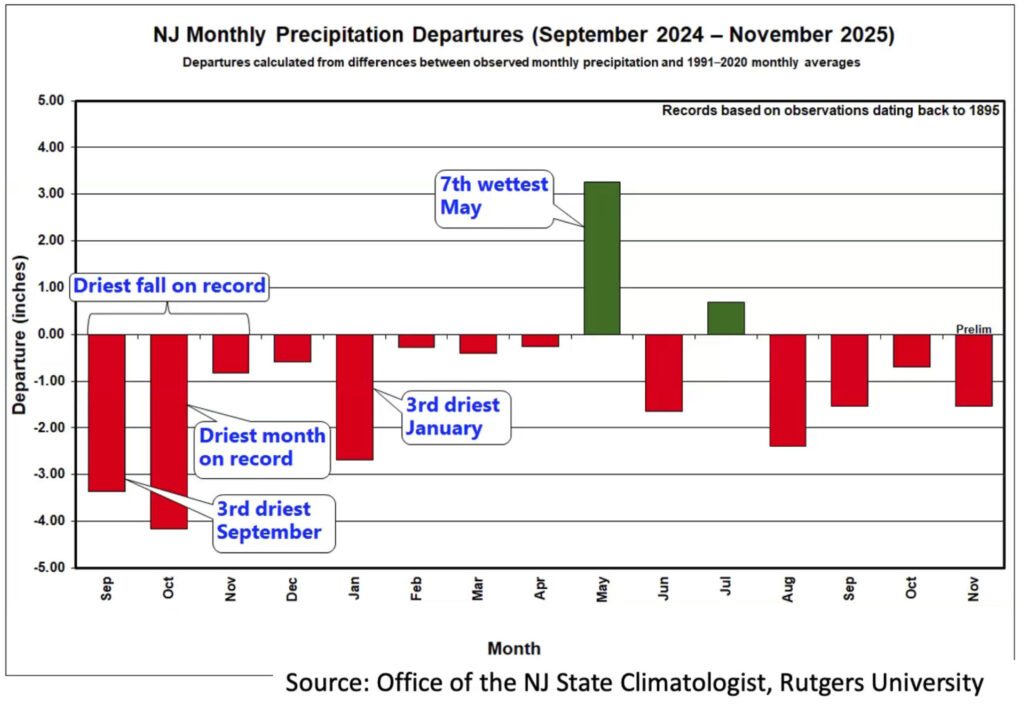
Friday’s declaration follows months of declining groundwater, shrinking stream flows, and reservoir levels that have fallen below anything recorded during last year’s drought period.
State Climatologist Dr. David Robinson said nearly every drought indicator has deteriorated over the past 15 months.
New Jersey has seen only two months of above-average precipitation during that period, Robinson noted, and while the record rain in May briefly helped, “…it wasn’t sufficient to completely alleviate the ongoing drought conditions.”
Reservoir systems tell the clearest story:
- Northeast region reservoirs — the core of the state’s drinking water supply — have dropped to 48% of capacity, compared with a normal level of 72% for early December.
- In the critical North Jersey District Water Supply Commission system, levels are now at their lowest point since the last Drought Warning.
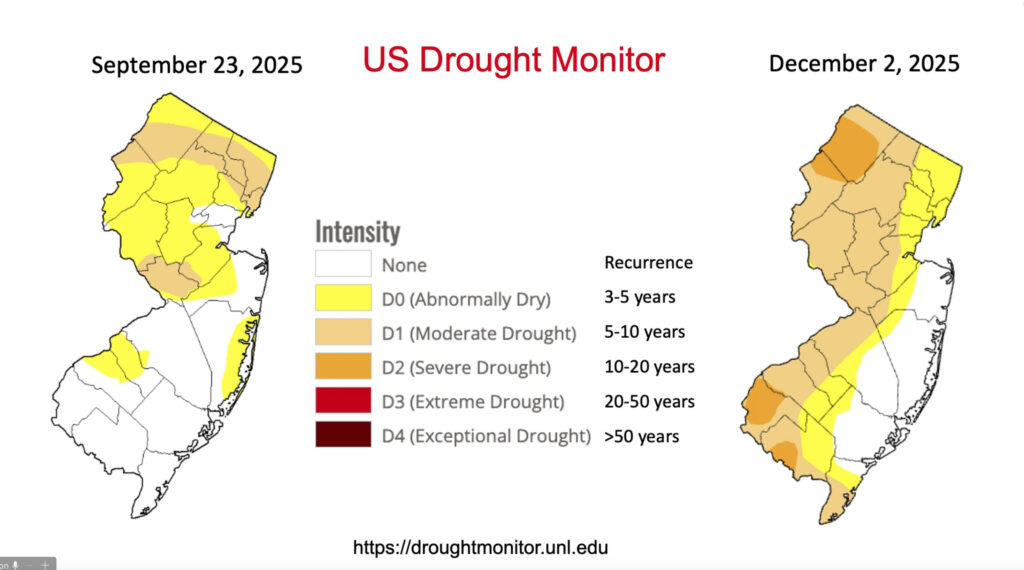
Conditions are less severe in Central and Coastal North regions, which include parts of Mercer County, but are still below normal. Groundwater-fed regions in the Northwest, Southwest, and Coastal South show extremely dry aquifers and stream flows.
At Thursday’s public hearing, State Geologist Steven Domber cautioned that the indicators show “broad, persistent deficits” across all regions.
A Warning Means DEP Begins Actively Managing Water Systems
The Drought Warning does not impose restrictions, but it immediately allows the DEP to:
- Coordinate water transfers between systems
- Adjust reservoir releases to preserve storage
- Modify stream-flow requirements downstream of reservoirs
- Intervene if any region approaches a supply shortfall
DEP Commissioner Shawn LaTourette, who signed the Administrative Order authorizing the Warning, said the uncertainty of the past year reflects the pressure climate change is placing on the state’s water infrastructure.
“We ask residents, businesses, and our partners in local government to join us in spreading the urgency of the need to conserve water,” LaTourette said.
What a Drought Warning Means for Mercer County and the Hopewell Valley
Mercer County sits within the Central drought region, where reservoir systems controlled by the New Jersey Water Supply Authority are at 79% of capacity — below the normal 89% for this time of year.
While not facing the steepest reservoir declines in the state, the region’s groundwater and stream flows have been trending downward, mirroring concerns raised at Thursday’s hearing.
Municipalities across Mercer County — many of them dependent on blended sources of surface water and groundwater — are being urged to take early action to reduce demand, especially before outdoor water use picks up again in spring.
For Hopewell Township and Hopewell Borough, where private wells and fractured-rock aquifers play an outsized role, prolonged precipitation deficits can lead to slower recovery times and more stress on shallow groundwater sources.
Residents Asked to Conserve — Here’s What DEP Recommends Now
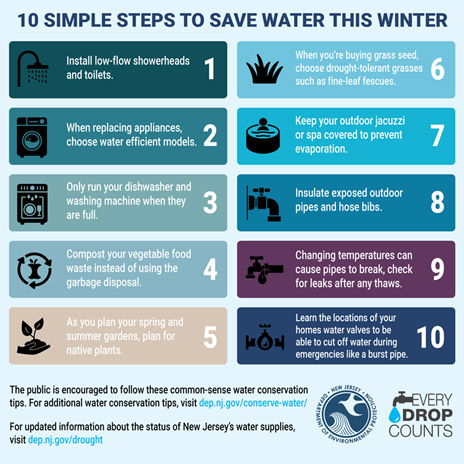
State officials issued a winter-focused conservation list, asking residents and businesses to reduce indoor water use and prevent leaks.
Among the recommendations:
- Only run dishwashers and washing machines when full
- Fix leaky faucets and pipes; consider low-flow toilets and showerheads
- Winterize and shut off irrigation systems
- Insulate outdoor pipes and hose connections
- Use car washes that recycle water
- Compost vegetable scraps instead of running garbage disposals
- Cover outdoor spas to limit evaporation
- Choose native and drought-tolerant landscaping for spring planting
For households on private wells — more common in the Hopewell Valley than in many parts of the state — the DEP stresses early conservation to prevent strain during the winter and early spring recharge periods.
What Comes Next
A Drought Warning is intended to slow the decline of water supplies and avoid emergency restrictions. But NJDEP officials made clear that if conditions worsen — or if winter precipitation fails to rebound — the state may need to consider mandatory limits on outdoor water use in the coming months.
For now, LaTourette and Gov. Phil Murphy are urging residents to act voluntarily.
Murphy said the DEP is closely monitoring drought indicators and water supplies and urged residents to begin conserving now.
Detailed water-supply data, conservation resources, and the full Administrative Order are available at njdrought.org.