
New Jersey has issued a statewide Drought Watch strongly urging residents and businesses to voluntarily conserve water as a result of prolonged below-average precipitation that is stressing water supplies. The issuance of the Drought Watch comes less than three months after the lifting of a statewide Drought Warning.
“Over the past year, New Jersey has experienced extreme weather variability that is consistent with a changing climate,” Environmental Protection Commissioner Shawn M. LaTourette said.“Last fall and winter were among the driest on record, leading to a Drought Warning in November that was followed by a very wet May and even severe flash flooding in parts of the state in July. But with the return of prolonged dry conditions over the latter part of this summer and early fall, water supplies are showing signs of stress again.”
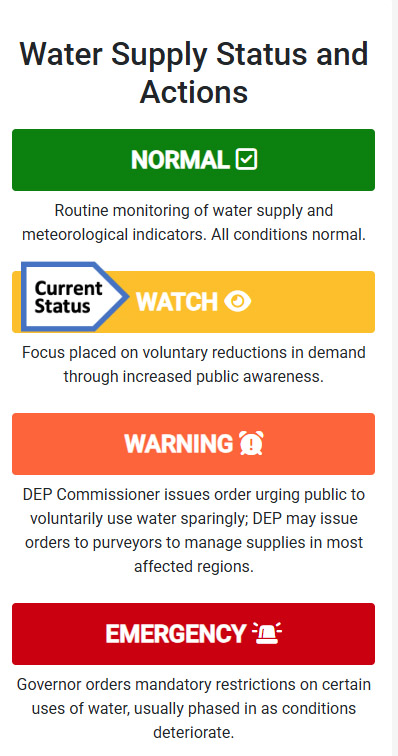
The declaration of a Drought Watch is intended to increase public awareness and appreciation of the stress water supply sources are facing. The issuance of a Drought Watch encourages the public to practice voluntary water conservation measures. If conditions do not improve, the state could declare a Drought Warning followed by a Drought Emergency, under which mandatory water use restrictions would become necessary.
Precipitation Variability Over the Past Year
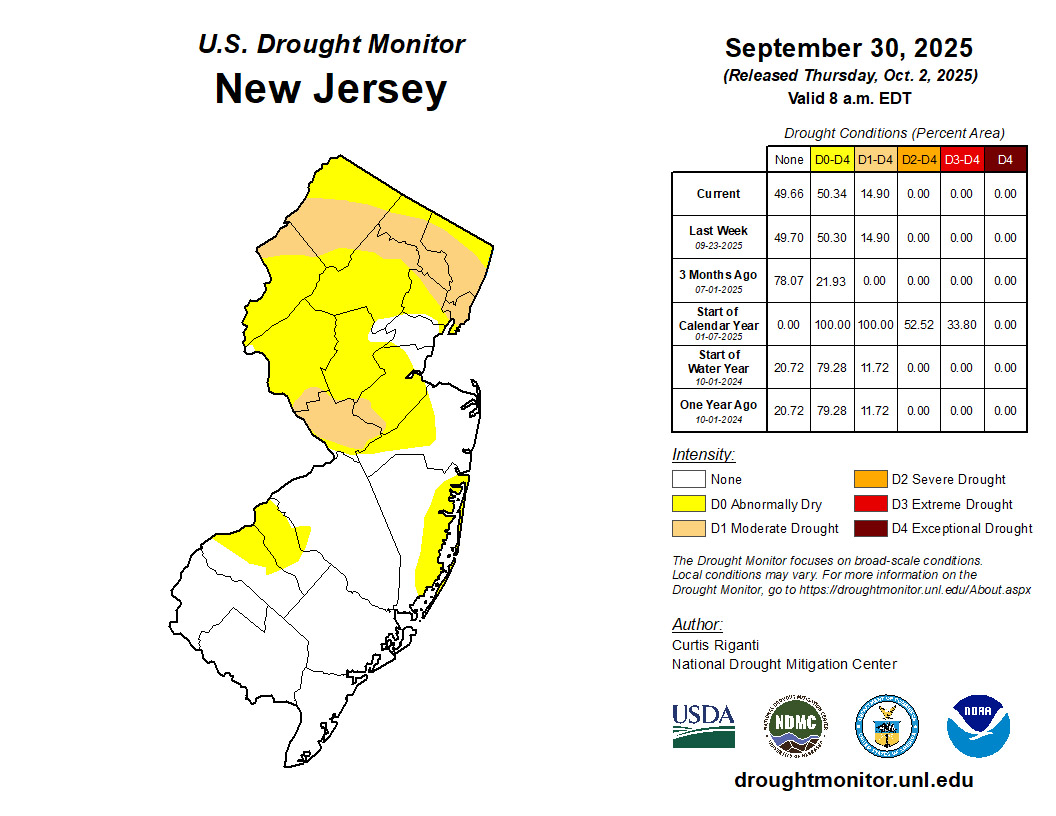
Rainfall across New Jersey has been one inch to six inches below normal over the past 90 days, contributing to diminished streamflow, reservoir, and groundwater levels. Moreover, the state has experienced below-average precipitation during ten of the last 12 months, while at the same time temperatures have remained mostly above average.
“A dry late summer and early fall, along with most over the past year coming in with below normal precipitation, are contributing to water resource concerns across the state,” said State Climatologist David Robinson.
“The Governor’s drought declaration is a stark reminder that climate change is reshaping New Jersey’s water future. Longer dry spells, hotter summers, and more extreme swings between drought and flooding are no longer predictions — they’re here,” said Jim Waltman, executive director at The Watershed Institute. “At The Watershed Institute, we urge bold action to not only conserve water today, but to invest in long-term solutions like green infrastructure, watershed protection, and stronger policies that build resilience for the generations to come.”
Average precipitation over the last 90 days has ranged from Moderately Dry to Severely Dry. Average stream flows across the state are also either Moderately or Severely Dry. Reservoirs in the Northeast and Coastal North regions are Moderately Dry. Unconfined groundwater across the entire state is rated as Severely Dry. Though rainfall in the Coastal South has been near average, groundwater has been remarkably slow to improve.
New Jersey entered a Drought Watch on Oct. 17, 2024, as a result of rainfall that was significantly below normal over the preceding summer. By the following month, the DEP placed all of New Jersey under a Drought Warning due to ongoing precipitation deficits and deteriorating water supply conditions, particularly storage levels in reservoirs.
The warning was lifted June 11 following the significant spring precipitation throughout most of the state, though a Drought Watch remained in the Coastal South region.
Climate Change and Precipitation Variability
As outlined in the 2024 New Jersey Statewide Water Supply Plan, New Jersey is experiencing the impacts of climate change on water supplies. Recent years have shown a trend of increasingly intense rainfall events followed by periods of little or no rain.
With the increased uncertainty posed by these weather patterns, it can become challenging for water supply managers to ensure the availability of water resources during dry periods.
The Department of Environmental Protection continues to closely monitor current drought indicators, which include precipitation, stream flows, reservoir levels, ground water levels, and water demand.
The DEP will continue to inform the public, local governments, and water systems of future actions to mitigate the risk of more severe conditions. Municipalities or water utilities may require additional restrictions depending upon local water supply conditions.
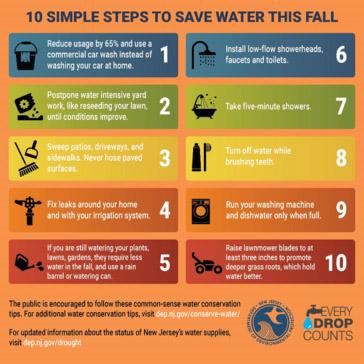
Fall Water Conservation Tips
Residents and businesses can practice many common-sense conservation measures to reduce indoor water use. It should be noted that the water needs of plants decrease at this time of year; however, it is recommended that you delay intensive irrigation activities, such as lawn reseeding until conditions improve. Adjustments to automated watering or sprinkler systems should be made accordingly.
Also, those who want to wash their vehicles are encouraged to do so at a commercial carwash as those businesses typically use water more efficiently.