
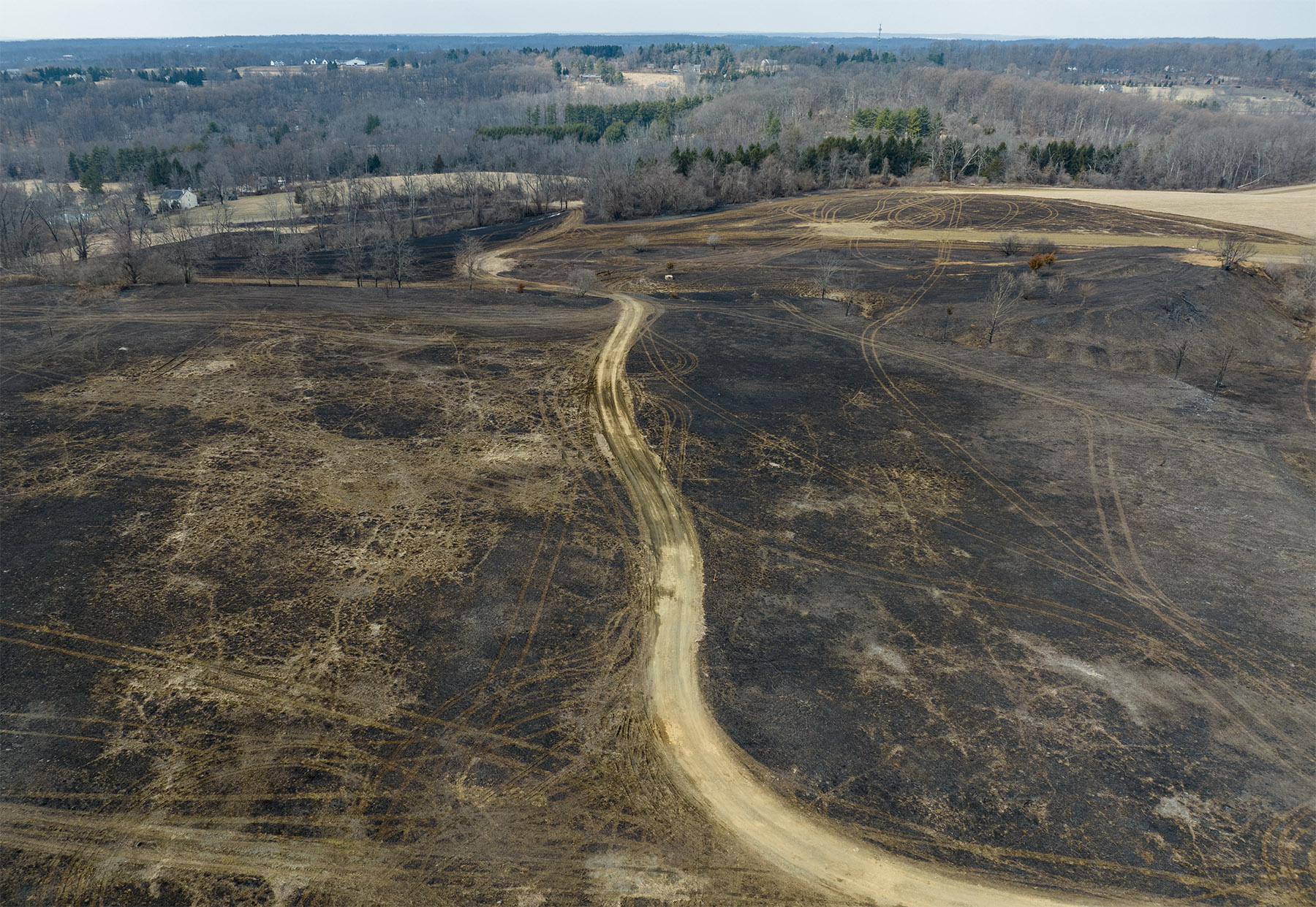
Last year, in early 2025, a wildfire scorched woodlands along Woosamonsa Road in Hopewell Township, leaving many residents shaken and reminded of how quickly fire can threaten homes, habitats, and peace of mind.
So why are local conservation organizations and landowners now intentionally planning to bring fire back to parts of the landscape this year?
Because wildfire and prescribed fire are very different flames.
Words like “out of control,” “threatening,” and “loss of property” often come to mind when we think about wildfire. Conservation professionals and ecologists, however, tend to associate prescribed fire with a different set of outcomes: reducing fuel loads, managing invasive species, improving plant diversity, enriching soil nutrients, and restoring long-standing land stewardship practices, including those historically used by Indigenous communities.
Wildfire is, by definition, fire that starts unexpectedly or spreads beyond control. Driven by weather conditions, wind, humidity, and available fuel, these fires can become destructive very quickly — a reality communities across the country know all too well.
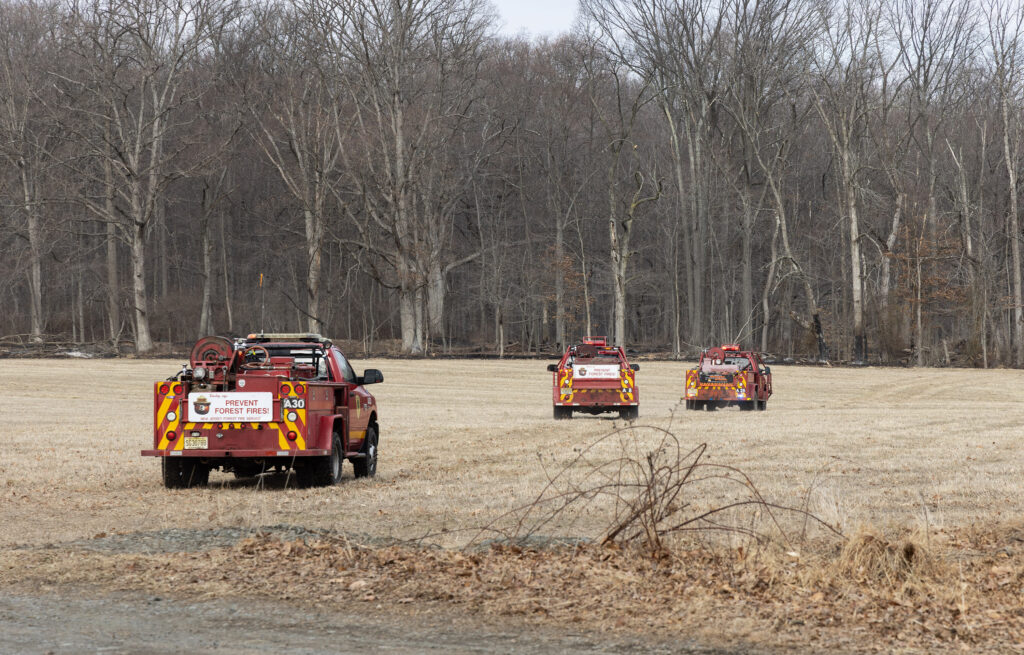
Prescribed fire, by contrast, is intentional. It is carefully planned and carried out only when weather and environmental conditions make its use safe and effective. In New Jersey, prescribed burns are conducted by the New Jersey Forest Fire Service, which works on state, county, municipal, nonprofit, and private lands. Legislation enacted in 2018 strengthened protections for practitioners and recognized fire as an important tool not only for wildfire prevention but also for ecological stewardship.
Regional land managers, including D&R Greenway and Mercer County, have used prescribed fire in recent years. In 2026, Friends of Hopewell Valley Open Space (FoHVOS) hopes to introduce prescribed burns on selected preserves as part of ongoing land management efforts.
Prescribed fire has proven particularly valuable in meadow and grassland stewardship. Maintaining healthy meadows often requires controlling encroaching woody vegetation. For decades, mowing with heavy equipment was one of the few available options. While effective in the short term, repeated mowing can compact soils, reduce their ability to absorb stormwater, and contribute to the buildup of dead plant material known as thatch. Thick thatch layers can inhibit seed germination and disrupt natural decomposition cycles, ultimately reducing habitat quality and plant diversity.
A carefully timed late-winter or early-spring burn can remove thatch, expose soil to sunlight, and return nutrients to the ground. These conditions often encourage stronger seed germination and earlier growth of warm-season grasses.
Fire can also help control invasive shrubs. As flames move across a landscape, heat can damage stems and bark, sometimes killing plants outright. In other cases, prescribed fire serves as the first step in a broader management strategy, followed by targeted herbicide treatments later in the growing season.
Having participated in several prescribed burns in central New Jersey, I have seen firsthand how dramatic walls of flame can move across a landscape with surprisingly gentle ecological effects. Flames can rise dozens of feet high and produce an unmistakable roar, yet minutes later the ground may already be safe to walk. Grassy meadow vole nests, lightly charred on the outside, can remain cool within. Cottontail rabbits often shelter in small depressions or moist pockets of soil as fire passes. Birds such as Savannah sparrows may return almost immediately, perching on newly burned shrubs. During one burn, Northern harriers were observed hunting low over the charred meadow, taking advantage of newly visible prey.
Concerns about wildlife safety are understandable. In practice, however, the sound and movement of an approaching fire typically alert animals in time for them to move to safety. Some species have adapted remarkably well to periodic fire, which has long been a natural part of many ecosystems.
While wildlife is well adapted to these conditions, humans are not. Residents may begin seeing signage and public alerts about scheduled prescribed burns later in the winter. The Forest Fire Service provides advance notice to nearby property owners and local emergency services. Land managers then post closure notices and share updates through email and social media. When a park or preserve is closed for a controlled burn, it is essential for visitors to respect those closures before, during, and immediately after the operation. Fire professionals determine when it is safe for public access to resume.
Prescribed fire can be an unsettling sight, particularly in a community that has recently experienced wildfire. Yet when used carefully and responsibly, it remains one of the most effective tools available for restoring healthy landscapes and reducing future wildfire risks. Understanding the difference between destructive wildfire and intentional, science-based prescribed fire is an important step toward living more safely — and more sustainably — within our local environment.