
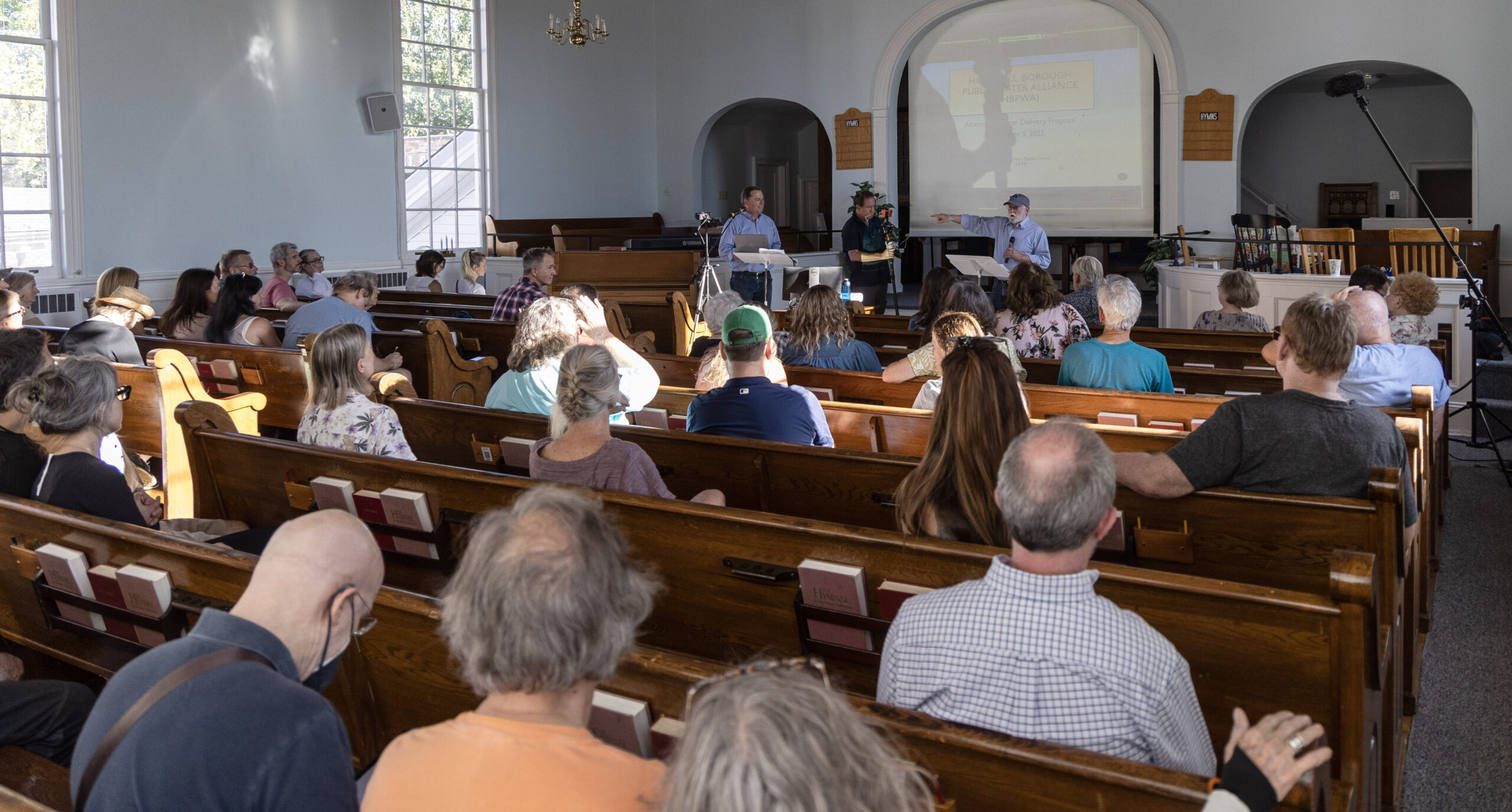
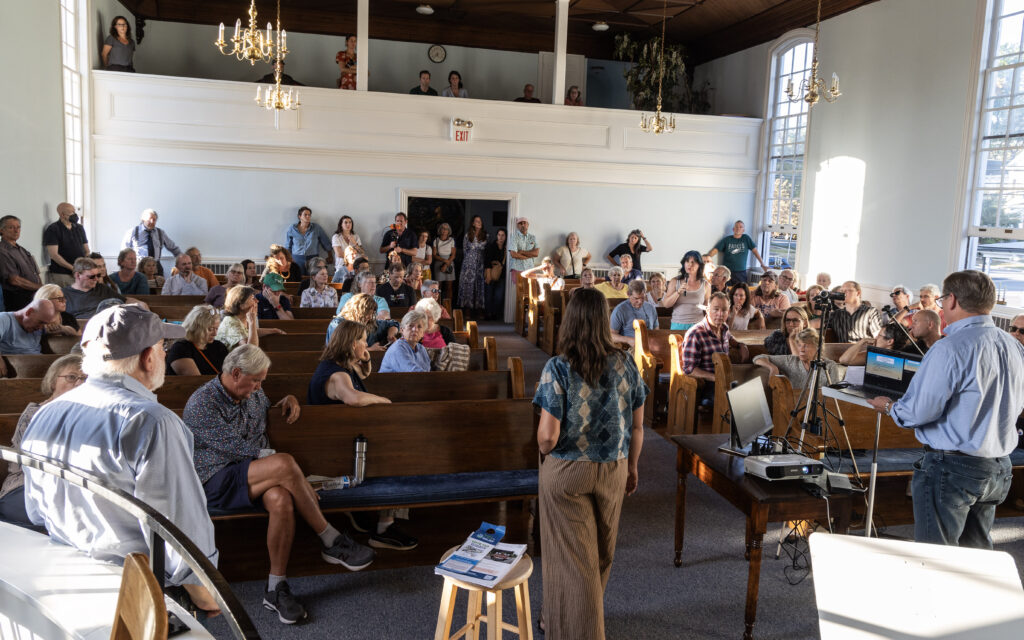
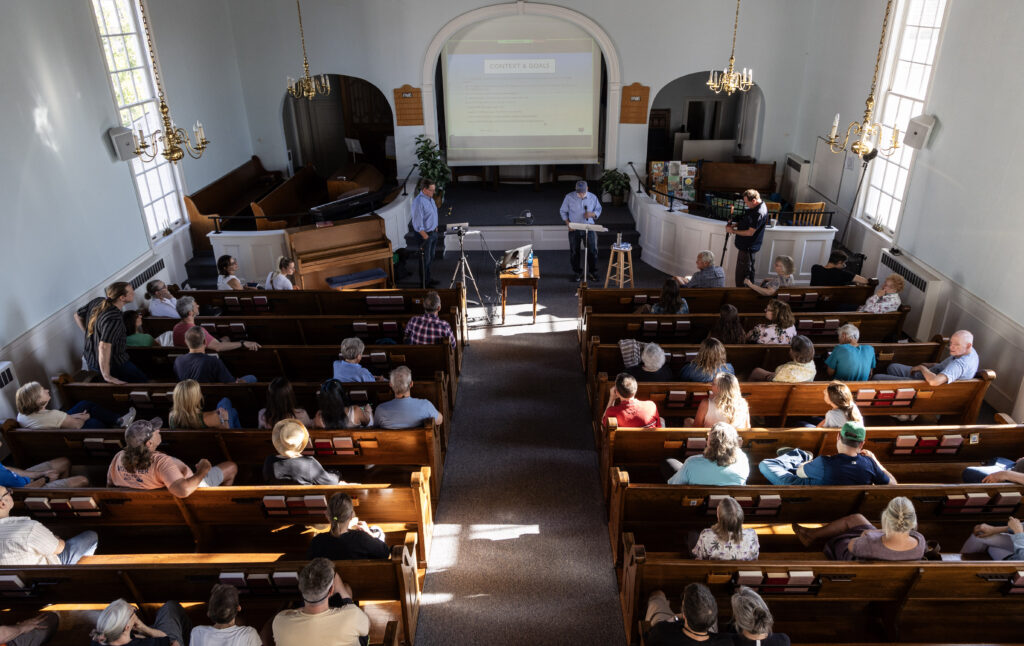
More than 120 residents filled the pews of First Calvary Baptist Church on Sunday afternoon for a community forum organized by the Hopewell Borough Public Water Alliance (HBPWA), the volunteer group urging residents to vote “No” on the proposed sale of the Borough’s water system to New Jersey American Water (NJAW).
The meeting, billed as “Save Our Water: There Is an Alternative to Selling Our Water,” marked the Alliance’s first public presentation outlining what members described as a locally driven, financially feasible plan to keep the system public.
The more than 2.5-hour session was at times technical and at times emotional—a mix of cost modeling, environmental advocacy, and spirited public questioning that underscored just how deeply the issue has resonated in the small, 1.8-square-mile borough.
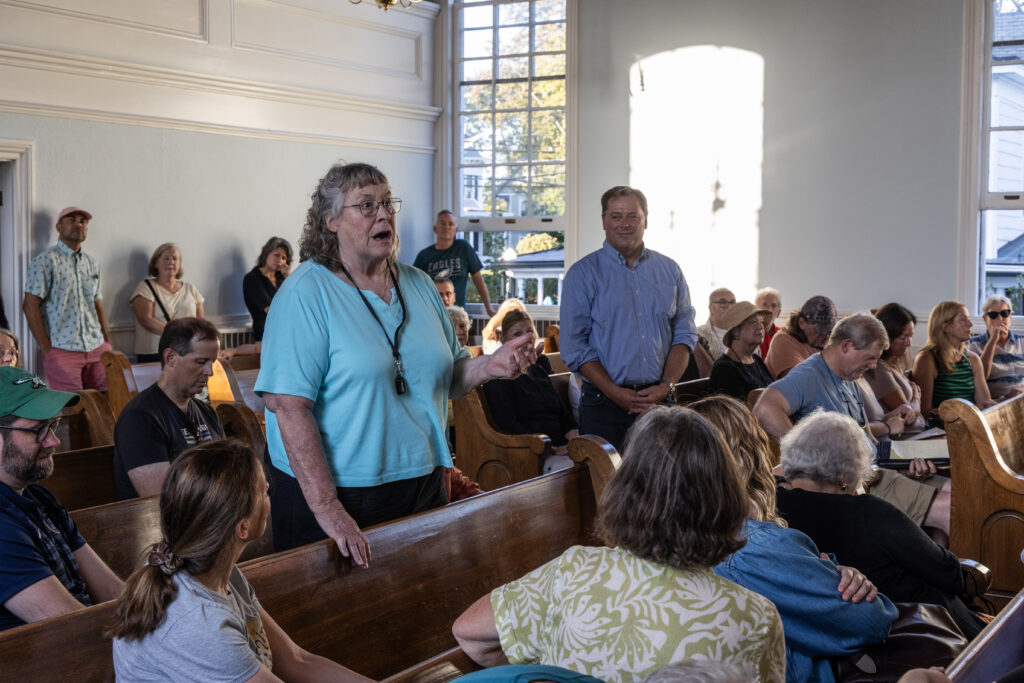
While the event remained largely respectful, there were moments of tension. Several Borough Council members attended as residents—acknowledging who they were when speaking—and Mayor Ryan Kennedy rose midway through to stress what he called “the part of the story not being discussed”: the immediate debt relief the Borough would receive through the sale.
The Question on the Ballot
On November 4, Hopewell Borough voters will decide whether to approve a $6.4 million sale of the Borough’s aging water system—including its wells, mains, and storage tank—to New Jersey American Water.
The sale has been endorsed by the Borough Council as a fiscally responsible, long-term solution to address aging infrastructure, regulatory compliance, and rate stability for residents.
If approved, the deal would end more than a century of locally operated public water service and shift management to the state’s largest private water utility. The Alliance led a successful petition earlier this year forced the question to appear on the ballot, giving voters final say.
“Vote No Means Pause”
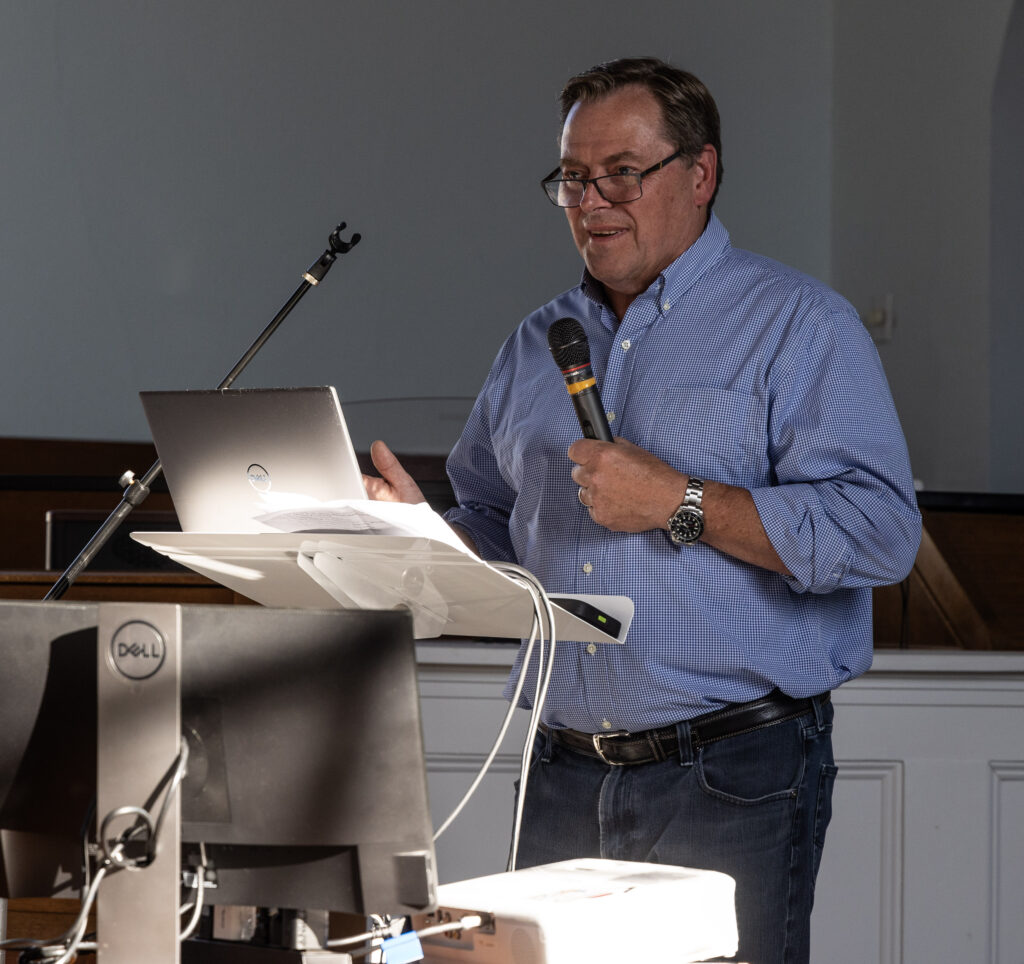
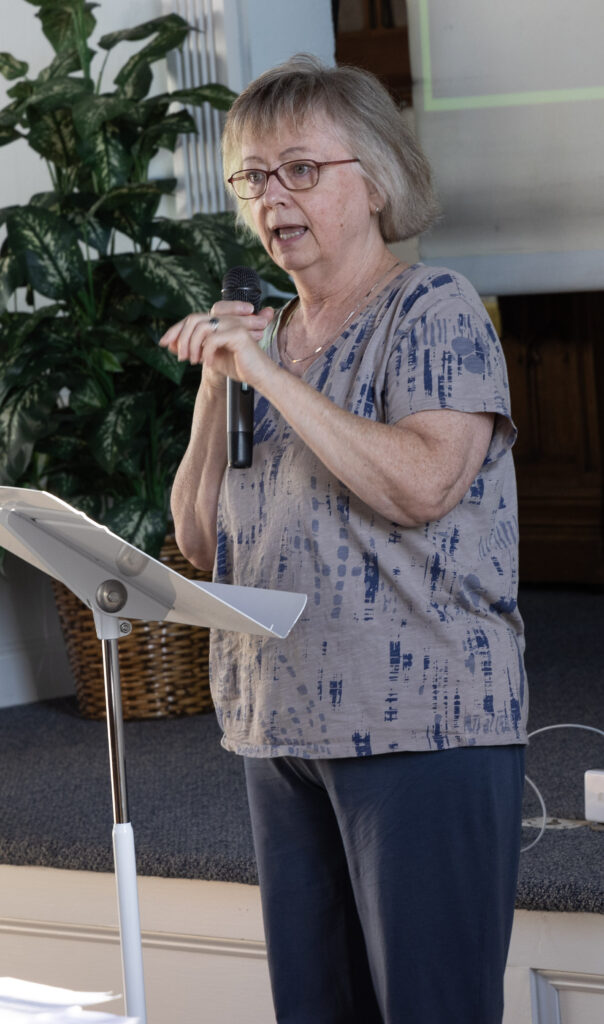
Alliance co-founders J. David Waldman and Ton Mesters led the presentation, joined by environmental experts Jeff Tittel, former director of the New Jersey Sierra Club, and Peg Gallos, executive director of the Association of Environmental Authorities.
Waldman opened by saying the Borough’s decision-making process had been “fast-tracked” without sufficient public input, arguing that the sale represents “an irreversible loss of local control.”
“We’re not fighting the Council,” Waldman said. “We’re embracing them. But we’re asking the community to hit pause. A ‘No’ vote simply means we take the time to use the grants we already have, fix the wells, and revisit this later if we must.”
The group’s refrain was that “vote no” doesn’t mean doing nothing—it means pausing to explore a different path that keeps ownership local and taps into existing resources.
The Alliance’s Alternative Plan
The HBPWA presented what they called a five-part alternative to privatization.
1. Use existing federal grant to fix wells
Hopewell Borough already has a $2.34 million federal grant to install PFAS and arsenic treatment at Wells 4 and 6, where contamination has limited supply. Once the upgrades are complete, the Alliance projects the wells could meet more than 100 percent of Borough demand, eliminating the current $270,000 per year purchase of supplemental NJAW water.
2. Create a municipal utility authority
The plan proposes forming a Hopewell Borough Municipal Utility Authority (MUA) through ordinance. A five-member board—including appointees with utility and financial expertise—would oversee operations, maintenance, and capital planning, allowing for professional management while keeping control local.
3. Establish a philanthropic water trust
A new 501(c)(3) nonprofit, the Hopewell Water Trust, would attract donations from residents, local businesses, and charitable foundations. Funds could help subsidize rates for lower-income customers and small businesses and provide capital for system upgrades.
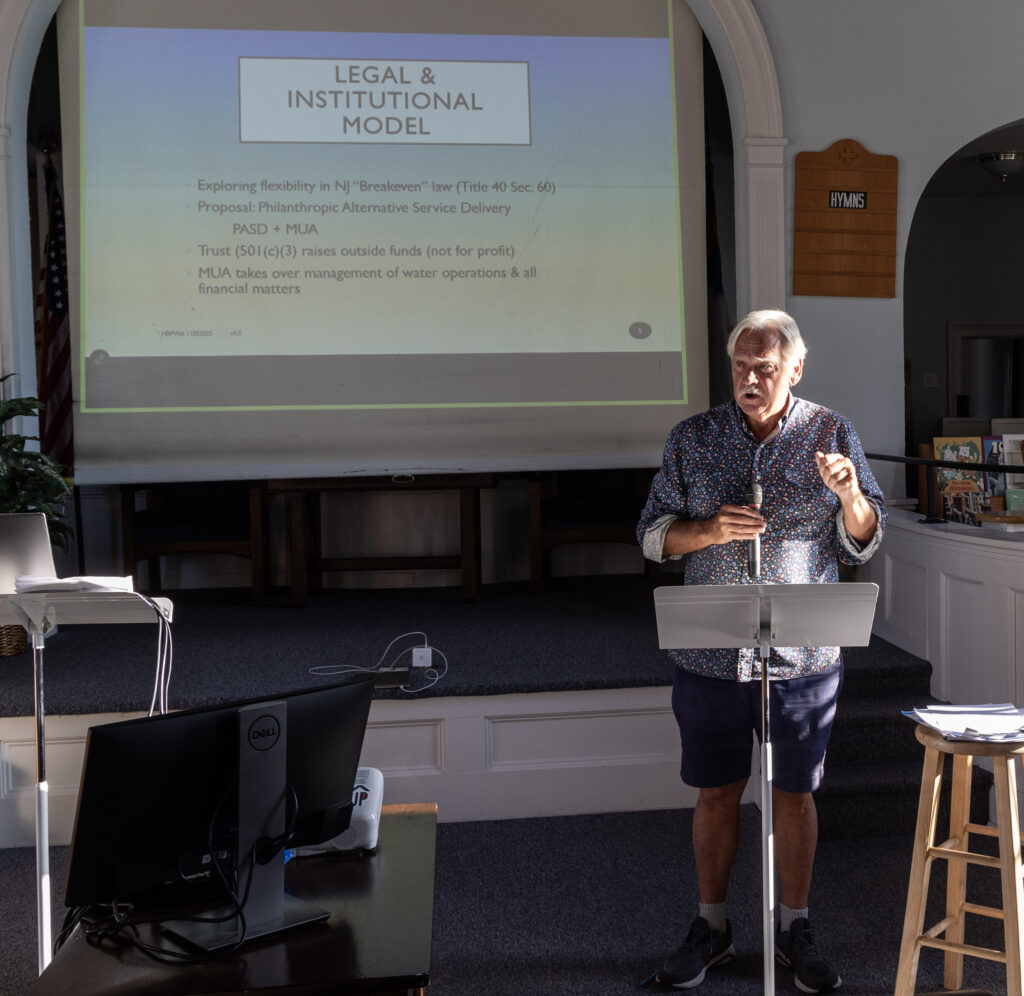
Waldman cited examples such as Flint, Michigan, where philanthropic partnerships have supported public utilities.
4. Restructure the capital plan
The Borough’s consultants estimate roughly $10.8 million in capital needs over 10 years. The Alliance’s model spreads those costs over 15 years, through water rates and philanthropic donations, reducing the annual burden while prioritizing lead line replacement, leak reduction, and tank rehabilitation.
Mesters said the Borough could fully retire system debt by 2055 and build a $2.4 million reserve fund to sustain maintenance.
5. Leverage local expertise and partnerships
The group emphasized that Hopewell’s size and civic engagement make it well suited to manage a community-based utility.
“We’re not a failing system,” Waldman said. “We’re a small system that needs investment—and we can do that ourselves.”
Financial comparisons and rate assumptions
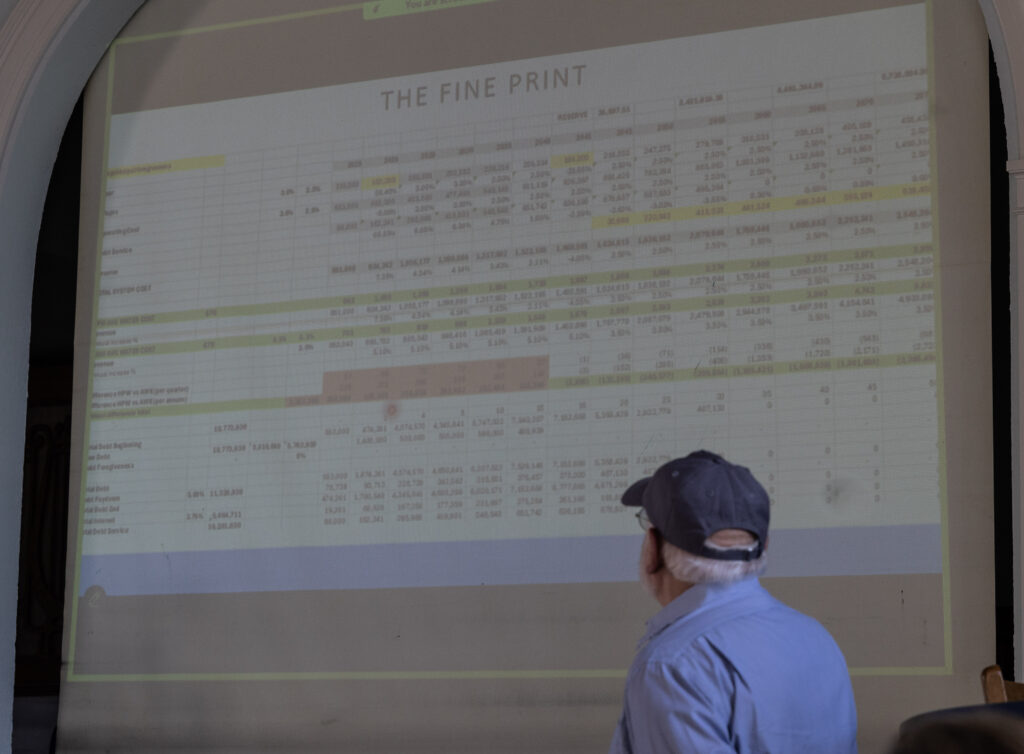
The Alliance acknowledged that water rates would likely remain higher for the next 15 years under local ownership but projected that the lines would cross around 2040, with Borough rates eventually becoming cheaper as NJAW’s increases continue.
Mesters’ model assumes 2.5 percent annual inflation and modest staffing costs, compared with NJAW’s 24 percent profit margin.
However, the Borough’s official FAQ paints a different short-term picture:
- Under Borough ownership, rates are projected to increase 4–7 percent annually for at least the next decade.
- Under NJAW, the average customer’s quarterly bill would drop by about 35 percent, and large-volume users such as restaurants would save 25–40 percent.
- Only low-use customers (2,000 gallons per quarter or less) would see a modest increase—about $11 per month.
Questions and funding challenges
During audience questions, several residents pressed the Alliance on how its plan would be financed without confirmed large donors. While the group emphasized the potential for philanthropic support through a proposed Hopewell Water Trust, no specific benefactors were identified.
However, near the end of the meeting, a representative from the Atlantic Foundation—a New Jersey–based philanthropic organization started by J. Seward Johnson, Sr.—announced that if voters reject the sale, the foundation would commit a $150,000 matching grant to help launch local fundraising on the post-referendum development of the plan.
Councilwoman Krista Weaver questioned the group’s campaign financing and compliance with election law, while Council President David Mackie challenged some of the environmental claims made by Jeff Tittel, citing his experience as a geologist and disputing characterizations of the aquifer and sale terms.
Mayor Kennedy’s counterpoint: debt relief and community savings
After more than two hours of presentations and public comment, Mayor Ryan Kennedy stood to address what he called a missing component in the Alliance’s analysis—the debt relief that would result from the sale.
“There’s no mention here that they’re giving us $6.4 million for our water system, which would allow us to retire all of our municipal debt as well,” Kennedy said. “When you combine the debt relief from having $6.4 million and removing all of our municipal debt, we’re looking at a $12 to $14 million benefit on top of what we would pay to New Jersey American.”
According to the Borough’s official FAQ, the sale proceeds would eliminate all existing water-utility and general-service debt, freeing roughly $1 million per year for other priorities and resulting in an estimated $12–$14 million in total community savings over the next decade.
Kennedy said becoming debt-free while securing ten years of stable rates represented a rare financial opportunity for the Borough.
“When I started this process more than two years ago,” he said, “I thought if I could find a solution that would get our rates under control and make the capital improvements we need without putting it all on the backs of Borough residents, that would be a win. That’s where I’ve landed.”
Infrastructure and environmental impacts
The Borough’s FAQ clarifies that maintaining local ownership would require $10.8 million in infrastructure spending within ten years (excluding PFAS and arsenic treatment.)
Under the sale, NJAW would fund $7 million in capital upgrades within five years, spreading the cost across its 700,000 customers statewide rather than through Hopewell’s limited rate base.
The FAQ also confirms the PFAS/arsenic grant cited by the Alliance, noting that PFAS systems could take at least two years for design, permitting, and construction, while NJAW would be in immediate compliance upon closing.
Another major cost differential involves lead service line replacement: the Borough would face roughly $1.2 million in costs borne entirely by customers, while NJAW would replace all lead and galvanized lines at a statewide cost of about $215 per average user, spread among all customers.
Audience reactions and closing remarks
Audience comments reflected many people in favor of voting no, while others expressed that they were unsure and were still trying to learn more about what the “right” decision will be.
“We think the community has the power and creativity to fix our own system,” Waldman said. “A ‘No’ vote is not the end—it’s an opportunity to make the right choice for Hopewell’s future.”
What’s next
The Hopewell Borough Water System Referendum appears on the November 4, 2025 General Election ballot.
If approved, the sale would be finalized and proceeds used to retire all municipal debt, leaving the Borough debt-free while NJAW assumes full operation and future investment responsibilities.
If rejected, the Borough will retain ownership and must determine how to finance ongoing maintenance, well rehabilitation, PFAS compliance, and infrastructure replacement—challenges estimated to total $10–12 million over the next decade.
With voting underway and election less than a month away, both campaigns—the Vote YES coalition led by NJAW and the Vote NO Alliance advocating local control—are ramping up outreach efforts across the community.