

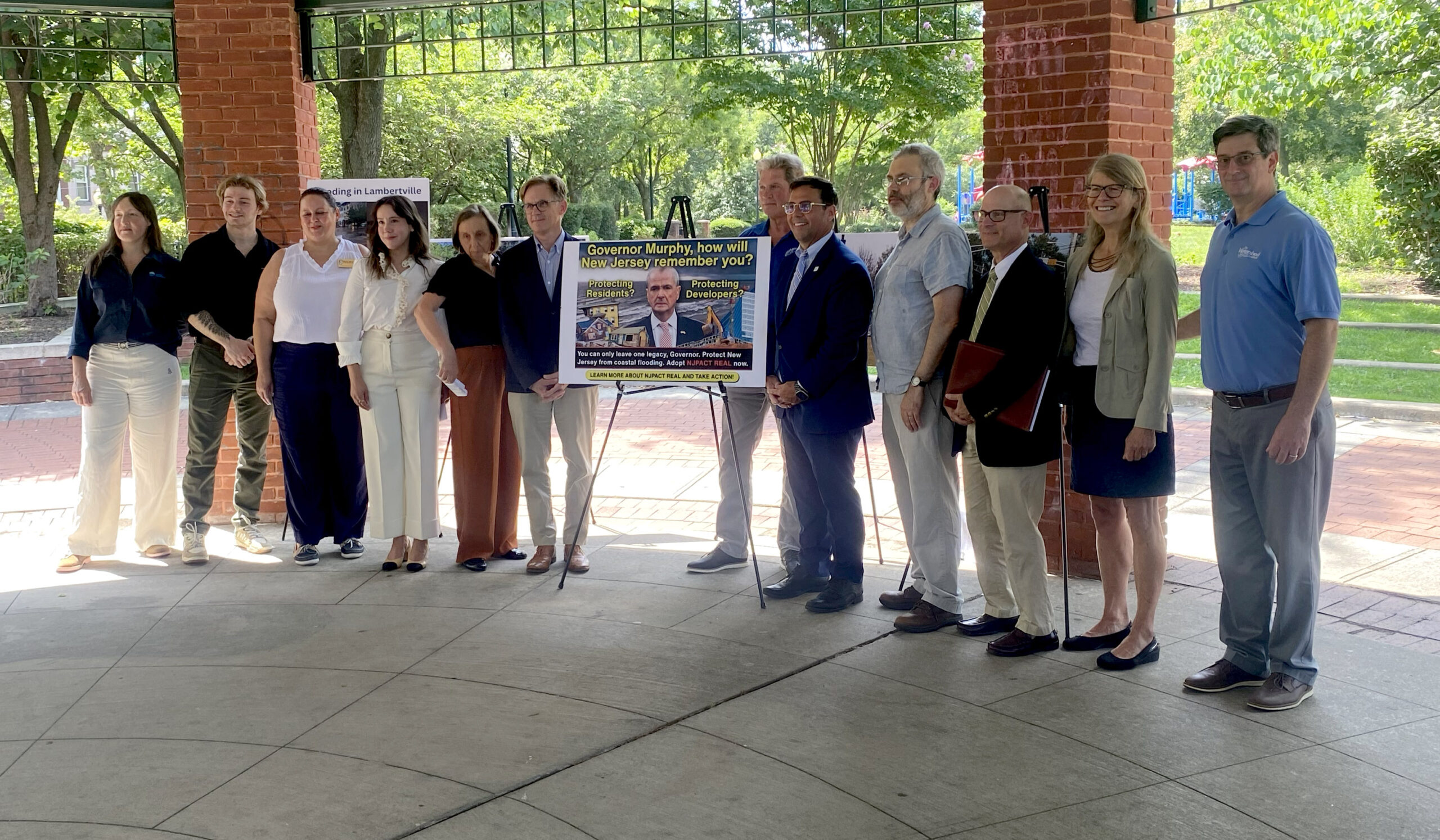
At a press conference Tuesday along the Delaware River in Trenton, elected officials and environmental advocates urged Governor Phil Murphy to adopt long-delayed flood protection regulations before an August 4 deadline.
The proposed NJPACT REAL rules—short for New Jersey Protecting Against Climate Threats: Resilient Environments and Landscapes—are designed to protect future development from the growing impacts of climate change, including sea level rise and extreme rainfall.
“We have an opportunity here in New Jersey to make better decisions that will quite simply protect lives, will save lives and will protect property, and our opportunity lies in these NJPACT REAL rules,” said Jennifer Coffey, Executive Director of the Association of New Jersey Environmental Commissions (ANJEC).
The event was held in South Riverwalk Park, a Trenton flood zone, and comes as devastating flash floods in Texas have drawn renewed attention to climate-fueled disasters. New Jersey, advocates said, is not immune.
“We are here today to urge the Governor to put NJ first and adopt the REAL rules. In just the last three months there have been multiple flash flood warnings, 5-plus inches of rain, and various flooded roads around the state. What once was a rare occurrence is happening all too frequently, sometimes with catastrophic results,” said Michael Pisauro, Policy Director at The Watershed Institute.
“We’re acting on climate science, not political science,” said Doug O’Malley, Director of Environment New Jersey.
The rules—promised by Murphy more than five years ago—would update outdated flood maps, incorporate future sea level rise projections, and apply to new construction and major redevelopment. According to the New Jersey Department of Environmental Protection (NJDEP), they would not create “no-build” zones or impose elevation requirements on existing buildings.
But the proposed regulations have faced strong opposition from developers, who claim they would increase construction costs.
“A lot of the information going out there from the building industry is about this massive added cost,” said Ed Potosnak, Executive Director of the New Jersey League of Conservation Voters. “You’re not adding a significant amount, but what you are adding is the ability to stay in your home and be safe, have a home that’s insured and retire sooner.”
Potosnak, a licensed contractor, warned that failing to implement the new rules would leave New Jersey relying on dangerously outdated flood data.
“If these rules don’t go into effect, we will be using flood data from before we really had what we would consider cell phones,” he said. “This is Motorola v60, flip phones. The technology we use today is so much more powerful than supercomputers back then, but the data we’re using is from way back then.”
Anjuli Ramos, Director of the New Jersey Sierra Club, said a recent storm triggered more than 100 flood reports in Monmouth and Ocean counties—and emphasized the urgency of updating standards amid declining federal disaster support.
“Now more than ever, we are witnessing devastating floodwaters tearing through communities across the country, destroying homes, displacing families, and taking lives,” Ramos said. “This is a very unique moment in time for New Jersey to take this opportunity to protect its people because we are incredibly vulnerable to the impacts of climate change because of our very susceptible coastline.”
Due to warming atmospheric conditions, storms are delivering more water in less time, overwhelming local systems. Rutgers researchers estimate sea levels in New Jersey could rise by at least 5.1 feet by the year 2100.
“Protect our pocketbooks, not the pocketbooks and ledgers of the corporations that are trying to benefit by keeping us in the past with outdated data that is going to kill more and more New Jerseyans,” Potosnak added.
Coffey noted that the rules have undergone both scientific and legal review—and dismissed what she described as “lies and disinformation” from opponents.
Concerned local leaders, including Cranbury Township Councilwoman Barbara Rogers, echoed calls for urgent action, saying municipalities cannot face these challenges alone.
“This is just adapting to what we’re already experiencing,” said Ramos.
Governor Murphy has until August 4 to adopt the rules.