
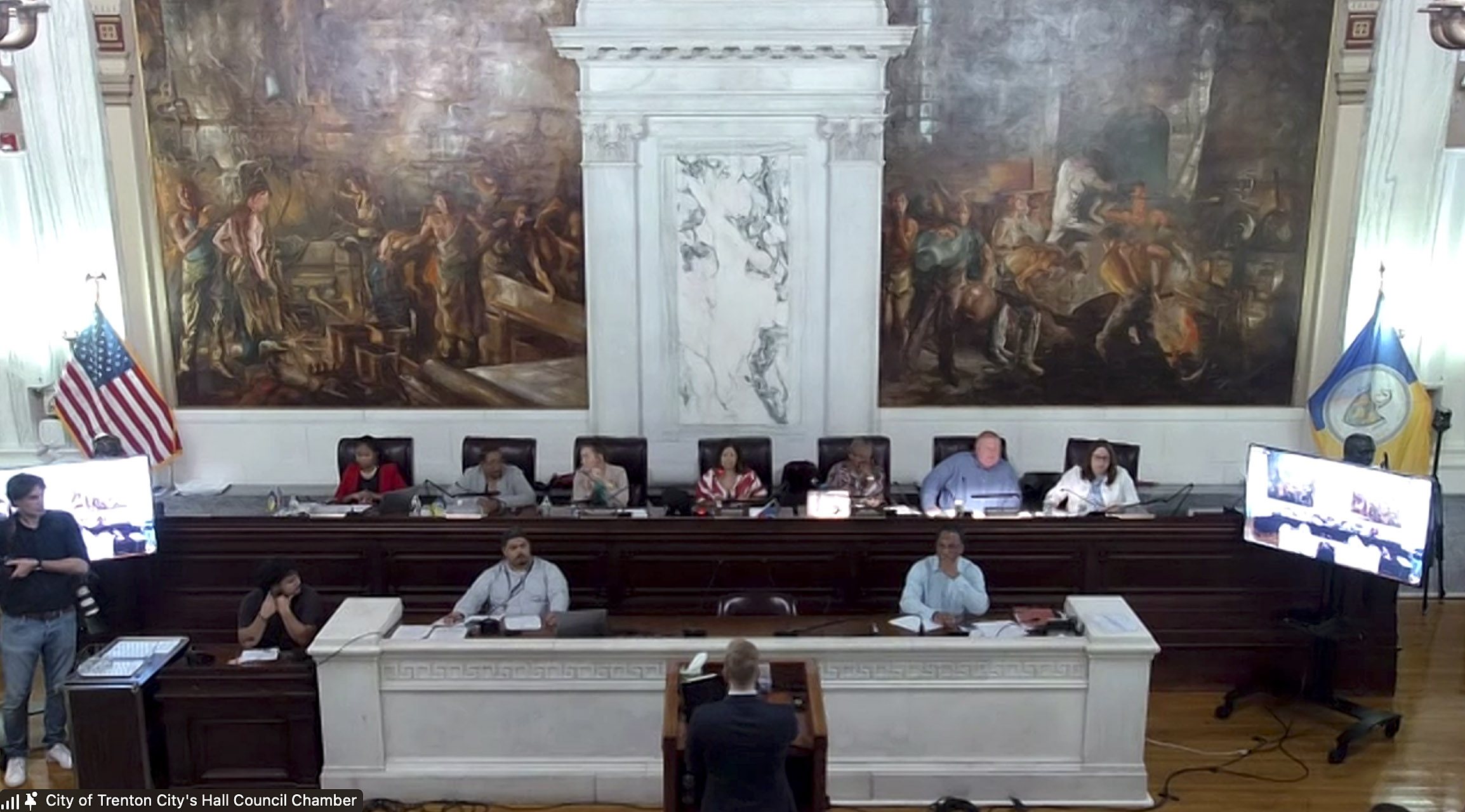
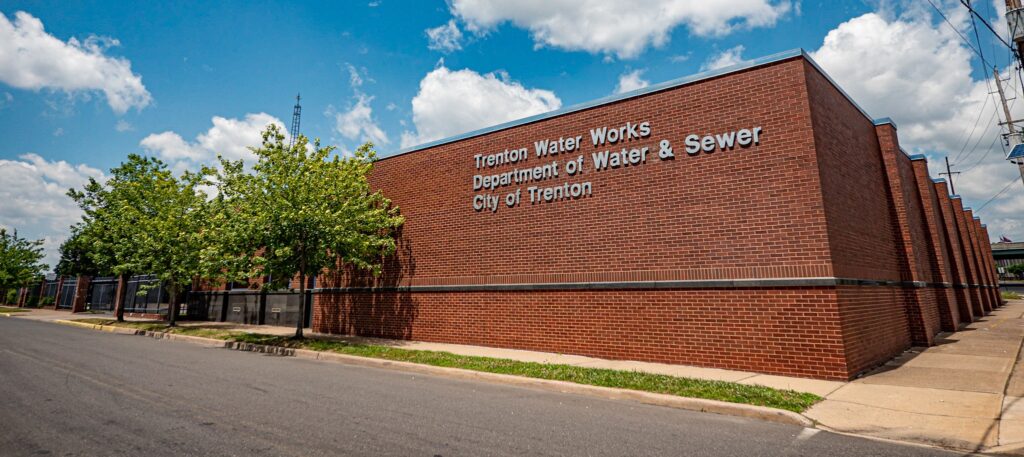
New Jersey Department of Environmental Protection Commissioner Shawn LaTourette faced hours of pointed questioning from the Trenton City Council on Monday before staying through a lengthy public comment session dominated by Trenton Water Works employees, as anxiety over a perceived “sale” collided with the state’s push to explore a regional, publicly owned utility.
LaTourette opened by casting the debate as a public-health imperative, not a fight over assets. “It’s not about taking something of value from the people of Trenton. It’s about protecting public water. Public health,” he said, adding that “the city cannot go it alone.” He recounted enforcement actions dating to 2009, a Legionnaires’ disease outbreak and the state’s “unprecedented step” declaring Trenton Water Works an “imminent and substantial endangerment.”
Council and commissioner clash
Council members pushed back in a series of heated exchanges. Councilwoman Jenna L. Figueroa Kettenburg said the plan would “penalize Trenton residents for failures that occurred under DEP watch.” LaTourette answered: “Oh, you’ve gotta be kidding me. No, that’s absurd… and quite frankly, it’s a bit shameful,” later adding, “I have come here to be yelled at by each of you… and I am deeply concerned about the public health of this community.”
Council Vice President Jasi-Mikae Edwards pressed for all governance options—not just a regional model—and faulted a communication gap: “We need you to reach out to us.” Councilwoman Jennifer Williams thanked the commissioner and staff for sitting through “four and a half hours on a Monday night,” underlining the meeting’s length and intensity.
Is TWW being sold?
LaTourette repeatedly said privatization is not on the table. He described a left-to-right spectrum with the “status quo” at one end and “privatization” at the other, arguing a public regional utility is “only one step to the right” and designed to preserve control. “With each… step to the right… you lose control,” he said.
Regional, public model on the table
The commissioner urged an 18- to 24-month public process—steered by an executive committee—including a full asset inventory and valuation, financial modeling, and intensive community engagement through town halls, printed materials, a website and surveys. “Everyone should have a voice,” he said.
He told council a public regional authority would not “take” city assets: “If there is a new regional utility that is public owned, you’re its majority shareholder… No one decides that for you. You will decide that.” He also said representation would be proportional to what each party brings: “You don’t lose something, but you do gain something.”
LaTourette argued a regional authority can tap tax-exempt financing and low-cost state funds unavailable under privatization and could improve bond confidence compared with the city’s current position. He noted most of TWW’s rate base and revenue are outside Trenton.
Recess, then public comment
After a short break, public comment began, and many TWW employees took the microphone. Council President Yazminelly Gonzalez set the ground rules and asked speakers to be respectful.
Workers defend plant operations
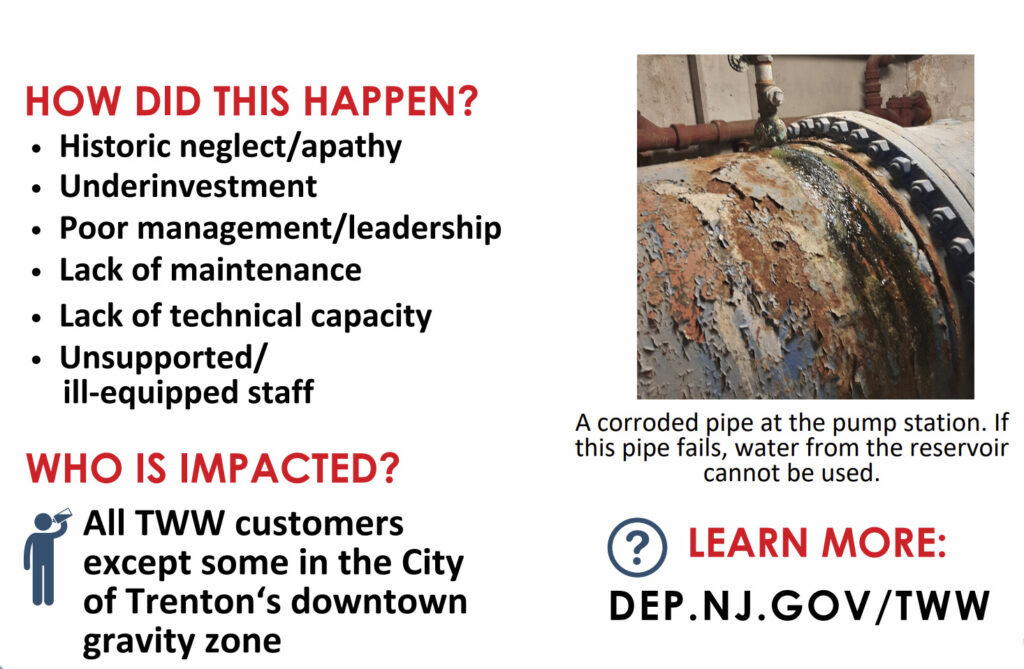
Plant supervisor Taya Brown-Humphrey said, “The water quality leaving the plant meets the Safe Drinking Water Act regulatory requirements,” and disputed claims that January’s “frazzle ice” incident was caused by operator error. Chief chemist DiAsia Brooks said a promised Legionella remedial measures plan still had not been delivered. Water and Sewer Director Sean Semple warned of fragility—“We [are] on the brink of catastrophic disaster… I’m scared… the plant could go down”—while arguing recent improvements are overlooked.
DEP officials countered earlier that TWW lacks a credible training program; staff disputed that in detail, pointing to in-house SOPs and recent training.
Compliance and risk remain
LaTourette said state support propping up the system is not a long-term solution and warned that if a collaborative path stalls and compliance still cannot be sustained, the matter could end up in court. “There’s no legislative order… [but] if you still can’t meet compliance… a court [may] have to decide,” he said.
Money, jobs, and control
Council members zeroed in on finances and local control. Edwards asked how a regional or Trenton-only authority would affect the city’s ability to transfer a share of surplus to the general fund, noting Trenton historically takes about 2%. Crystal Feliciano flagged that TWW contributes about $1.52 million to supporting departments and $2.6 million to the general fund, asking what happens to that revenue under regionalization and whether union jobs and contracts would be protected.
Fears that other towns would “push in and take over” surfaced throughout the night. “We have to move our feet before we lose our seat at the table,” Edwards said, while residents warned against “giving away” a city asset.
‘Sale’ anxiety vs. DEP’s assurances
Several council members and residents equated regionalization with a sale. LaTourette insisted otherwise and emphasized process: “Engage in a process to design it… If you don’t like how that process ends up, don’t vote for it.” He said any new authority’s governing documents would be built with Trenton at the table.
What’s next for council
No decision was made. Gonzalez said the council would hold follow-up conversations to sort “what we found to be true and not true.” Williams and others thanked employees for speaking out and the commissioner for staying.
Neighboring towns stake out positions
Lawrence Township Mayor Patricia Farmer attended the meeting; speakers noted she has shown up at prior town halls, while officials from Hopewell, Hamilton and Ewing did not attend Monday. Hopewell Township recently passed a resolution supporting a regional approach to the water system, and Ewing and Hamilton are expected to consider similar resolutions this week—moves that reflect positions the communities have signaled for some time. During public comment, residents raised questions about money owed by the suburban towns and warned against being “pushed aside” in any governance shift. About 55% of TWW customers live outside Trenton and 45% inside the city.
How we got here
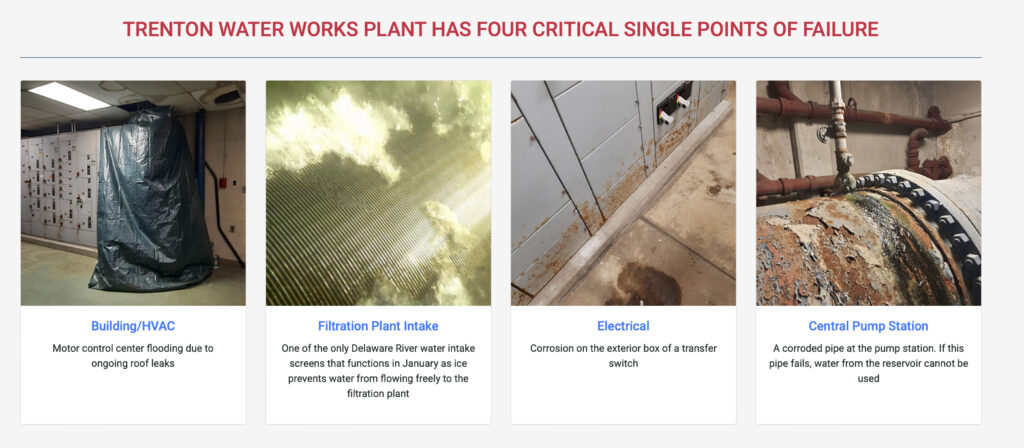
Regulators say Trenton Water Works has struggled for years with reliability, maintenance, and capital improvements. DEP cited a string of enforcement actions in 2009, 2013, 2014, 2017 and 2018 to address persistent noncompliance.
In 2020, DEP brought litigation under the Safe Drinking Water Act. After subsequent events — including a Legionnaires’ disease outbreak — DEP took the unprecedented step of declaring TWW an “imminent and substantial endangerment” to public health.
Under that order, DEP has provided operational oversight and stabilization: water program staff are regularly on-site, contractors have been secured at the state’s expense, and limited equipment and engineering support have been procured. State officials stressed this stabilization is not a long-term fix.
DEP then commissioned two independent assessments: one on TWW’s technical, managerial, and financial capacity; another on restructuring options. Those reviews concluded the system faces extremely high risk in its current form and could be successful if restructured as a public utility independent of the city, with modernized governance and operations.
To explore that path, DEP outlined an 18–24 month public process to study a regional, publicly owned authority, including asset valuation, financial modeling, and extensive community engagement (town halls, printed materials, a website, surveys). Officials emphasized this is not a foregone conclusion.
Several longstanding technical issues frame the debate. DEP flagged TWW’s open water reservoir as a decades-old source of noncompliance; TWW says it has a reservoir replacement plan underway. A January 2025 “frazzle ice” intake event also looms large; staff say it was not operator error and that intake systems were staffed around the clock.
On Legionella, TWW’s chief chemist noted a February 2023 letter (WAM-200001) said a remedial measures plan would be provided; as of Aug. 18, 2025, she said the utility had not received it.
Finally, after a second Unilateral Administrative Order late last year, DEP issued an RFP to bring additional contracted staff to TWW to help fill vacancies and build capacity — a stopgap the state says cannot substitute for a durable structural solution.