
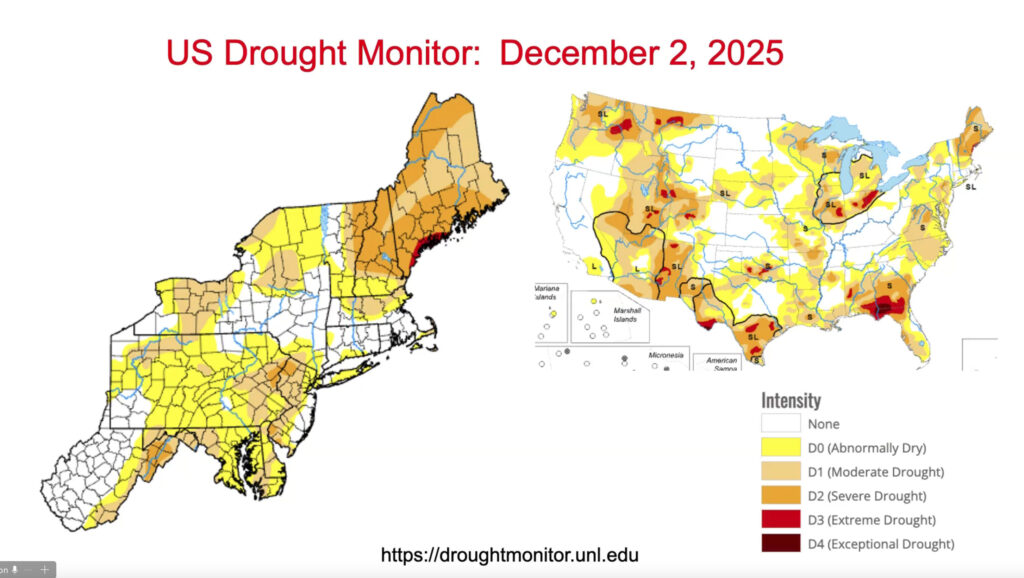
New Jersey’s drought conditions have quietly but steadily deepened over the past 15 months, prompting state officials this week to outline the possibility of escalating from a Drought Watch to a Drought Warning if reservoir levels and precipitation trends fail to improve.
The state has received just 74% of normal rainfall over that period — a sustained deficit that has touched every region but hit the north and northwest especially hard.
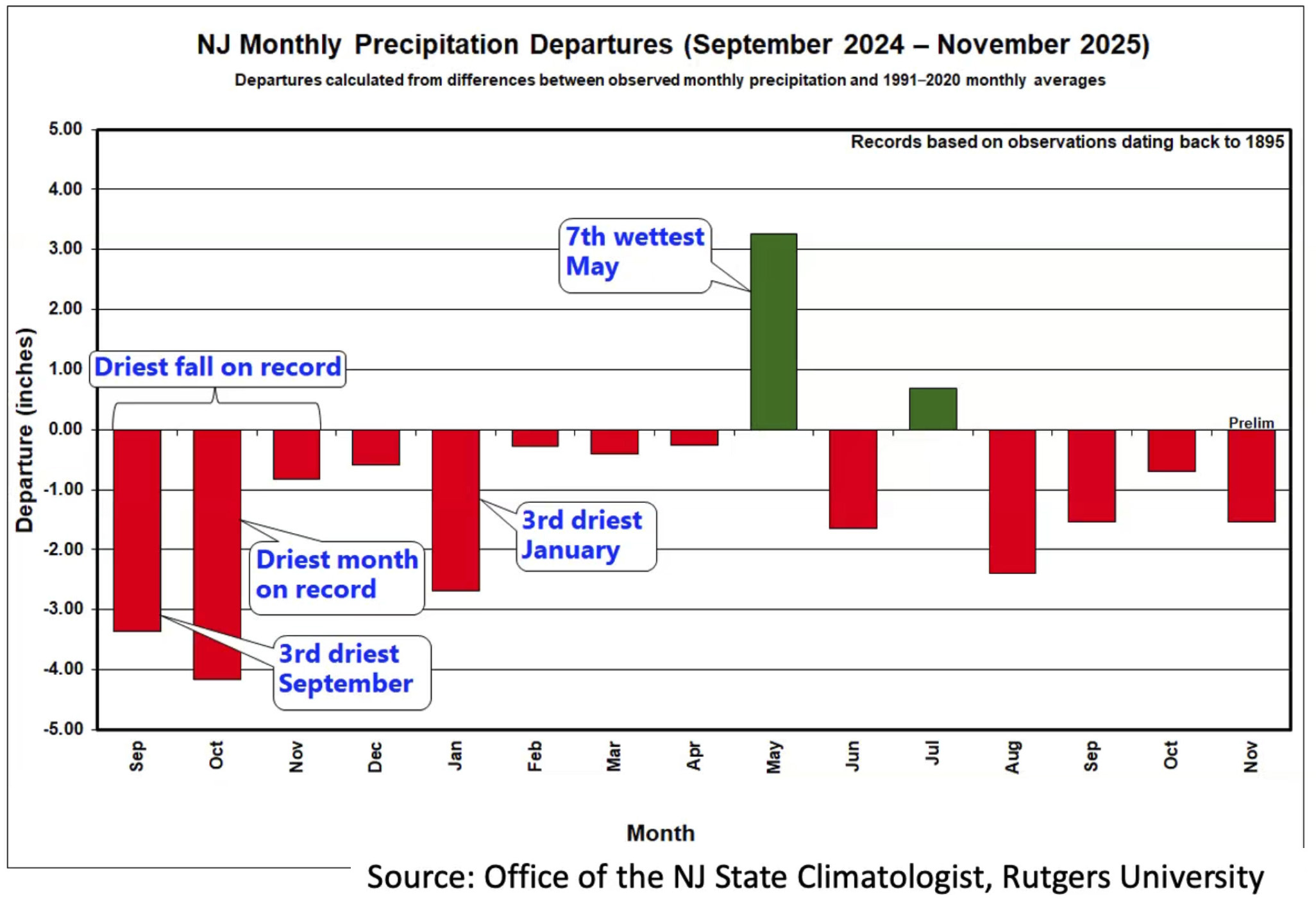
“Thirteen of the last fifteen months have seen below average precipitation,” said Steven Domber, New Jersey’s State Geologist during a New Jersey Department of Environmental Protection (NJDEP) public hearing on the drought. “That’s really what’s driving this discussion today — a lack of precipitation.”
Domber noted that while late-fall rainfall offered temporary improvement in some areas, it was nowhere near enough to compensate for long-term dryness that began in late 2024 and persisted through most of 2025.
New Jersey is 15.5 inches behind — equal to four months of missing rain
State Climatologist David Robinson reinforced Domber’s assessment, offering a broader look at how deeply the deficit has carved into the state’s water budget.
“Going back 15 months, New Jersey is 15.54 inches below normal in the precipitation department,” Robinson said. “That’s akin to about four months of missing precipitation over that time.”
He emphasized that warmer seasons have also played a role: “Evaporation is greater under warmer conditions, putting more stress on our water supply.”
North Jersey driest, but deficits are statewide
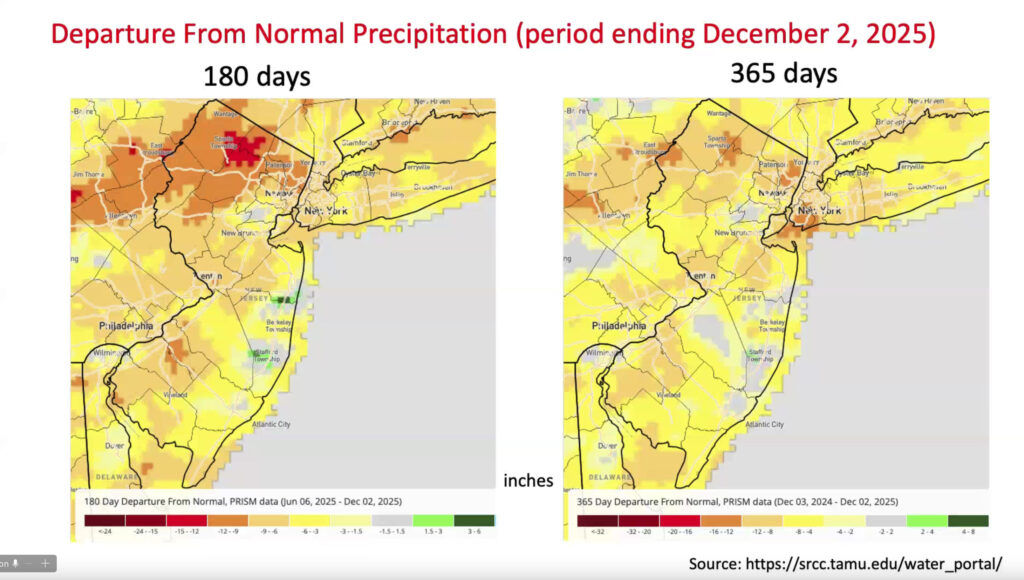
The Highlands and upper Passaic region show the greatest departure from normal — in some areas more than 12–16 inches below average over six months — but central New Jersey continues to struggle as well.
Robinson noted that Central Jersey sits at 77% of normal rainfall over the past 15 months, with similar deficits since summer. Reservoir and groundwater indicators in the central and southern regions remain below seasonal expectations.
What a Drought Warning would mean
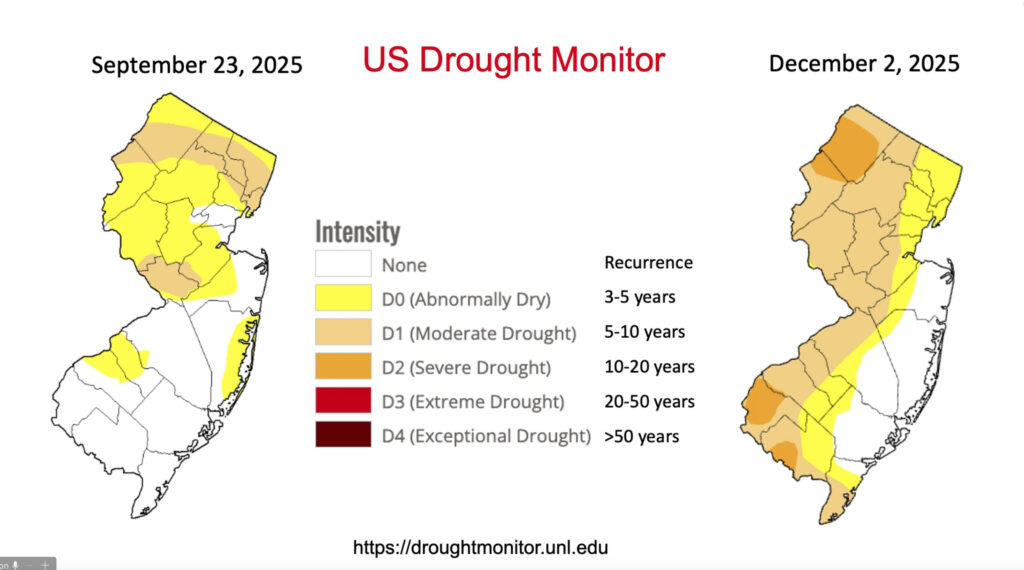
New Jersey has been under a Drought Watch since October 1, urging voluntary water conservation.
A Drought Warning, if issued, does not impose immediate mandatory restrictions but allows the NJDEP to:
- Direct changes to reservoir release schedules
- Require water suppliers to perform leak detection
- Order interconnection tests
- Adjust diversion limits
- Coordinate regional supply transfers before conditions worsen
A Warning can be applied statewide or to specific drought regions.
Local implications: Mercer County and the Hopewell Valley
Mercer County is not currently the epicenter of the drought, but it remains part of a broad central New Jersey corridor where rainfall has consistently underperformed for more than a year.
Data from the New Brunswick climate station show totals at 77% of normal since fall 2024 and 78% of normal since summer 2025, contributing to lower soil moisture, slower groundwater recharge, and increased sensitivity to warming winter temperatures.
For the Hopewell Valley, these conditions intersect with local vulnerabilities:
- Smaller aquifers that depend on strong winter recharge
- Regional supply systems influenced by Delaware River flows and reservoir levels
- Pressure on water infrastructure if spring rainfall is weak
Officials stressed that even regions not currently at critical reservoir levels could face tightening conditions depending on how winter and early spring unfold.
Expert stakeholders and residents press for stronger action
During the hearing’s public-comment session, stakeholders from across New Jersey’s watershed regions urged the state to act more aggressively.
Speakers representing Raritan Headwaters, and residents near the Wanaque, Spruce Run, and Round Valley reservoir systems emphasized:
- Persistent multi-year drought indicators
- Low reservoir and groundwater levels entering winter
- Vulnerability of smaller systems during peak demand
- The need for stronger statewide messaging on conservation
Multiple commenters described a pattern of “drought every summer” over the past four years, urging DEP to move beyond voluntary measures. Others pointed to development pressures and land-use decisions that they felt did not fully account for water availability.
Across comments, one theme was clear: residents and watershed groups want earlier, stronger signals from the state, believing a Drought Warning would underscore the seriousness of conditions and align water suppliers and the public behind conservation goals.
State encourages residents to use NJDEP drought tools
As conditions evolve, DEP officials urged residents, municipalities, and water systems to make use of the state’s “Every Drop Counts” drought-awareness campaign.
The portal — available through the DEP drought page — includes:
- Seasonal conservation tips for homeowners and businesses
- Downloadable outreach materials for towns, schools, and community groups
- A model municipal water-conservation ordinance
- Guidance for water purveyors on drought communication and public alerts
Officials said these tools are designed to help communities get ahead of deepening deficits. Even small steps, they noted, add up when taken statewide — especially during the winter months, when groundwater recharge is limited.
A complicated winter ahead
The National Weather Service’s December outlook leans wetter-than-normal, offering some potential short-term relief. But the seasonal December–March forecast is far less definitive, showing no strong signal for meaningful replenishment — and even a tendency toward drier conditions in the south.
Robinson cautioned that while individual storms help, the state’s overall hydrologic position reflects “persistent deficits,” not isolated dry spells.
What’s next
NJDEP officials will evaluate hydrologic conditions, reservoir trends, and public testimony before determining whether a Drought Warning is necessary. A decision could come this winter.
For now, the state’s message is clear: New Jersey is not in crisis — but the trajectory is concerning and reversing it will require both cooperation and precipitation.