

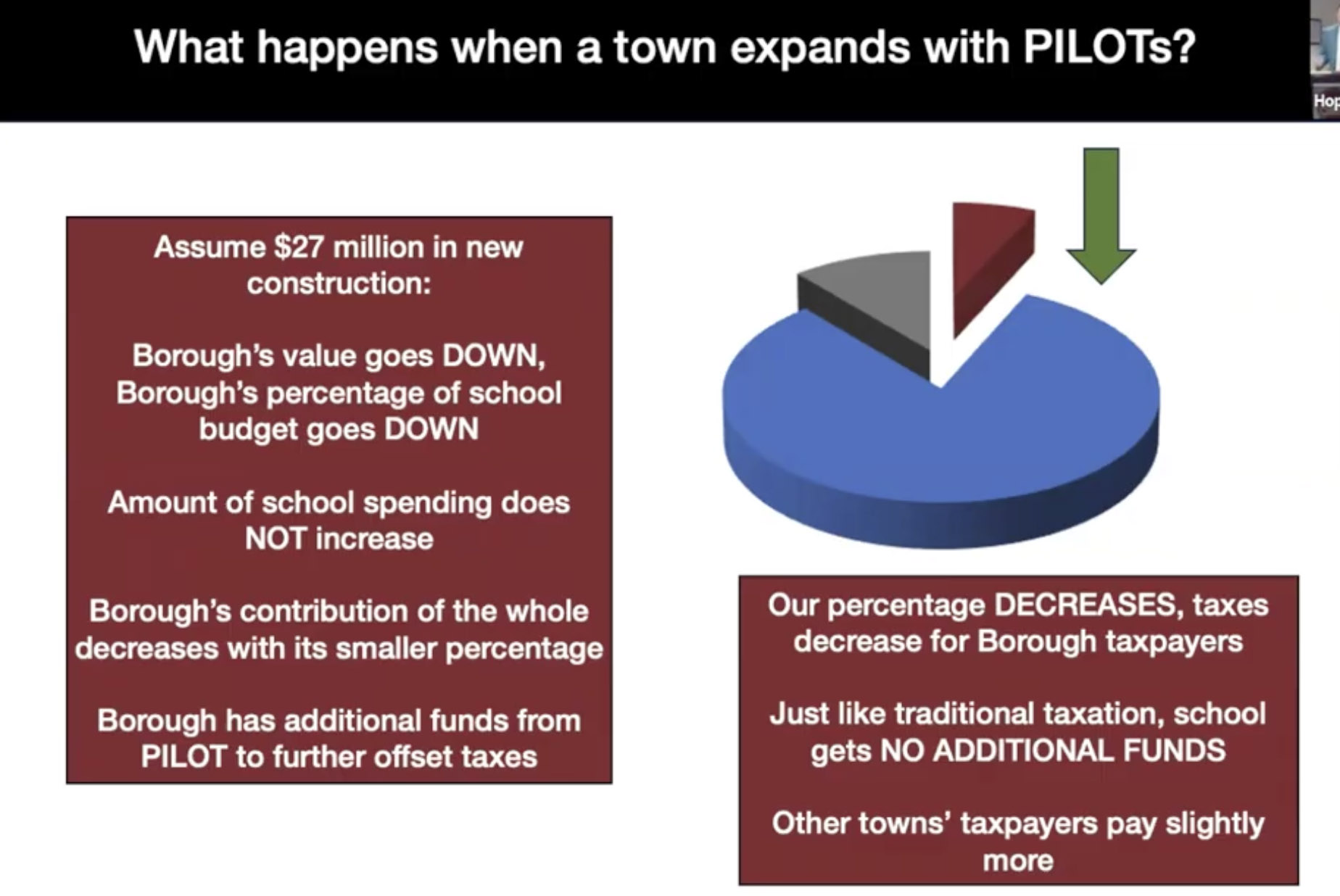
Hopewell Borough officials and financial advisors spent more than an hour Thursday evening walking residents through the mechanics of the borough’s first Payment In Lieu of Taxes agreement, explaining how the financial structure tied to the Hopewell 57 redevelopment project will affect municipal finances and the regional school district.
The presentation at the council meeting and was intended to help residents better understand the PILOT agreement approved by Borough Council in December and the broader implications of the redevelopment project now moving through the Planning Board.
The discussion featured Bryan Morris, a financial advisor with Phoenix Advisors who worked with the borough on the agreement, along with remarks from Mayor Ryan Kennedy and questions from residents and community leaders.
*Editor’s Note: MercerMe Editor Seth Siditsky contributed to this story
Explaining how PILOTs work
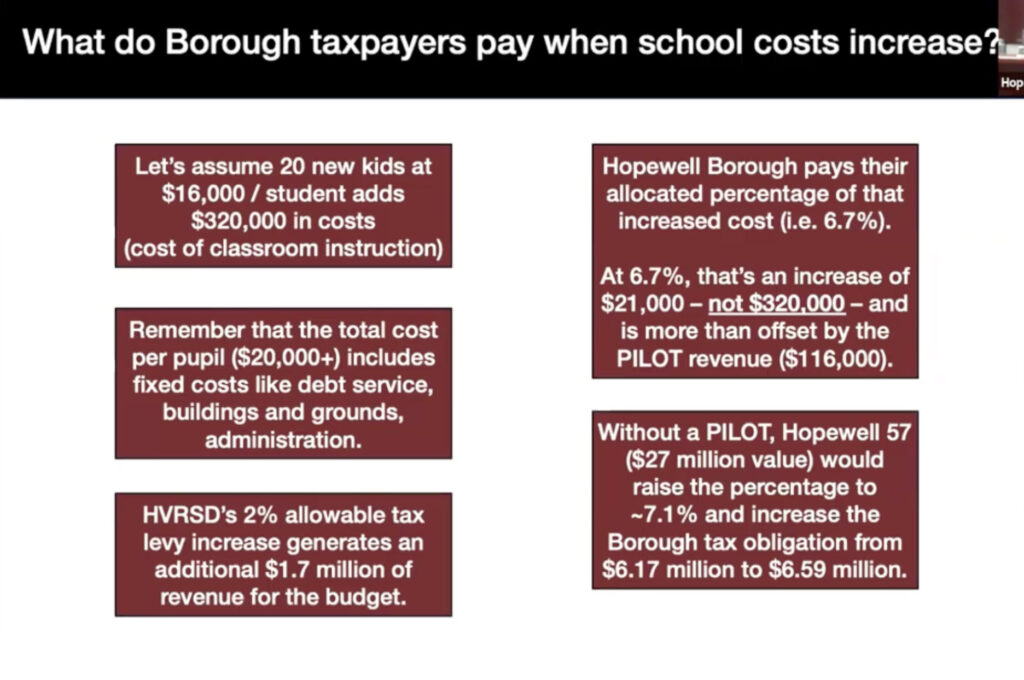
Morris began the presentation by explaining the fundamental difference between traditional property taxes and payments made through a PILOT agreement.
Under conventional property taxation, revenue from a development is divided among multiple government entities, with the largest share typically going to the school district.
Under a PILOT agreement, however, most of the revenue flows directly to the municipality.
For Hopewell Borough’s agreement, 95 percent of the payment goes to the borough and 5 percent goes to Mercer County, while the school district does not receive direct payments from the PILOT.
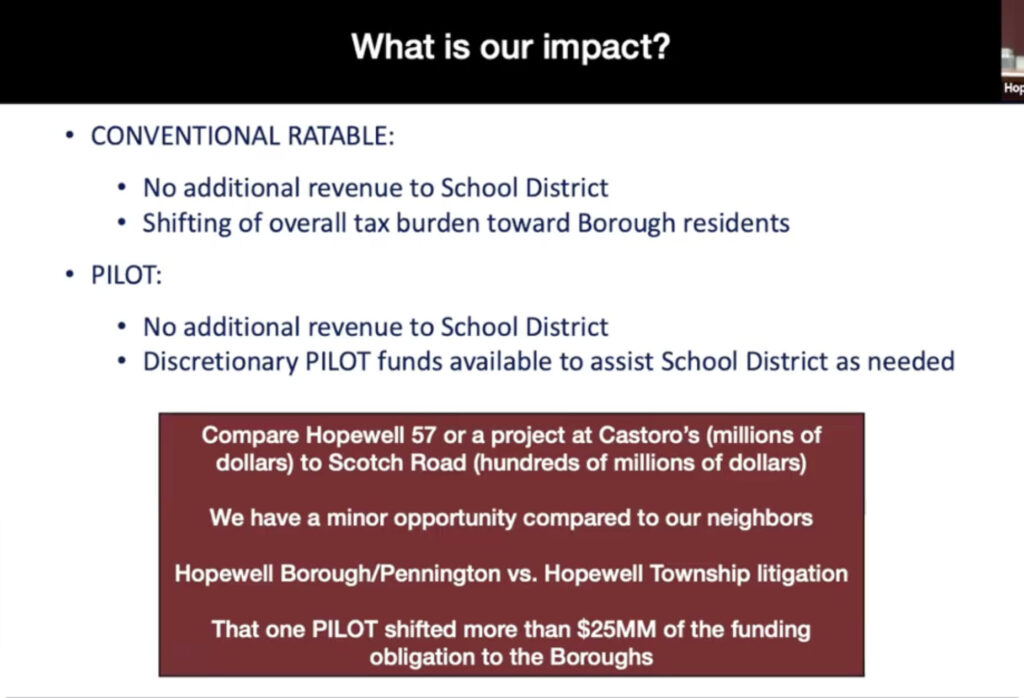
That difference has fueled much of the public discussion surrounding PILOT agreements in the Hopewell Valley over the past several years. Hopewell Township has PILOT agreements in place, most notably with Hopewell Parc.
Morris explained that PILOT agreements are often used to help make complex redevelopment projects financially feasible.
“These are typically used when there are extraordinary costs involved in redevelopment,” Morris said.
In the case of the Hopewell 57 project, those costs include environmental remediation, demolition of the existing industrial building, flood mitigation work, and site preparation.
Background: The Hopewell 57 project
Borough Council approved the 30-year financial agreement for the project in December.
The redevelopment will transform a long-vacant industrial property at 57 Hamilton Avenue into a residential community with 120 rental units, including 96 market-rate apartments and 24 affordable units.
At the time of the vote, Morris told council that the project carries a total development cost of approximately $44 million and would likely not be financially viable without the PILOT structure.
The site currently generates roughly $78,000 annually in property taxes.
Under the approved agreement, the borough expects to receive about $11.6 million in PILOT revenue over 30 years.
Annual payments will start at a minimum of about $120,000 and increase over time as the project stabilizes and generates rental income.
By the end of the agreement, annual payments are projected to exceed $1 million per year.
Why the borough approved a PILOT
Kennedy said the borough faced a difficult decision when considering the financial agreement.
Without the PILOT, the redevelopment project likely would not have moved forward, leaving the industrial property vacant and generating little tax revenue.
Officials also noted that municipalities across New Jersey often rely on PILOT agreements as redevelopment tools for sites with significant environmental or infrastructure challenges.
Kennedy said the council weighed the trade-offs carefully before approving the agreement.
“We had to make a challenging decision,” Kennedy said during the presentation.
School district concerns remain part of the conversation
During the meeting, Mark Peters, the borough representative on the Hopewell Valley Regional School District Board of Education and chair of the board’s finance committee, spoke about how development and PILOT agreements affect school finances.
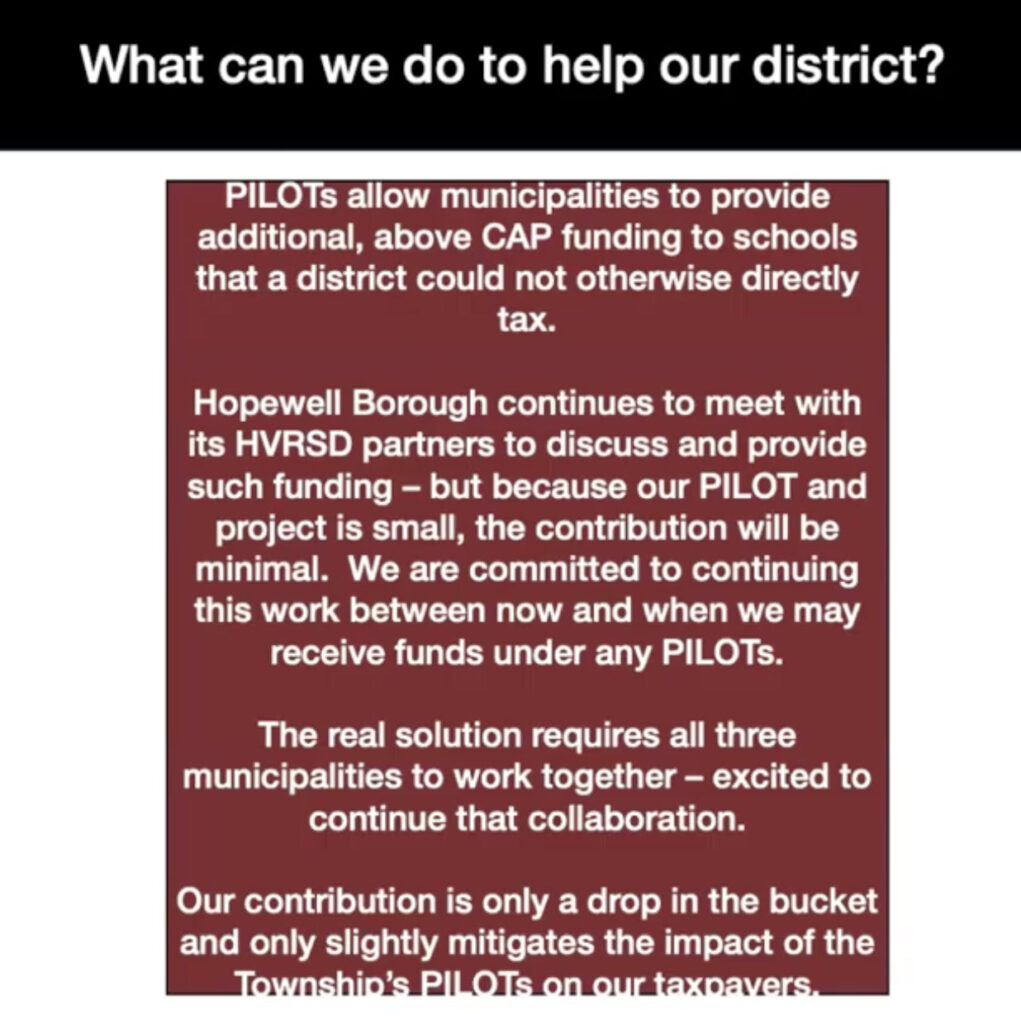
Peters thanked borough officials for supporting the district and acknowledged that the Hopewell 57 project will not generate large amounts of revenue through the PILOT structure.
“I appreciate the support of the school district,” Peters said.
He suggested that municipalities continue exploring creative ways to help support school finances, including potentially using other municipal revenue sources to assist with debt obligations.
Peters also pointed to the scale of PILOT revenues generated by larger developments elsewhere in the region.
He cited Hopewell Township’s recent $16.1 million commitment toward the Bear Tavern Elementary School expansion, funded through PILOT revenue from the Hopewell Parc PILOT agreement.
“The PILOT programs in the township are bringing in a significant amount of money as compared to the borough project.” Peters said.
At the same time, Peters noted that new residential development can create costs for school districts that may not appear immediately in annual budgets.
If new students require additional special education services or transportation routes, those expenses may surface in later budgets.
“We don’t always see those costs in the current year’s budget,” Peters said. “But we do have to address them in future budgets.”
Despite those challenges, Peters said continued communication between the district and municipalities will be important as development moves forward across the region.
“I just hope that as a town we can continue to talk and work together on these things,” he said.
A broader regional debate
PILOT agreements have been the subject of significant debate across the Hopewell Valley in recent years.
Hopewell Borough and Pennington Borough previously joined a legal challenge to a large PILOT agreement tied to the Hopewell Parc development in Hopewell Township. Hopewell Borough later withdrew from the case, while Pennington Borough continued to pursue the matter until the NJ Supreme Court decided to not hear a final appeal. The resolution of that case allowed the Township to move forward on their $16.1 million dollar commitment.
The Hopewell Valley Regional School District has also raised concerns about how PILOT agreements affect the distribution of tax revenue used to fund schools.
Because school budgets are set independently, districts must raise the amount needed to operate through their tax levy regardless of whether a development pays traditional property taxes or a PILOT payment.
What happens next
While the PILOT agreement has already been approved, the Hopewell 57 project must still complete the Planning Board’s site plan review process.
That review is currently underway and will address issues such as building design, traffic impacts, stormwater management, and emergency access.
Additional Planning Board hearings on the redevelopment are expected to continue in the coming weeks.
Borough officials said discussions with the school district and residents will also continue as the project moves forward. It is likely years away before the construction of Hopewell 57 would be completed, people would be living there, and Hopewell Borough would be collecting money from the PILOT.
Also from the meeting
In other business, Hopewell Borough Council agreed to support a grant application from Friends of Hopewell Valley Open Space for restoration work at Hopewell Borough Park.
Executive Director Jenn Rogers told council the group is applying to the New Jersey American Water Charitable Foundation for funding that could bring about $30,000 in improvements to the park. The concept includes native plantings to improve biodiversity, stabilize stream banks, and create demonstration areas that could inspire residents to incorporate more native landscaping at home. Council signaled support for the proposal and agreed to provide a letter of support for the grant application.
Council also received an update on the planned sale of the borough water system to New Jersey American Water. Mayor Ryan Kennedy said the schedule remains on track for a June or July turnover. Borough officials said more details will be shared as the transition approaches, including information related to billing and what residents should expect. Administrator Jerry Giaimis later said the borough is preparing its 2026 budget as if the sale is not yet happening, with debt service still included. Once the sale closes, the borough will incorporate the proceeds and apply them under budget law.
Council unanimously adopted Ordinance 909, expanding the borough’s Board of Health roster to include alternate members in order to help the board maintain a quorum.
Council also unanimously adopted Ordinance 910, a required affordable housing ordinance aligning the borough with state Uniform Housing Affordability Controls, and Ordinance 911, which updates the borough’s affordable housing development fee ordinance.
Ordinance 912, adjusting cannabis business hours so local operators can match the hours of neighboring shopping center businesses also passed.
Council unanimously adopted Ordinance 913, which corrects the location of a water line easement so borough records match where the pipe is actually located.
Ordinance 914, concerning theater liquor licenses under a newer state law, was introduced on first reading. A public hearing and possible adoption are expected in April.
Council also approved resolutions 2026-35 through 2026-46 in bulk. Those included several affordable housing administrative measures, including appointment of an administrative agent, a municipal housing liaison, endorsement of an updated affordable housing plan, and an affirmative marketing plan.
Looking ahead, borough officials announced several upcoming events. A ribbon cutting for MasterPlan Investment Group is scheduled for March 20 at noon at 14 Mercer Street. Downtown Hopewell’s annual Mocktail Crawl is set for May 9. And on June 6, the borough plans a community celebration marking both the nation’s 250th anniversary and Hopewell Borough’s 135th anniversary.
Because of spring break and Passover, the borough’s April schedule will shift. The next council meeting will be Monday, April 6.