
As spring planting season ramps up across the region, many residents are heading to garden centers or clearing out overgrown areas of their yards.
But some of the most common plants found in local landscapes — from flowering shrubs to fast-growing vines — are now at the center of a sweeping new state law aimed at slowing the spread of invasive species.
Signed by Gov. Phil Murphy on Jan. 20, the New Jersey Invasive Species Management Act creates new restrictions on the sale and distribution of dozens of non-native plants long known to crowd out native ecosystems.
For many homeowners, the changes may feel less like a policy shift and more like a realization: some of the plants already growing in their yards — or lining nearby woods and trails — are now officially classified as harmful to the state’s environment.
From backyard to forest edge
A walk through local open space makes the issue visible.
Multiflora rose tangles through forest edges. Japanese barberry forms dense, thorny understories. English ivy climbs trees and stone walls. White honeysuckle flowers have just opened and although they smell great they are taking over the understory crowding out other species.
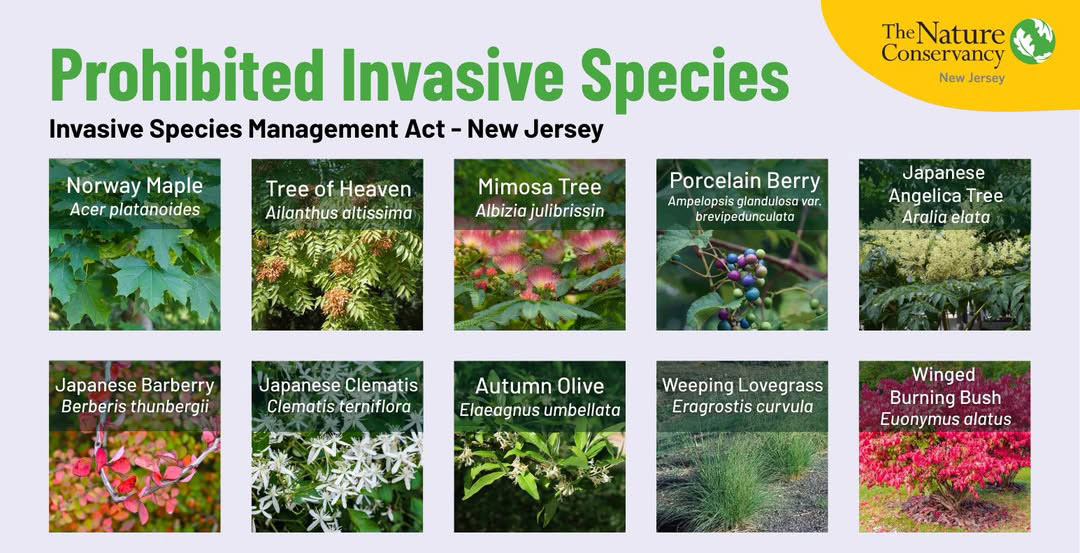
These are among more than 30 species now designated as “prohibited invasive species” under the law.
The legislation defines invasive species as non-native organisms that can spread aggressively and cause environmental, economic, or health-related harm — often because they lack natural controls in their new environment.
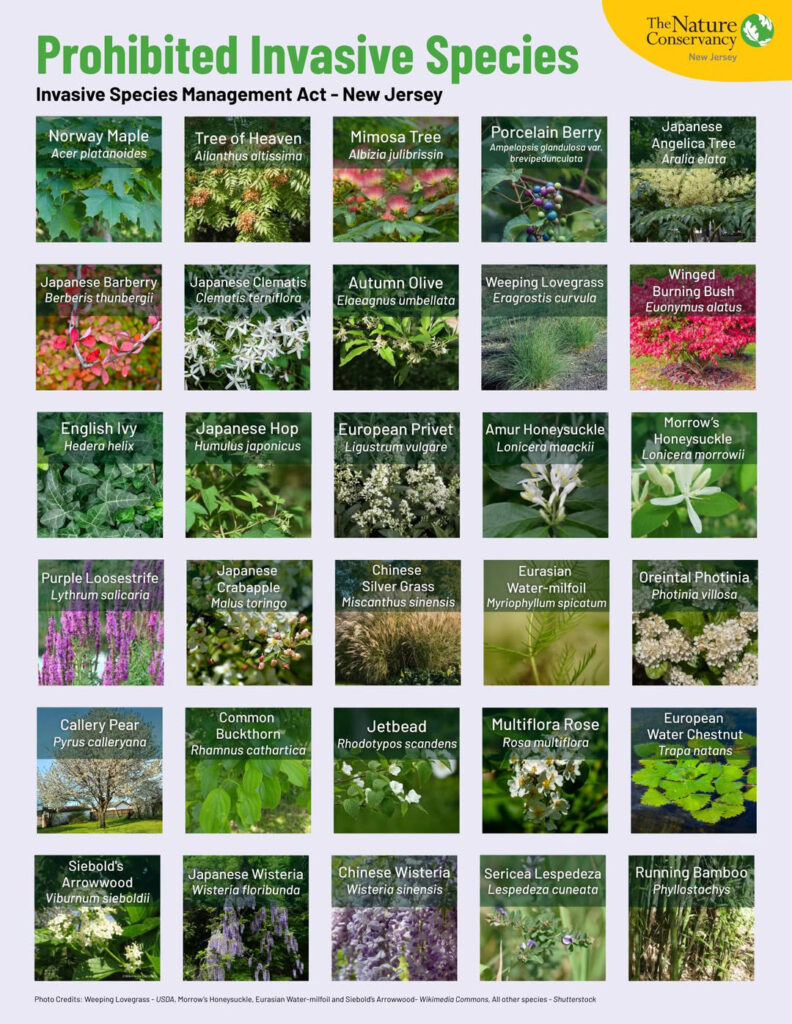
The full list: What plants are now restricted
The law specifically identifies the following plants as prohibited invasive species in New Jersey:
- Norway maple
- Tree of heaven
- Mimosa tree (Persian silk tree)
- Porcelain berry
- Japanese angelica tree
- Japanese barberry
- Japanese clematis
- Autumn olive
- Weeping lovegrass
- Winged burning bush
- English ivy
- Japanese hop
- European privet
- Amur honeysuckle
- Morrow’s honeysuckle
- Purple loosestrife
- Japanese crabapple
- Chinese silver grass
- Eurasian water-milfoil
- Oriental photinia
- Callery (Bradford) pear
- Common buckthorn
- Jetbead
- Multiflora rose
- European water chestnut
- Siebold’s arrowwood
- Japanese wisteria
- Chinese wisteria
- Sericea lespedeza
- Running bamboo
Additional species may be added through future rulemaking by the state.
What the law actually does
The new law creates a statewide framework for managing invasive species, including:
- A formal list of prohibited plants
- A phased timeline restricting their sale, distribution, and propagation
- The creation of a permanent New Jersey Invasive Species Council to guide policy and science-based decisions
Under the timeline laid out in the legislation, propagation and importation of listed species will be restricted roughly one year after enactment, with broader sales bans following in later years.
The law also allows for a gradual phase-out period for nurseries and growers, rather than requiring immediate removal of inventory — an approach intended to balance environmental goals with economic realities.
Penalties for violations can reach up to $2,000 per day in some cases.
Why it matters now
For residents, the law does not require immediate removal of invasive plants already on private property.
But experts say the shift is likely to influence what is available at garden centers, how landscapes are designed, and how municipalities approach planting and land management.
Even small patches of invasive plants can spread beyond property lines — carried by birds, wind, or water — into parks, preserved land, and neighboring yards.
Local connection: Hopewell Township’s next step
In Hopewell Township, that broader shift is already starting to take shape at the municipal level.
The Township Committee is expected to vote in early May on a native plant landscaping ordinance that would require the use of native species in certain development applications.
The proposal, developed with input from the Environmental Commission, is designed to encourage planting practices that support local ecosystems — aligning closely with the goals of the new state law.
What homeowners can do
For now, the biggest impact for most residents may be awareness.
Understanding which plants are considered invasive — and choosing native alternatives when planting — is expected to play a key role in the law’s long-term success.
As the growing season begins, what appears in local yards, parks, and open spaces may gradually shift — shaped not just by preference, but by policy aimed at restoring balance to New Jersey’s ecosystems.