

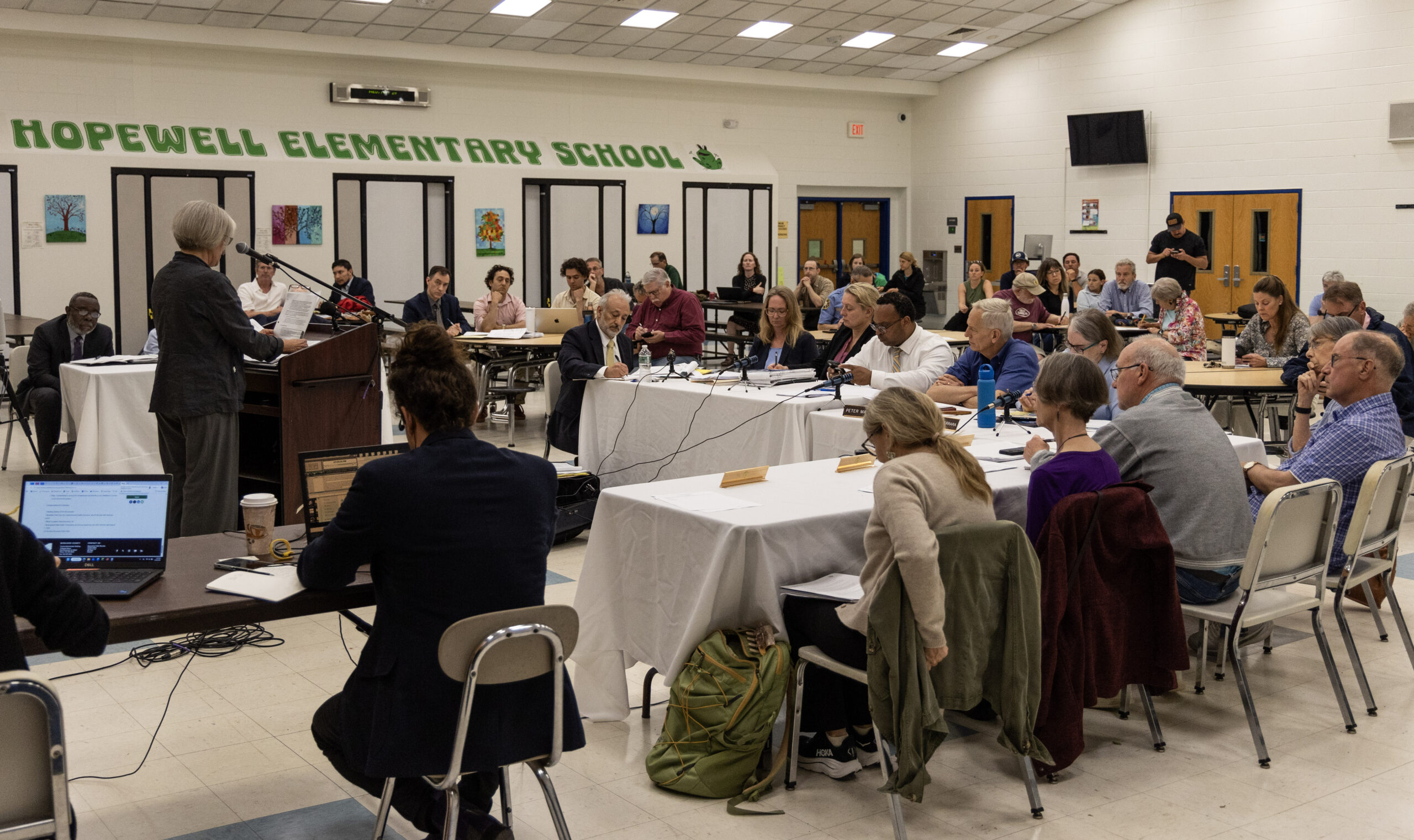
After months of hearings, testimony, and increasingly emotional public debate, the Hopewell Borough Planning Board closed public comment Wednesday night on the proposed Hopewell 57 redevelopment project, moving the application one step closer to board deliberations and an eventual vote.
The meeting, held again at Hopewell Elementary School to accommodate the large crowd, lasted more than three-and-a-half hours and reflected mounting frustration among residents over both the scale of the proposed 120-unit development and the process surrounding it.
While applicant professionals and borough consultants continued to defend the project’s traffic and stormwater analyses, residents repeatedly questioned whether the board still had meaningful authority to alter aspects of the proposal after the Borough Council’s earlier approval of the redevelopment plan and redevelopment agreement.
“I feel sort of bamboozled and ignorant,” one resident said during public comment, asking board members to explain how unresolved questions from residents would ultimately be addressed. “I am sure other people feel the same way.”
The project, proposed for the former industrial and commercial property along Hamilton Avenue, includes market-rate and affordable housing and complies with the borough’s redevelopment plan without requesting variances.
Public Comment Process Draws Frustration
The hearing opened with the board attorney Christopher DeGrezia explaining that the meeting would focus heavily on public comment and that the applicant had granted the board an extension under New Jersey’s Municipal Land Use Law to avoid the possibility of an automatic approval if statutory deadlines expired.
Board officials also attempted to tighten procedures for public participation, encouraging speakers to keep comments to roughly three minutes so more residents could be heard. The change itself became a source of frustration for some attendees, who noted that earlier meetings had allowed more extended back-and-forth exchanges between residents, applicant professionals and the board.
“We want to hear what you have to say, but we want to hear from everybody,” DeGrezia said early in the hearing while explaining the effort to keep comments focused.
As the hearing progressed, several residents expressed confusion and concern about shifting procedures and what they viewed as diminishing opportunities for dialogue.
Resident Keith Hovey, speaking on behalf of the Hopewell Community Alliance, argued that residents had repeatedly been told during earlier redevelopment discussions that many of their concerns would be addressed later during Planning Board review.
“We were told, ‘Go to the planning board when a site plan is submitted. Don’t worry about zoning ordinances now,’” Hovey said.
Hovey said many residents now feel the board’s authority is more limited than originally understood because the redevelopment framework has already been approved.
Hopewell Community Alliance Organizes Opposition Effort
Much of the organized opposition during the latest phase of the hearings came through the Hopewell Community Alliance, a newly formed 501(c)(3) nonprofit focused on development and planning issues within the borough.
During the hearing, Hovey referenced the group’s efforts to retain outside experts to review the project’s traffic and environmental impacts.
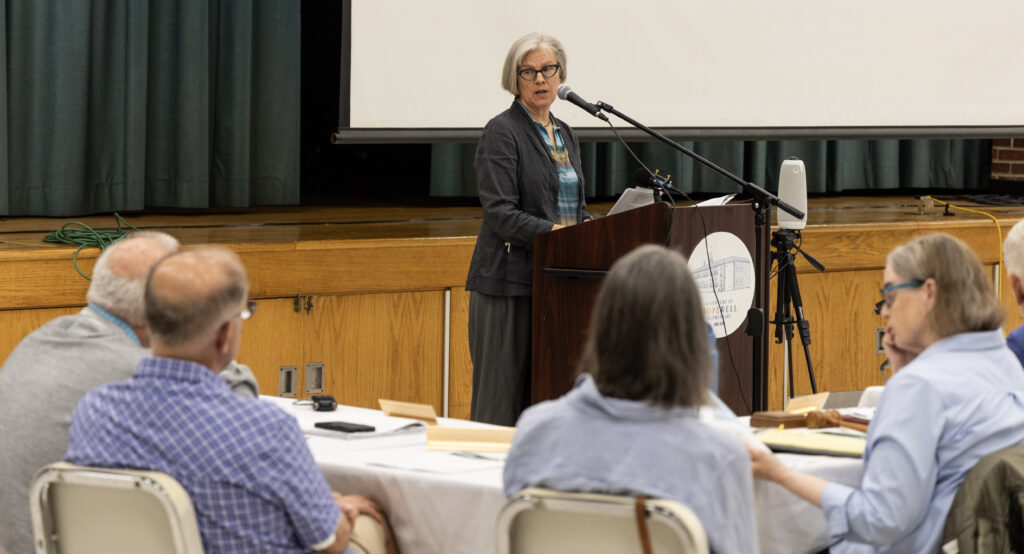
The organization brought in professional engineer and traffic consultant Lee Klein as well as environmental and floodwater expert Susan Bristol to testify during the public comment portion of the hearing.
Klein challenged several assumptions within the applicant’s parking and traffic analysis, arguing the project should not rely on surrounding streets for parking overflow and questioning whether the proposed parking ratio accurately reflects local car ownership patterns.
Susan Bristol focused heavily on flooding and environmental concerns, particularly surrounding stormwater management, drainage and future flood resilience standards.
Their testimony was repeatedly referenced by residents throughout the evening as community members urged the Planning Board to slow the process and more critically examine unresolved engineering and environmental questions before moving toward a vote.
Traffic and Parking Remain Central Issues
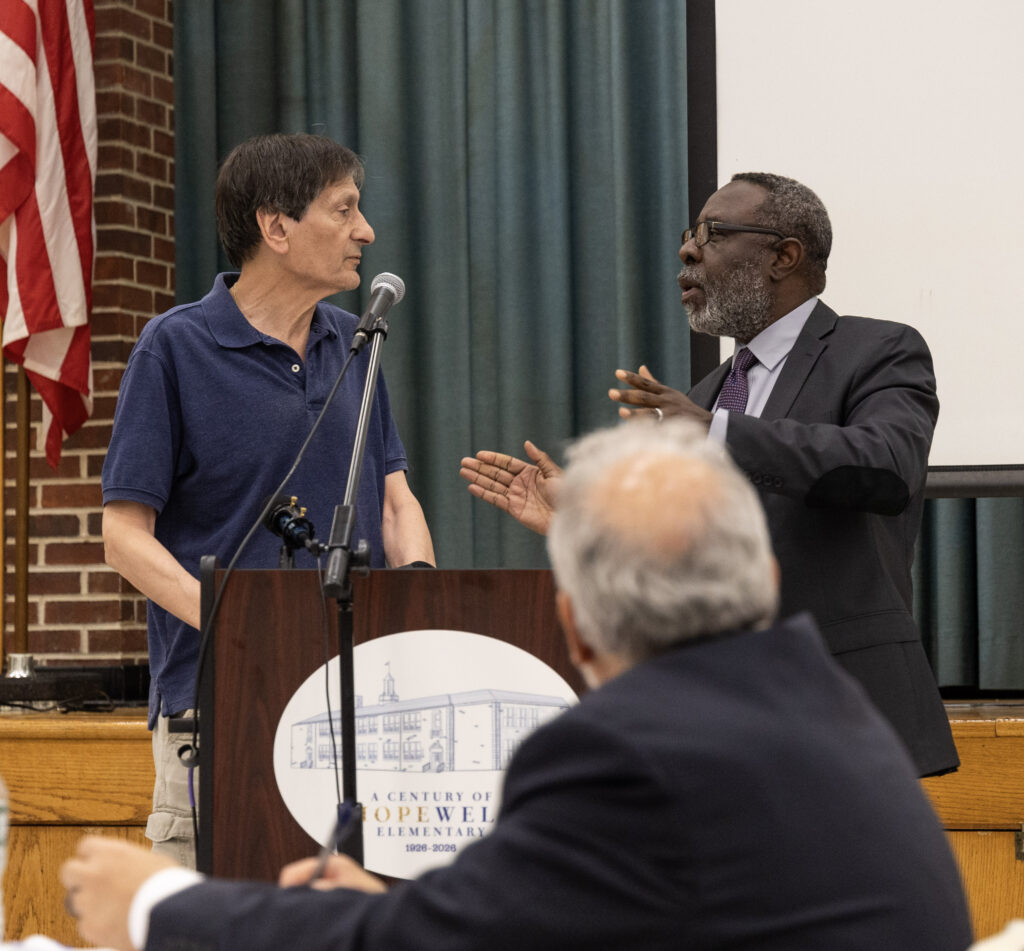
Traffic remained one of the central topics throughout the evening.
The applicant submitted a supplemental intersection analysis examining additional intersections at Lafayette Street and Elm Street and at East Broad Street and Princeton Avenue after residents previously challenged aspects of the traffic study.
Applicant traffic engineer Victor Anosike testified that the updated analysis showed no meaningful deterioration in traffic conditions.
“Level of service A remains the same,” Anosike said regarding the Lafayette and Elm intersection, describing delays as “very minimal.”
The borough’s traffic consultant largely concurred with those conclusions in a May 15 review memo, writing that the proposed development was “not expected to have an adverse effect” on operations at the analyzed intersections.
Still, residents and their own experts continued to challenge key assumptions behind the traffic and parking analysis.
“They have more than enough parking on their site,” Klein testified while arguing that the development should not rely on surrounding streets for overflow parking.
Klein also questioned whether the project’s parking ratio of 1.5 spaces per unit realistically reflects local car ownership patterns.
“Sixty-one percent of the people in this area own two or more cars,” Klein said, referencing research conducted by residents. “The one point five might be a little on the low side.”
Some residents also proposed broader traffic calming changes around the site.
Hopewell Borough resident Clark Reed, who described himself as a “Hopewell Borough lifer” who grew up on Harrison Avenue, urged officials to consider additional stop signs, sidewalks and converting part of Hamilton Avenue to one-way traffic.
“I think that these kinds of little things add up,” Reed said. “If we all work together to kind of get this project the best place that it can be.”
Flooding and Stormwater Concerns Continue
Flooding and stormwater management concerns also surfaced repeatedly throughout the hearing.
Supplemental stormwater review documents submitted to the board by borough engineers identified numerous outstanding technical issues still requiring clarification or revisions, including drainage routing, runoff calculations, pipe capacity and questions involving 100-year storm events.
Bristol, speaking on behalf of the Hopewell Community Alliance, argued that the project site sits within the Bedens Brook watershed and in an area with longstanding flooding concerns. Her report cited state flood mapping tools, watershed planning documents and borough infrastructure studies while arguing additional flood-control, environmental and stormwater documentation should be provided before the board votes on the application.
Residents living near the site questioned whether the borough and the applicant could adequately guarantee protection from future flooding events.
“I stand here as an individual who lives right across the street, who has seen the flooding from Ida and Henri and had to refinish his basement twice,” Hovey said. “What it sounds like people are telling me is that even though it’s not my fault, it’s going to be my responsibility when it goes sideways.”
Residents and experts also raised questions surrounding pending state flood resilience regulations known as the “REAL” rules and whether unresolved permitting questions could become significant as the project moves forward.
Bristol also connected the project to broader downstream flooding concerns along the Broad Street corridor and other redevelopment areas, including the Castoro property.
Residents Raise School Funding and Growth Concerns

Several speakers widened the discussion beyond the project itself, raising concerns about the cumulative impacts of development on schools, infrastructure and borough services.
Residents referenced ongoing school funding pressures and the broader financial strain already facing the Hopewell Valley Regional School District, which has spent the past year discussing enrollment growth, facilities expansion and rising operating costs connected in part to new housing development throughout the region.
Others questioned whether the borough would ultimately face additional infrastructure costs tied to traffic, drainage and long-term maintenance issues surrounding the redevelopment.
At several points, the hearing reflected not only disagreements about the project itself, but broader tensions about growth, redevelopment and the future character of Hopewell Borough.
“This development with the four stories, the people coming in, is on the horizon,” Reed said while warning that other redevelopment pressures may follow. “It’s on the horizon.”
Planning Board Expected to Begin Deliberations
Public comment on the Hopewell 57 application has now concluded.
The Planning Board is expected to begin deliberations on the application at their meeting on June 10 at 7pm at Hopewell Elementary School.