

The Hopewell Valley Regional Board of Education voted Monday, March 23 to advance a tentative 2026–27 school budget that includes a 5.2% tax levy increase, the result of months of deliberation over rising costs, growing enrollment, and how much of the burden the community could reasonably absorb.
The board unanimously approved the proposal, which will now be submitted to the Mercer County Executive Superintendent for review ahead of a public hearing scheduled for April 27.
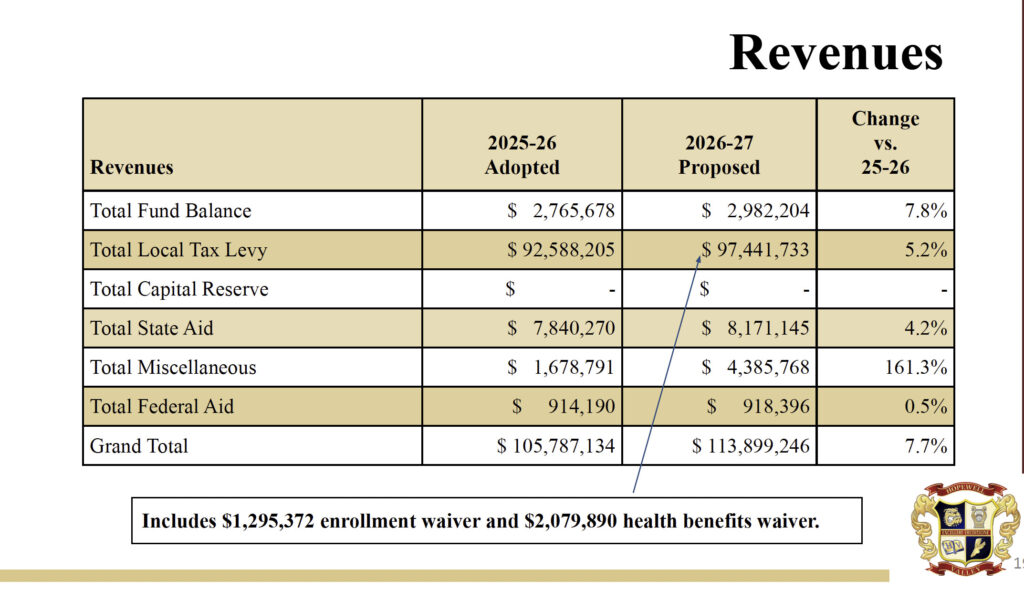
The tentative budget includes a total general fund tax levy of $94.7 million and a total levy across all funds of $97.4 million.
But behind the unanimous vote was a more complicated discussion—one that reflected a board trying to avoid both steep tax increases and the kind of cuts that have reshaped school districts across New Jersey.
What the tax increase means for residents
The proposed budget represents a 5.2% overall tax levy increase, a figure district officials said reflects both rising costs and deliberate efforts to limit the burden on taxpayers.
The increase is lower than the district’s 5.8% general fund tax levy growth, due to a reduction in debt service payments.
Assistant Superintendent for Finance Robert Colavita explained that while the district’s operating costs continue to rise, changes in debt service—and the timing of 2025 referendum spending—are helping soften the immediate impact.
“That is a way to push off the impact of the new referendum for at least a year,” Colavita said.
Because the district issued bonds earlier this year but will not begin major construction spending until later, those funds are currently being invested, generating interest revenue that can be used to offset debt payments.
“That money will sit for nearly a year earning interest… we will earn enough interest to pay the entire debt service balance of the new debt for next year,” he said.
In practical terms, the district is increasing spending on day-to-day operations, but temporary savings on debt payments are reducing the immediate impact on taxpayers.
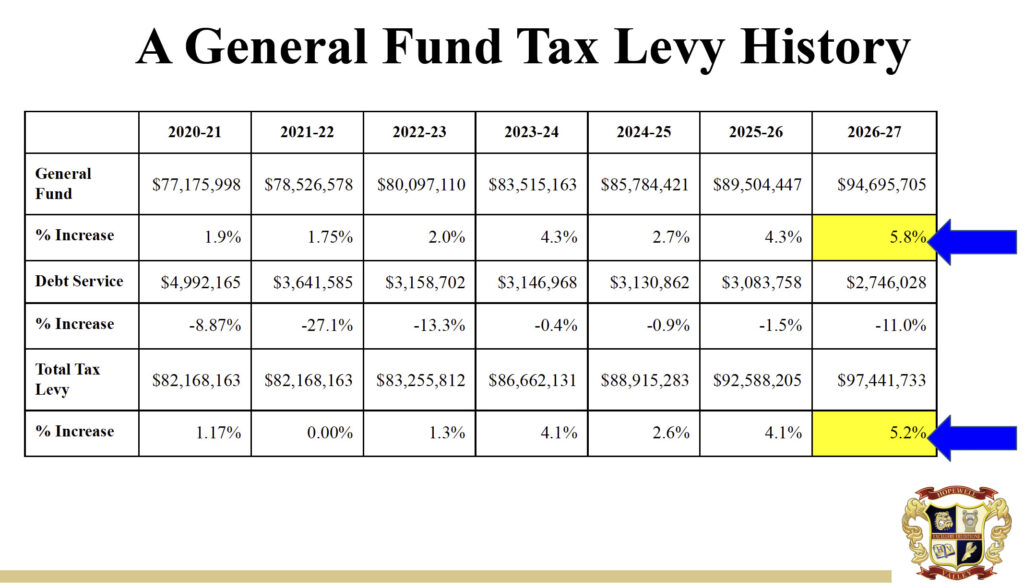
An approximately 11% drop in debt service—tied in to earlier 2016 referendum debt—helps bring the overall levy increase down to 5.2%.
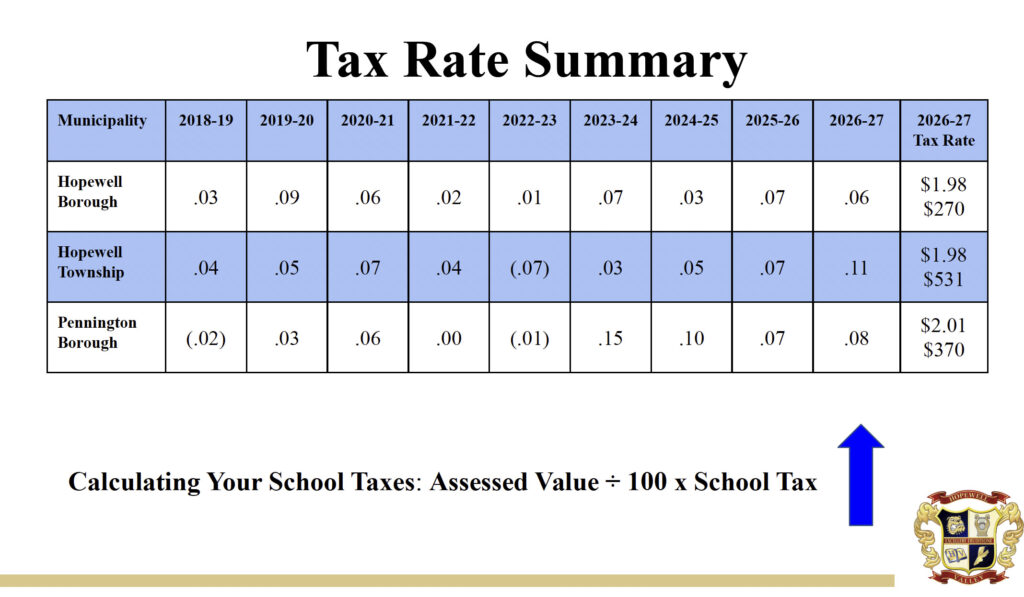
For the average homeowner—based on a property assessed at approximately $500,000—the projected annual increase is:
- About $531 in Hopewell Township
- About $370 in Pennington Borough
- About $270 in Hopewell Borough
Colavita also emphasized how dependent the district is on local taxes with 85-90% of the budget coming from taxes and local revenue.
How the full budget is funded
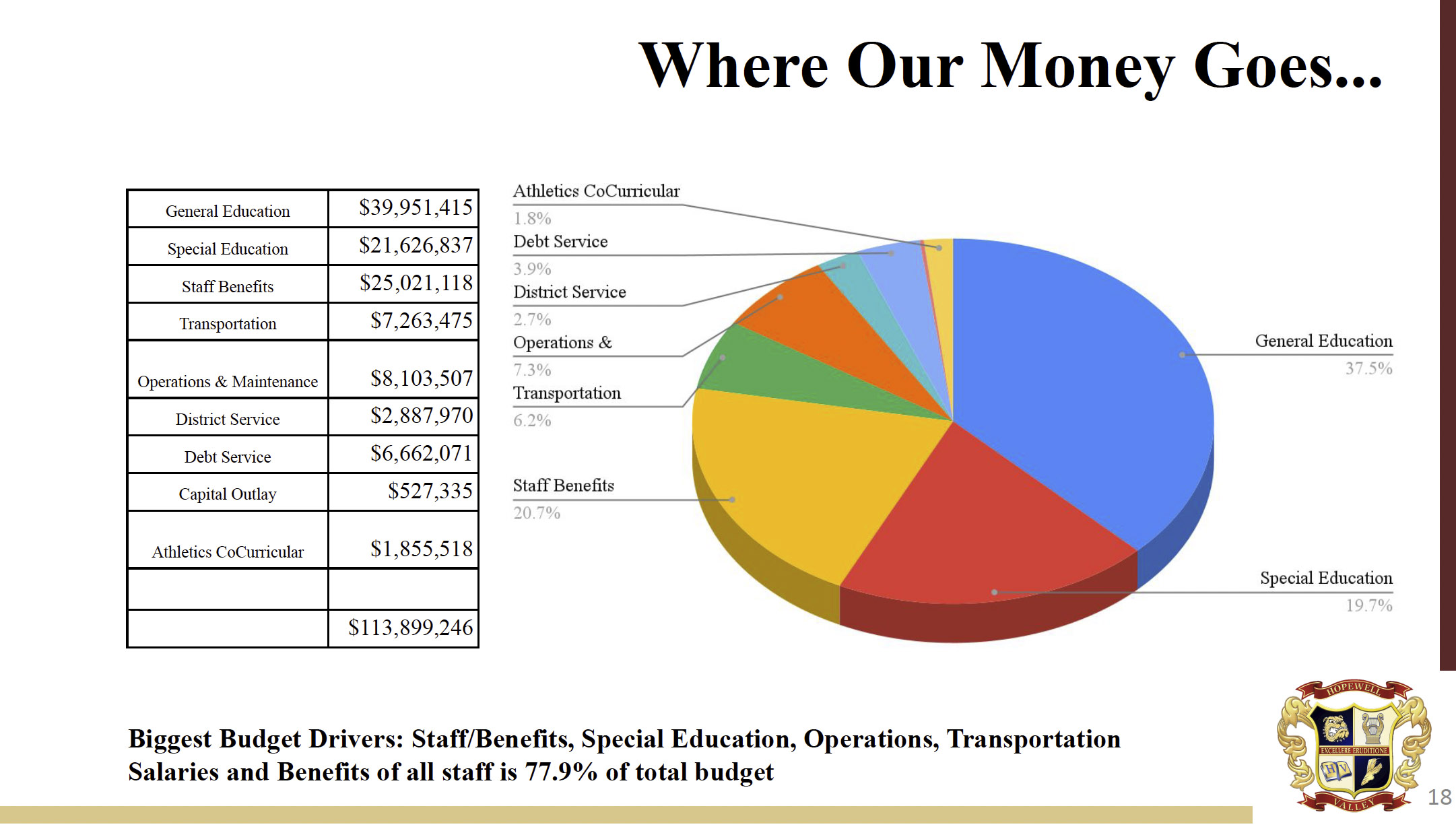
While the district’s total budget is approximately $113.9 million, the proposed tax levy of $97.4 million represents the local share, with the remaining funding coming from state aid, federal grants, surplus, and other revenue sources.
The district’s general fund—its primary operating budget—totals about $106.3 million, of which approximately $94.7 million is supported by local taxes.
Additional funds, including the special revenue fund and portions of the debt service fund, are supported through non-tax revenue such as grants and interest earnings.
In simple terms, the district’s total budget reflects everything it plans to spend, while the tax levy reflects what local residents are asked to pay.
Rising costs and enrollment driving the budget
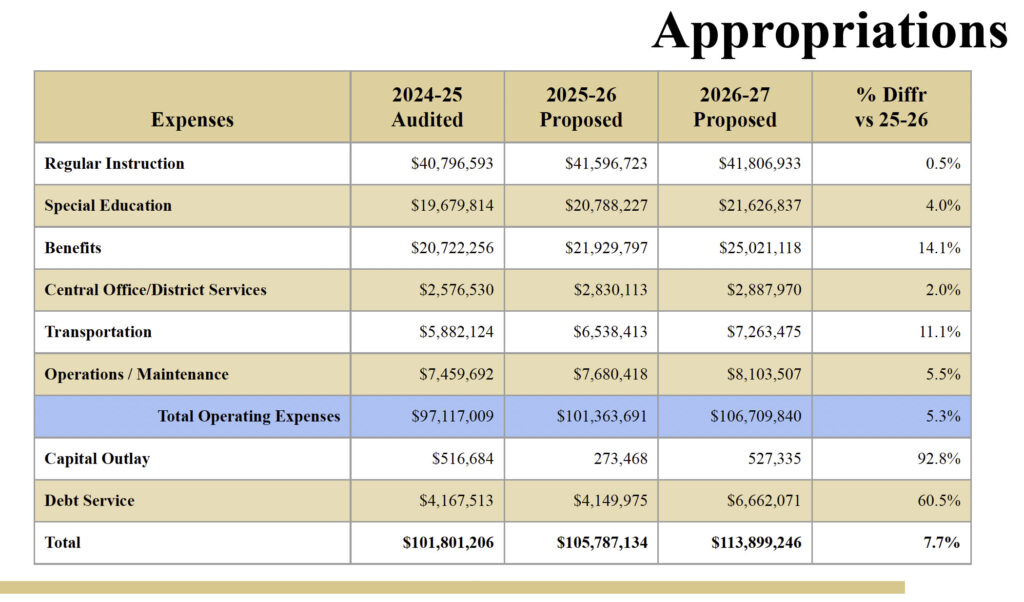
Among the most significant pressures shaping the 2026–27 budget is the rising cost of employee health benefits.
The district budgeted approximately $17.3 million for health insurance this year but is already running about $1.5 million over budget. Next year’s costs are projected to climb to more than $20 million, continuing a trend that outpaces other areas of spending.
Colavita said those increases are largely outside the district’s control.
“We can’t,” he said when asked about adjusting health plans, noting that current state law limits changes until the end of 2027.
Even with those constraints, he said, the district is performing better than some alternatives, noting that costs could be higher under the state health benefits system with some districts dealing with 30-50% increases.
Health care costs alone consume much of the district’s allowable revenue growth. Combined with modest increases in state aid and the 2% tax cap, those fixed expenses quickly narrow the district’s financial flexibility.
“Just rolling over our salaries from this year to next year… you can see the difficulty we would have,” Colavita said.
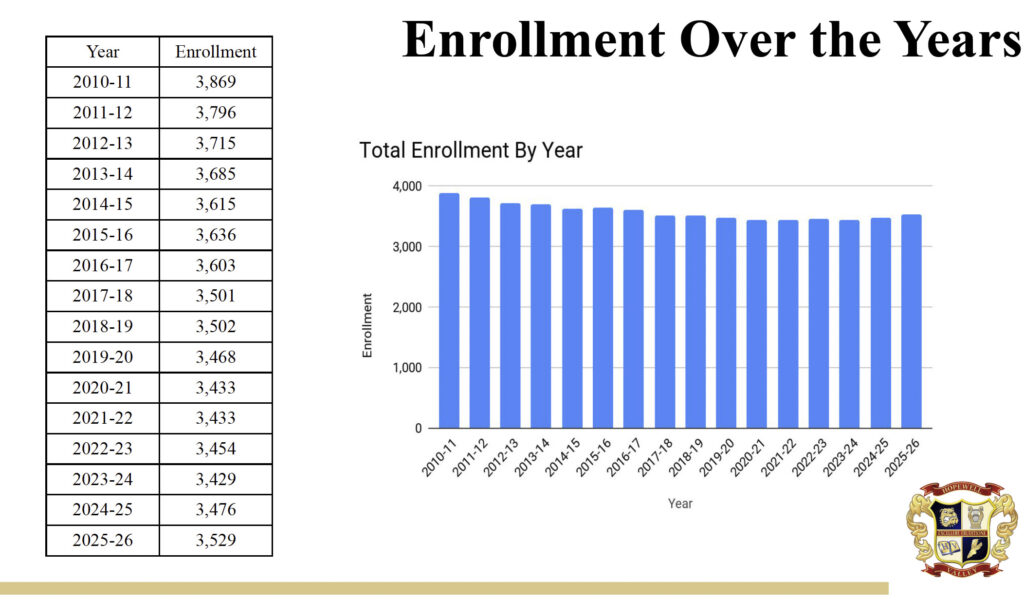
At the same time, enrollment is rising again after more than a decade of gradual decline.
District data shows enrollment increasing from 3,429 students in 2023–24 to 3,529 in 2025–26, reversing a long-term downward trend.
Administrators said that growth is being driven by new housing developments across the region and is expected to continue in the coming years.
“We are seeing an uptick, and we should continue to see that uptick for the next several years,” Colavita said.
That increase brings added costs for staffing, classroom space, transportation, and student services—many of which are required under state law.
“These are not optional for the district,” Superintendent Dr. Rosetta Treece said.
Administrators emphasized that these pressures are ongoing, not one-time increases.
A regional squeeze: balancing taxes, cuts, and what schools can offer
District officials made clear the choices facing Hopewell Valley are not unique—and that even a higher tax increase would not fully resolve the pressures shaping this year’s budget.
At earlier points in the process, administrators said the tax levy could approach 6%. But even at that level, Treece said the district would still be forced to make cuts.
“I don’t feel comfortable… asking the taxpayer and us not feeling something too,” she said, emphasizing that reductions had to be part of the solution—not just higher taxes.
Instead, the board reduced the budget by roughly $950,000 and settled on a lower increase.
The discussion reflected a broader reality playing out across the region.
In Robbinsville, officials have warned of deep cuts—including potential layoffs and reductions to programs—after voters rejected an operating referendum. In Montclair, a narrowly approved referendum and ongoing budget pressures have forced difficult decisions about staffing and services after that district was around $20 million in the hole.
Elsewhere in New Jersey, districts in Monmouth County have moved to close schools while still raising taxes, underscoring the scale of the financial gap many systems are facing.
“We see school districts around us that have been devastated — they’ve lost all their sports, they’ve lost clubs, they’ve lost programming,” Treece said.
Board member Mark Peters added that local structural issues can further compound the problem, particularly when development does not translate into school funding.
“When a PILOT (payment in lieu of taxes) is put in place on the developments, it is like fence goes around the PILOT, and that doesn’t become part of the taxable base,” Peters said. “Which means that everyone else has to pay a larger share.”
That combination—rising costs, limited state aid, and constraints on local revenue—leaves the district with few options beyond some mix of tax increases and cuts.
Cuts spread across programs and operations
To close the budget gap, the district outlined a range of reductions affecting staffing, programs, and student experiences.
Among them:
- Staff reductions primarily through attrition
- Increased class sizes
- Reductions in field trips, guest speakers, and assemblies
- Cuts to supplies, subscriptions, and school-level budgets
- Scaling back curriculum development and program expansion
- Potential elimination of under-enrolled programs and clubs
Those reductions reflect an effort to spread the impact across the district rather than concentrate it in a single area.
“There’s no way we can just keep holding on everything and not have to make changes,” Treece said.
She also warned that future cuts could go further if financial pressures continue.
The temporary reduction in debt service, officials noted, will not last, meaning the full impact of referendum borrowing is expected to be felt in future budgets.
Understanding the cap and limited options
New Jersey law generally limits school tax levy increases to 2%, but districts can exceed that cap through specific adjustments.
This year, the district used waivers that allowed for:
- $2.08 million in a health care cost adjustment
- $1.29 million in an enrollment adjustment
Even with those adjustments, administrators said the allowable increases are quickly consumed by fixed costs.
Next steps
The tentative budget will now be reviewed by the county before returning to the board for final adoption.
A public hearing is scheduled for April 27 at 6:30 p.m. at the district administration building.
Residents will have another opportunity to comment before the budget is finalized.