
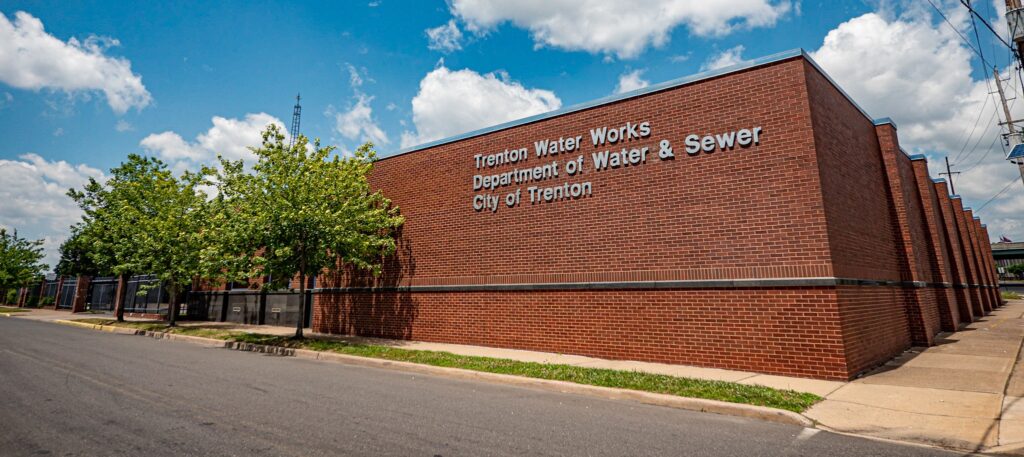
Trenton Water Works (TWW) issued a Water Conservation Advisory on Thursday, asking more than 200,000 customers in its five-municipality service area to voluntarily reduce water use amid freezing temperatures that have disrupted operations at the water filtration plant.
The advisory applies to residents in Trenton, Hamilton, Ewing, Lawrence, and Hopewell Township, and urges customers to limit water use to essential needs such as drinking, cooking, sanitation, and emergency purposes. Non-essential uses — washing cars, watering landscaping, filling pools, or running appliances with partial loads — are discouraged until further notice.
“Cold weather impacts the performance of our water infrastructure,” said Sean Semple, director of Trenton’s Department of Water and Sewer, in the utility’s announcement. Semple said that while treatment and distribution remain operational, “freezing temperatures and prolonged cold weather conditions affect TWW’s water filtration plant’s ability to pump water from the supercooled Delaware River and water mains and service lines in our 683-mile distribution system.”
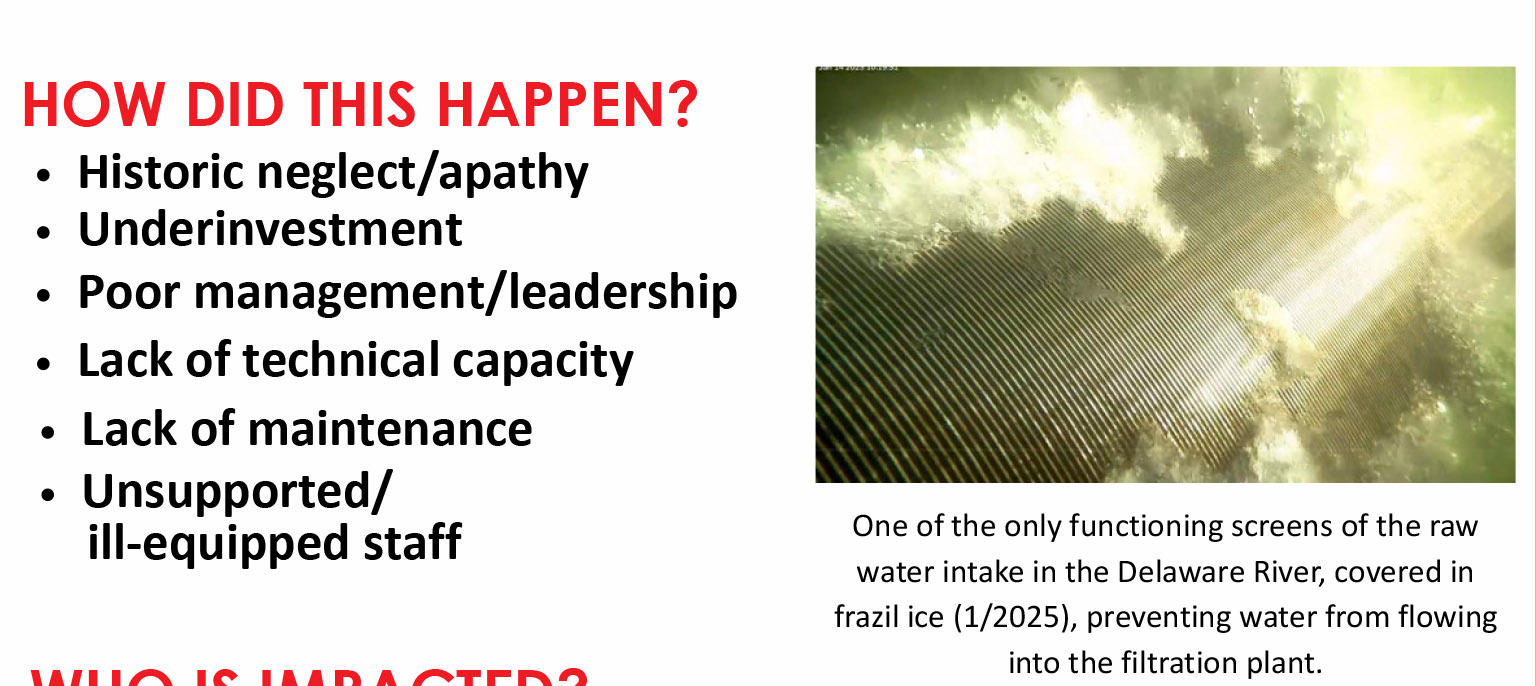
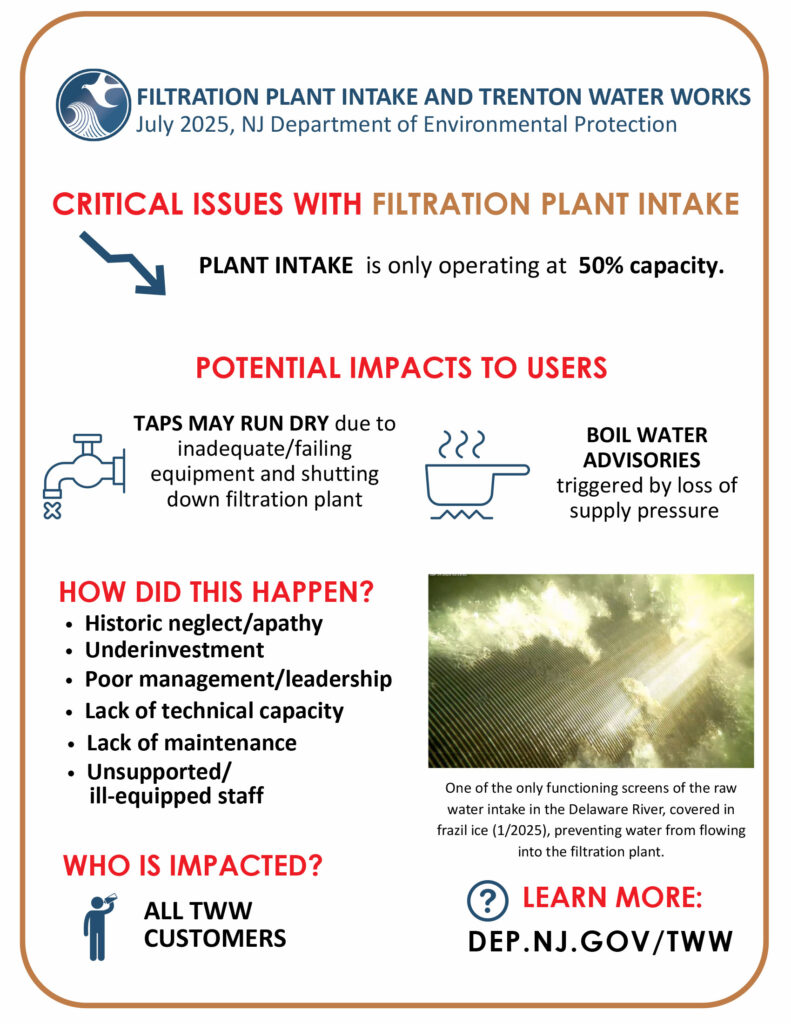
The advisory comes as frazil ice — slushy, fast-forming ice crystals that can clog raw water intakes — once again hampers the utility’s ability to pull water from the Delaware River, an issue that also surfaced during last winter’s shutdowns.
NJDEP: Intake Problems are an Emergency and Conservation Notice Required
TWW’s announcement follows a sharply worded December 12 letter from the New Jersey Department of Environmental Protection, which confirmed that TWW’s treatment plant was forced to shut down for several hours last week due to frazil ice at the intake. NJDEP said the problem, combined with ongoing water main breaks and a planned shutdown for intake cleaning, caused the Pennington Reservoir to drop below normal operating levels.
To protect supply through the winter, NJDEP ordered TWW to postpone the rest of its intake cleaning project until spring, when ice formation is no longer a risk.
The letter states that “the frazil ice conditions continue to demonstrate that the intake is a critical point of failure that must continue to be addressed as an emergency.” It mandates that TWW:
- Issue a water conservation notice until further notice.
- Provide daily updates on reservoir levels and interconnections through March 2026.
- Procure an emergency contract for divers to clear frazil ice when needed.
- Provide updates on the intake redesign RFP.
Surrounding Mayors Call it “A Bad Comedy Show”
The mayors of Hamilton, Ewing, and Hopewell Township issued a joint statement Friday, saying the advisory reflects TWW’s continuing inability to manage predictable winter conditions.
“If it did not have real world impacts, we would think this is a bad comedy show,” the mayors said. “Under their current leadership, TWW has failed time and time again… If we weren’t already worried about brown water or legionella; now we again must worry if we even have any water.”
They called on lawmakers in Legislative Districts 14 and 15 to amend the Water Infrastructure Protection Act to allow NJDEP — not TWW leadership — to determine when a system requires public reformation hearings. The mayors added that they will work with the state to explore whether the TWW-served municipalities could create their own regional water utility to “permanently divorce ourselves of TWW’s incompetence.”
What is Frazil Ice?
Frazil ice forms when supercooled water in a river begins to freeze into tiny, slushy crystals rather than solid sheets. Unlike the surface ice most people are familiar with, frazil ice develops below the surface, swirling in the water like a thick slush.
For water systems that pull raw water directly from a river — like Trenton Water Works — frazil ice can clog intake screens and pipes, drastically slowing or even stopping the flow of water into the treatment plant. When this occurs, utilities may be forced to reduce pumping or temporarily shut down operations until it is cleared.
Frazil ice typically forms during prolonged cold snaps, particularly when water is fast-moving and turbulent, conditions that prevent solid ice sheets from forming. Because the Delaware River rarely freezes over completely, frazil ice can recur multiple times each winter, creating repeated stress on TWW’s already vulnerable intake system.
Part of a Growing Timeline of Breakdowns
Thursday’s advisory is the latest development in a turbulent year for Trenton Water Works.
In July, NJDEP issued a major enforcement letter warning that TWW’s infrastructure was at risk of “catastrophic failure,” citing numerous issues with TWW including frazil ice and the intake system as among the water system’s most vulnerable components. You can read that earlier coverage here:
https://mercerme.com/njdep-warns-of-catastrophic-failure-risk-at-trenton-water-works-as-infrastructure-risks-mount/
In November, all four suburban towns served by TWW, including Hopewell Township, Hamilton, Ewing, and Lawrence, formally joined NJDEP’s lawsuit against the city over persistent violations and delays in mandated infrastructure upgrades:
https://mercerme.com/all-suburban-towns-join-njdep-lawsuit-against-trenton-water-works-as-2025-failures-mount/