

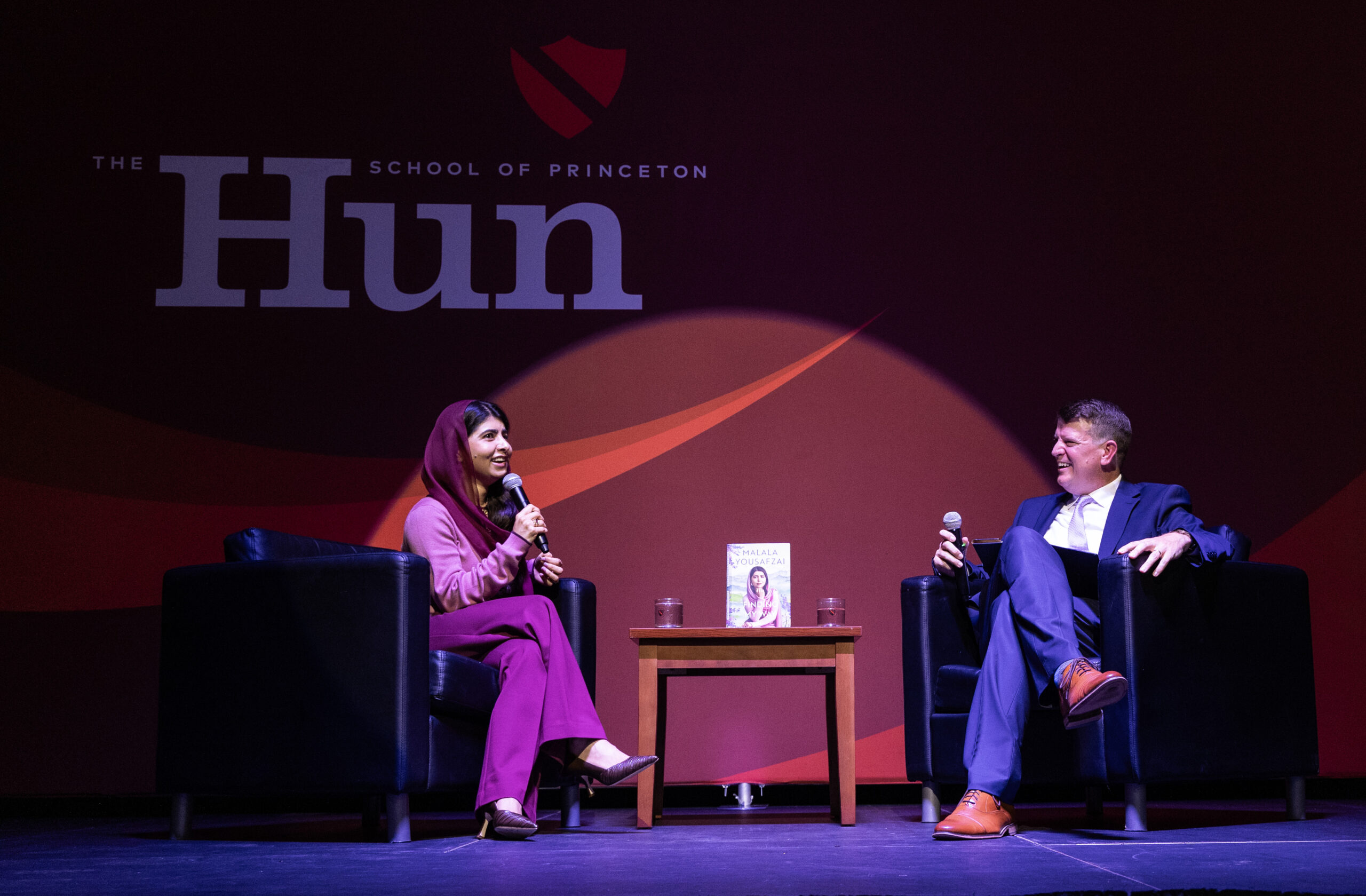
Malala Yousafzai was 11 when she began speaking publicly about girls’ right to an education as the Taliban tightened its control over Pakistan’s Swat Valley. She was 15 when a Taliban gunman shot her on her way home from school. At 17, she became the youngest person ever awarded the Nobel Peace Prize.
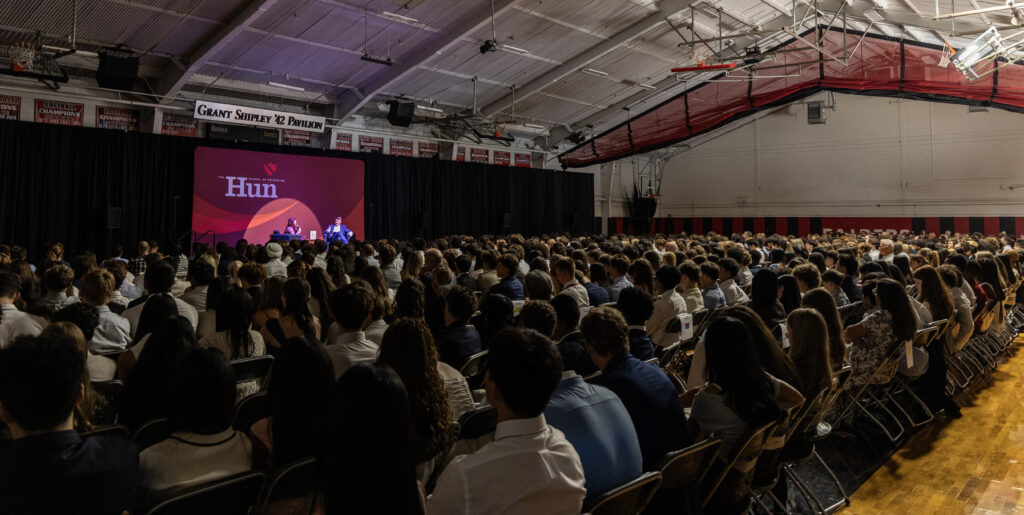
On Monday, sitting before a gym filled with hundreds of students at The Hun School of Princeton, Yousafzai talked about all of that.
But she also talked about something that has increasingly occupied her in the years since: getting the chance to simply grow up.
Yousafzai visited Hun on Sept. 14 to open the school’s Centennial Speaker Series, which brings authors, artists and thought leaders to campus to broaden students’ understanding of the world.
Students filled rows of chairs across the athletic center, facing a stage where Yousafzai and Head of School Bart Bronk sat in armchairs with a copy of her new memoir, Finding My Way, between them.
Their wide-ranging conversation moved between the extraordinary circumstances that made Yousafzai one of the world’s most recognizable advocates for girls’ education and the more ordinary experiences that followed — lonely high school lunches, college friendships, falling in love, social media and figuring out who she wanted to become.
Yousafzai, now 29, said she wanted to share more of the person behind the public story in Finding My Way, released earlier this month.
“I wanted to share this story now because I know that a lot of young people learn about me at school, or they do a project, and I wonder, like, how they perceive that story,” Yousafzai said.
She recalled learning about historical figures whose lives could appear almost perfect in retrospect, without their personal struggles, friendships and families.
“I was wondering, you know, like, am I supposed to be like a normal person?” she said. “Am I allowed to be a normal person as well?”
‘I could not imagine a future for myself without an education’
Bronk began by taking Yousafzai back to the Swat Valley, where her activism began.
Growing up in a family that valued education — her father, Ziauddin Yousafzai, was an educator and advocate for girls’ schooling — Malala began speaking publicly as the Taliban sought to push girls out of classrooms and public life.
She recalled being 10 or 11 and lying awake wondering whether her school would be bombed and whether she would make it safely home.
“At the time, I felt that we had no choice but to speak out, because I could not imagine a future for myself without an education,” she said.
The Taliban, she said, sought to erase women and girls from public life, beginning by denying girls an education.
“I didn’t feel like I had a choice,” Yousafzai said. “I felt that this was the only way I could have this right to keep learning.”
In October 2012, a Taliban gunman shot Yousafzai. She survived and was eventually treated in Birmingham, England.
She described waking in a hospital far from the mountains, friends and life she had known in Pakistan.
“I missed my friends, I missed my old life, I missed that normalcy,” she said.
As she recovered, Yousafzai came to see her survival as an opportunity to advocate for other girls.
“I was grateful that I was living the second life, and I knew that this was now for a purpose,” she said, “and that purpose was to help every girl in the world get access to education.”
She thought about girls whose stories would never receive the same international attention — girls who had lost their education or been married as young teenagers.
“My story is actually not unique,” she said. “This is the story of millions of girls out there.”
Yousafzai and her father founded the Malala Fund in 2013. A year later, she received the Nobel Peace Prize at 17, becoming its youngest-ever laureate.
A Nobel Prize — and lonely lunches
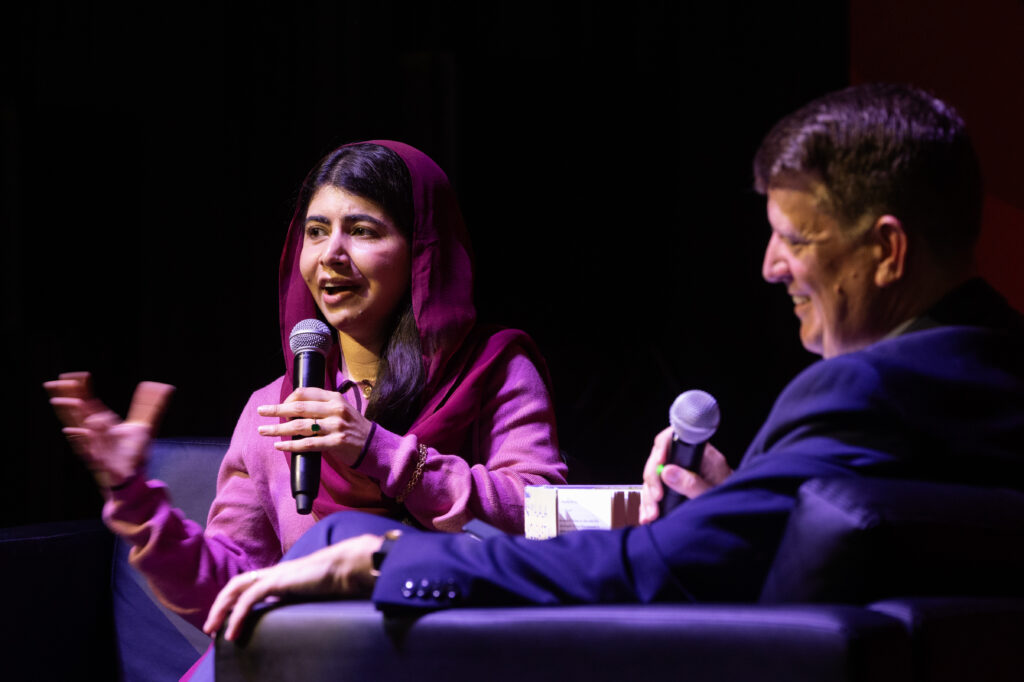
International recognition didn’t make adolescence any easier.
At an all-girls high school in Birmingham, Yousafzai struggled to understand a new culture and make friends. She remembered lonely lunches and wanting simply to fit in.
Then, at 17, a deputy head teacher summoned her from chemistry class.
“And she calls you when you are in trouble,” Yousafzai said. “So I was praying for myself.”
Instead, she learned she had won the Nobel Peace Prize.
For a moment, she joked, classmates suddenly seemed more interested in her. By the next day, everything was back to normal.
“You can have any awards and titles, but you still may not be cool enough for your school friends,” she said.
Her advice now to that teenage version of herself would be to be less hesitant, talk to people and participate.
“You are not alone,” she said. “Go out and participate in as many things as possible, and enjoy and have a laugh and talk to as many people. Make at least more than one friend.”
Finding her own way
At Oxford University, Yousafzai followed that advice. She joined clubs and societies, including rowing and Hindu, Christian and Muslim student groups, and embraced a social life she had missed in high school — even if it sometimes meant staying up until 3 a.m. to finish her schoolwork.
“Every week in college was essay crisis,” she said, but the friendships were “truly worth it.”
Those experiences helped inspire Finding My Way. Yousafzai said she wanted young people experiencing loneliness, anxiety or uncertainty to know they weren’t alone.
“I wish I had a book like this that I could have read,” she said.
She also spoke about falling in love and wrestling with whether to marry after growing up seeing girls forced into child marriage and women expected to make greater compromises.
She ultimately came to see marriage to her husband, Asser Malik, as an equal partnership — despite once telling her college friends she would never marry.
“I was the first one in my friends group to get married,” she said.
Yousafzai also described learning to separate her own choices from other people’s expectations.
Wanting to dress more like other students at Oxford, she once Googled “Selena Gomez casual style” for inspiration. When a photograph of her wearing jeans and a bomber jacket appeared online, she faced criticism from some for supposedly abandoning her culture and from others for continuing to wear a headscarf.
“Why do I have to justify what I wear to people?” she recalled thinking.
Her answer was to “keep wearing jeans and keep wearing what I love.”
Her advice for dealing with social media criticism was equally straightforward: Don’t read the comments.
She drew laughs describing younger TikTok users who are surprised to discover she is still a young woman.
“They thought that I was a figure from the, you know, 19th century or long time ago,” she said. “I’m like, I do feel old, but like not that old.”
Investing in girls
More than 15 years into her activism, Yousafzai said her work has increasingly focused on putting resources and decision-making power directly into the hands of girls.
“A lot of people talk about girls and invite them to tell their stories, but they don’t actually give them grants or give them a seat at the table or include them in the real decision-making process,” she said.
At the Malala Fund, she said, at least 20% of grants go directly to organizations led by girls and young women.
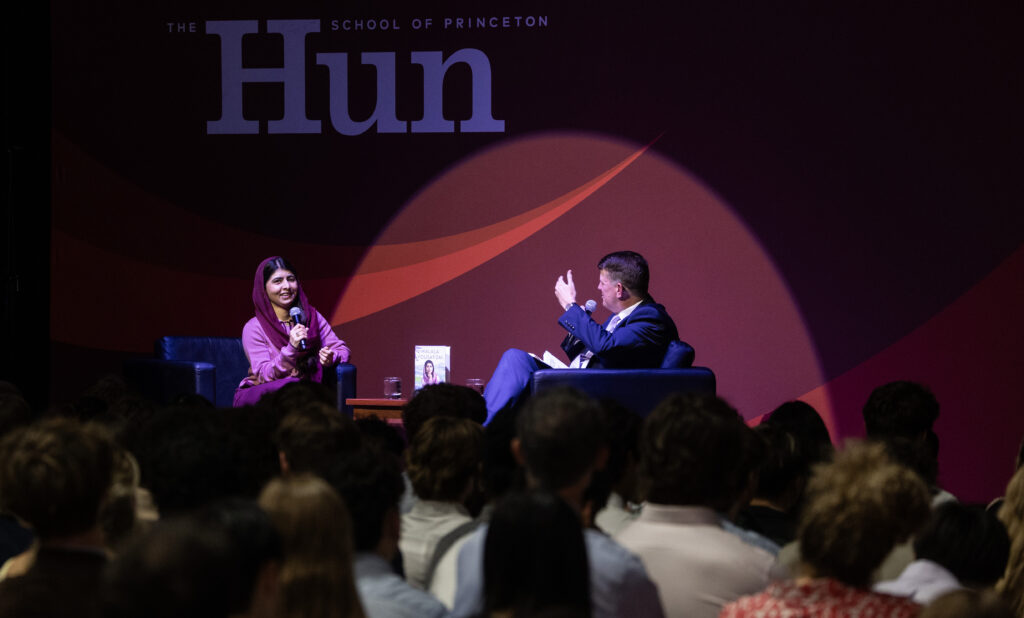
She has also pushed for girls to receive a full secondary education, arguing that adolescence is when barriers including child marriage, period poverty and household responsibilities can increasingly push girls out of classrooms.
“If we are dreaming small and then if we are aiming small, I don’t think we’ll see much progress,” she said.
Asked what brings her the most pride, Yousafzai pointed to girls she has met around the world who are leading change in their own communities.
“When I see all of that work that these girls are leading in their community, that don’t often make it to the headlines,” she said, “it gives me a real sense of happiness and joy.”
Hun students ask the questions
Bronk eventually turned the microphones over to students.
Asked what had changed since she began her activism, Yousafzai said she sees both progress and setbacks. More girls are attending school and policies have changed, she said, while climate disasters, the pandemic and the Taliban’s return to power in Afghanistan have pushed others out of classrooms.
Afghan girls have been barred from school beyond sixth grade, she said, but some continue learning through computers and phones or in underground schools.
“I remember one girl telling me that even reading a book alone in her room is an act of resistance,” Yousafzai said.
A student asked what advice she would give girls entering male-dominated fields.
“If we are the first woman or one of the few women in the room, we are not only bringing a change in that ecosystem, but we are also becoming role models to the next generation of girls as well,” she said.
Another student asked about artificial intelligence and education. Yousafzai acknowledged that she was not an expert on the subject before emphasizing safety, accountability and inclusion.
“Humanity should come first before anything else,” she said, adding that girls and diverse communities should be included in decisions about emerging technology.
A seventh-grader’s question about her family brought Yousafzai back to the role her father played at the beginning of her activism.
Other girls in her classroom had also been willing to speak publicly, she said, but some were stopped by fathers or brothers.
“The only thing that was different in my case was that my father never stopped me,” Yousafzai said. “There was nothing unique in my story other than having a supportive father.”
She said that experience showed why men and boys also have a role in advancing equality.
‘Real change happens when we work collectively’
The final student question brought the conversation back to where it had begun.
“Why does it fall on individual activists to demand change?” a freshman asked.
“I love your question,” Yousafzai responded.
Then she challenged its premise.
“We should not think about change as being one activist-led thing,” she said. “I think that’s what we’re getting wrong.”
One person can recognize an injustice, speak up and start a conversation, she said, without being responsible for solving it alone.
“You don’t have to have all the answers,” Yousafzai said. “You don’t have to be an expert on every issue.”
“Real change happens when we work collectively.”
For the hundreds of students sitting before her in Princeton, Yousafzai had offered a simpler challenge earlier in the afternoon.
“Do what you love and what you are most passionate about,” she said. “I want you to be confident in the dreams that you have for yourself and for your community.”
“Dreaming big is so important,” she added. “I just can’t wait to see the future that you will be leading.”