
For the first time in more than a decade, voters in New Jersey’s 12th Congressional District will choose a new representative in Congress, with four candidates offering different approaches to the economic and political challenges facing the district and the country.
Democratic Rep. Bonnie Watson Coleman, who has represented the district since 2015, announced last year that she would not seek reelection. The decision by Watson Coleman, the first Black woman elected to represent New Jersey in Congress, opened a seat that has been held by Democrats for decades.
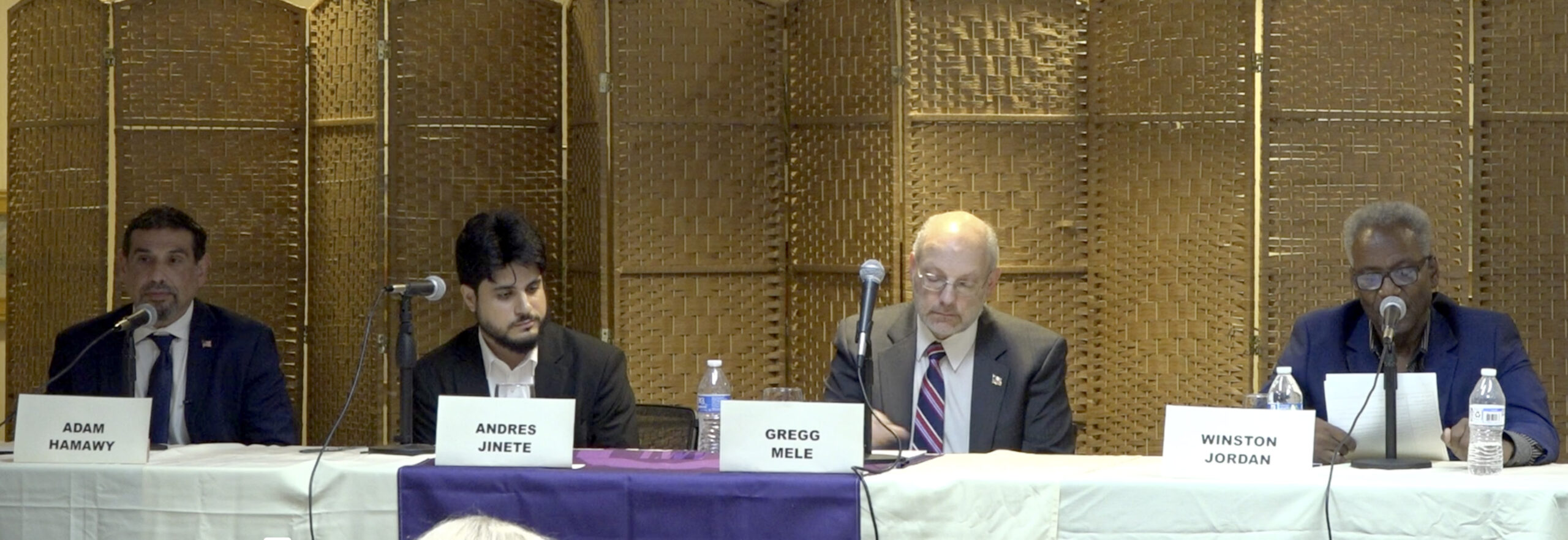
Voters will choose among Democrat Adam Hamawy, Republican Gregg Mele, Green Party candidate Andres Jinete and Winston Jordan, who is running under the ballot designation “Get Money Out.”
All four participated in a recent forum organized by the League of Women Voters of the Greater Princeton Area at Princeton Windrows, a retirement community in Plainsboro. The event gave voters an opportunity to hear directly from the candidates on issues ranging from the cost of living and health care to immigration, government spending, foreign policy and artificial intelligence.
The district includes portions of Mercer, Middlesex, Somerset and Union counties, encompassing communities with widely varying populations, economies and needs, including Trenton, Princeton, the Hopewell Valley and Plainfield.
Although the candidates frequently agreed on the problems facing Americans — particularly rising costs, the influence of money in politics and dissatisfaction with Washington — they differed substantially on how Congress should respond.
The following overview draws primarily from the candidates’ statements during the League forum. Links to their campaign websites provide additional information about their backgrounds and policy positions.
Four candidates with different backgrounds
Adam Hamawy, Democrat, is a physician and Army veteran who won a crowded Democratic primary in June. A father of four who grew up in New Jersey, he described his experiences as a combat surgeon in Iraq, a first responder after the Sept. 11 terrorist attacks and a volunteer physician in international conflict and disaster zones.
His work treating patients, including two medical missions to Gaza, has shaped his political priorities.
“Every day, I see patients who are being crushed by the health insurance industry,” Hamawy told the audience.
He said his campaign is focused on expanding access to health care, addressing economic inequality and redirecting federal spending toward domestic needs.
Gregg Mele, Republican, is an attorney and former Wall Street professional who emphasized his background in finance, economics, technology and law.
He said he spent 16 years working on Wall Street before establishing his own practice more than two decades ago. He also spoke about his family’s experience with New Jersey’s high cost of living.
Mele said he and his wife have five children and four grandchildren, but most now live outside New Jersey.
“Almost all of them out of state now because of the affordability and other issues, and that weighs on a family,” he said.
He described his priorities as making New Jersey more affordable, improving public safety, reducing government waste and bringing more federal funding back to the district.
Andres Jinete, Green Party, introduced himself as a community organizer who has worked in libraries, tenant advocacy and labor organizing throughout Central Jersey.
He described efforts to help families facing language barriers and other challenges, as well as his involvement with the Central Jersey Tenant Union.
Jinete said his campaign centers on housing affordability, universal health care, workers’ rights and reducing military spending.
“I’m very focused on how can we improve the material conditions for our families and our communities here in the district,” he said.
Winston Jordan, Get Money Out, is an engineer and technology professional who has made campaign finance reform the central issue of his candidacy.
Running without a major-party affiliation, Jordan said he is refusing campaign donations entirely, arguing that the time members of Congress spend raising money interferes with their responsibility to constituents.
He has proposed reintroducing federal legislation to restrict fundraising by sitting members of Congress and wants the district to become a testing ground for programs addressing poverty, health care and economic insecurity.
Affordability brings agreement on the problem, but not the solutions
Asked to identify the most pressing issues facing the district, all four candidates pointed to affordability, but their proposed solutions reflected different views of government’s role in the economy.
Hamawy said housing, health care and the ability of working families to maintain their standard of living are interconnected.
He supports Medicare for All, expanding Social Security and restoring policies such as the expanded child tax credit, which he said helped reduce child poverty.
“Everywhere we go, whether it’s in this district or around the state, around the country, we hear people talking about affordability,” Hamawy said.
He argued that the federal government should invest more heavily in health care, housing and education rather than military operations and immigration enforcement.
Mele agreed that affordability is a major problem but questioned whether expanded government programs would provide sustainable solutions.
“The best performance economically anywhere in history is when the free market can do things,” he said.
Mele argued that competition encourages businesses to become more efficient, improve products and lower prices. He also raised concerns about spending in public education, saying schools should face greater competition and that more authority over instructional decisions should rest with teachers.
Jinete identified housing costs as a central cause of financial pressure on families.
He called for national rent controls, expanded public housing and a social housing model involving government and nonprofit housing providers, citing Vienna, Austria, as an example.
He also supports a $25 federal minimum wage, tuition-free college and universal health care, with increased taxes on wealthy Americans helping finance those programs.
Jordan focused on poverty and the potential economic disruption of artificial intelligence.
He advocated a form of universal income, arguing that automation could displace workers and that the tax system should be changed to distribute more of the nation’s wealth to working households.
Health care exposes different approaches
Health care produced some of the forum’s clearest policy differences.
Hamawy, drawing on his experience as a physician, criticized insurance company practices that he said interfere with treatment decisions and increase costs.
He called for greater transparency, limits on prior authorization requirements, restoration of Affordable Care Act subsidies and Medicaid funding, and ultimately a Medicare for All system.
Mele opposed a single-payer approach, arguing that the government should work with insurance companies, health care providers and patients to develop a more balanced system.
He said competition and cooperation among those groups would be more effective than replacing the existing insurance structure.
Jinete also supported universal health care but emphasized political organizing as the way to achieve it.
He argued that pharmaceutical companies, insurers and other corporate interests exercise too much influence over both major political parties, preventing more substantial changes.
Jordan offered a different proposal based on his experience receiving care through the Department of Veterans Affairs.
He suggested expanding the VA’s capacity to serve some civilian patients through a pilot program in the 12th District, with insurers reimbursing the agency for services. He said such a program would require sufficient funding to protect and improve care for veterans.
The proposal would represent a significant change from the VA’s current mission and would require federal authorization and additional operational planning.
Immigration and the role of Congress
The candidates were also asked whether Congress has failed to address longstanding immigration issues, including the legal status of Dreamers and questions surrounding birthright citizenship.
Mele said Congress has neglected its responsibility to update immigration law and should establish clearer, more consistent rules.
He called for lawmakers to reach an agreement that addresses the different aspects of immigration rather than continuing to use the issue as a political dispute.
Hamawy also criticized both major parties for failing to develop a workable system.
He called for a clearer legal process that allows immigrants to enter the country, join family members and contribute to their communities. He also strongly criticized Immigration and Customs Enforcement and called for abolishing the agency.
Jinete described his experiences working with immigrant families and responding to immigration enforcement actions.
He called for expanded paths to legal status and argued that U.S. foreign policy should do more to address economic and political conditions that contribute to migration.
Jordan focused on Congress’ responsibility to preserve the separation of powers.
He argued that inadequate staffing of immigration courts has contributed to prolonged backlogs and uncertainty for people navigating the legal system. He also criticized both Republican and Democratic administrations for allowing immigration problems to persist.
Spending, debt and the influence of money
The discussion of the national debt revealed another dividing line among the candidates.
Mele said the federal government has grown too large and should review programs to identify waste, fraud and spending that does not produce meaningful benefits.
He called for a more efficient government and said programs that are ineffective should be reduced or eliminated.
Hamawy and Jinete both argued that the United States spends too much on military operations and not enough on domestic needs.
Hamawy said infrastructure, health care and education should receive greater priority in federal budgeting.
Jinete proposed much larger reductions in military spending, including closing overseas bases. He also advocated major changes to the nation’s monetary system, including bringing functions of the Federal Reserve under the Treasury Department.
Jordan focused on tax policy, arguing that decades of changes have disproportionately benefited wealthy Americans. He said reversing those policies would help address both federal debt and persistent poverty.
The candidates found more common ground when the discussion turned to campaign finance, although they proposed different reforms.
Jordan returned repeatedly to what he called the problem of “congressional call time,” the hours lawmakers spend soliciting donations.
He supports the Stop Act, federal legislation intended to prohibit members of Congress from personally soliciting campaign contributions while serving in office.
Jordan said he believes rejecting campaign contributions would allow him to devote his attention to constituents rather than donors.
Hamawy said he does not accept corporate political action committee contributions and supports public financing of elections.
Mele also criticized the influence of campaign money and proposed a system in which donations to a congressional race would be divided equally among the candidates on the ballot. He additionally supports congressional term limits and has pledged to limit his own time in office.
Jinete called for overturning the Supreme Court’s Citizens United decision and proposed a constitutional amendment creating a process for national ballot initiatives.
Foreign policy and emerging technology
The candidates’ differences extended to U.S. foreign policy, particularly American support for Israel and the Palestinians.
Mele described Israel as an important U.S. ally and emphasized the threat posed by Iran and armed groups in the Middle East.
Hamawy spoke about treating patients during his medical missions to Gaza and called for ending military assistance to Israel until concerns about compliance with international human rights standards are addressed.
Jinete also called for ending military support and cooperation with countries he accused of committing human rights violations, while Jordan emphasized how campaign contributions and party politics can influence foreign policy decisions.
The forum concluded its prepared questions with a discussion of artificial intelligence and its effects on jobs, energy consumption, privacy and the environment.
Hamawy supported federal oversight and a temporary pause on certain AI development to better understand its risks and benefits.
Jinete called for a ban on new large-scale data centers, citing concerns about electricity consumption and environmental effects.
Jordan supported regulation focused on safety and privacy and argued that the economic benefits of AI should help fund universal income programs as technology displaces workers.
Mele emphasized the opportunities created by technological change, arguing that the country should focus on education and retraining workers for emerging industries.
Voters choose a new representative Nov. 3
The four candidates are seeking a two-year term representing a district that includes not only the Hopewell Valley but also densely populated cities, suburban neighborhoods and rural communities.
The forum highlighted how differently they view the role of the federal government, even when discussing shared concerns such as affordability, access to health care and the influence of money in politics.
Their approaches range from reducing government spending and encouraging private-sector competition to expanding federal programs, changing tax policy and restructuring how campaigns are financed.
Early in-person voting begins Saturday, Oct. 24, and continues through Sunday, Nov. 1. Polling locations are open from 10 a.m. to 8 p.m. Monday through Saturday and 10 a.m. to 6 p.m. on Sundays.
For Hopewell Valley residents, the Pennington Fire Company at 120 Broemel Place is one of eight early voting locations in Mercer County. Election Day is Tuesday, Nov. 3, with polls open from 6 a.m. to 8 p.m.
The full League of Women Voters candidate forum is available to watch on Vimeo. Additional information about each candidate’s campaign and policy positions is available through the campaign websites linked above.