

The Hopewell Valley Regional School District will shift attendance zones for a limited number of elementary students beginning in the 2026–27 school year, as officials work to manage continued enrollment growth tied to new housing and rising student populations.

About 80 families have been notified that their children will attend a different elementary school next year under the plan, which district leaders describe as a targeted adjustment rather than a district-wide redistricting.
Superintendent Dr. Rosetta Treece said the changes are designed to balance enrollment across schools while maintaining class sizes and programming.
“We recognize that making a change in a child’s school is an adjustment for families, and we deeply appreciate their understanding,” Treece said. “We are looking at the geographic regions and balancing numbers as evenly as possible across the district.”
Where changes will occur
The redistricting focuses on areas experiencing the most growth, particularly around Bear Tavern Elementary and Stony Brook Elementary — the schools closest to several new housing developments.
Under the plan:
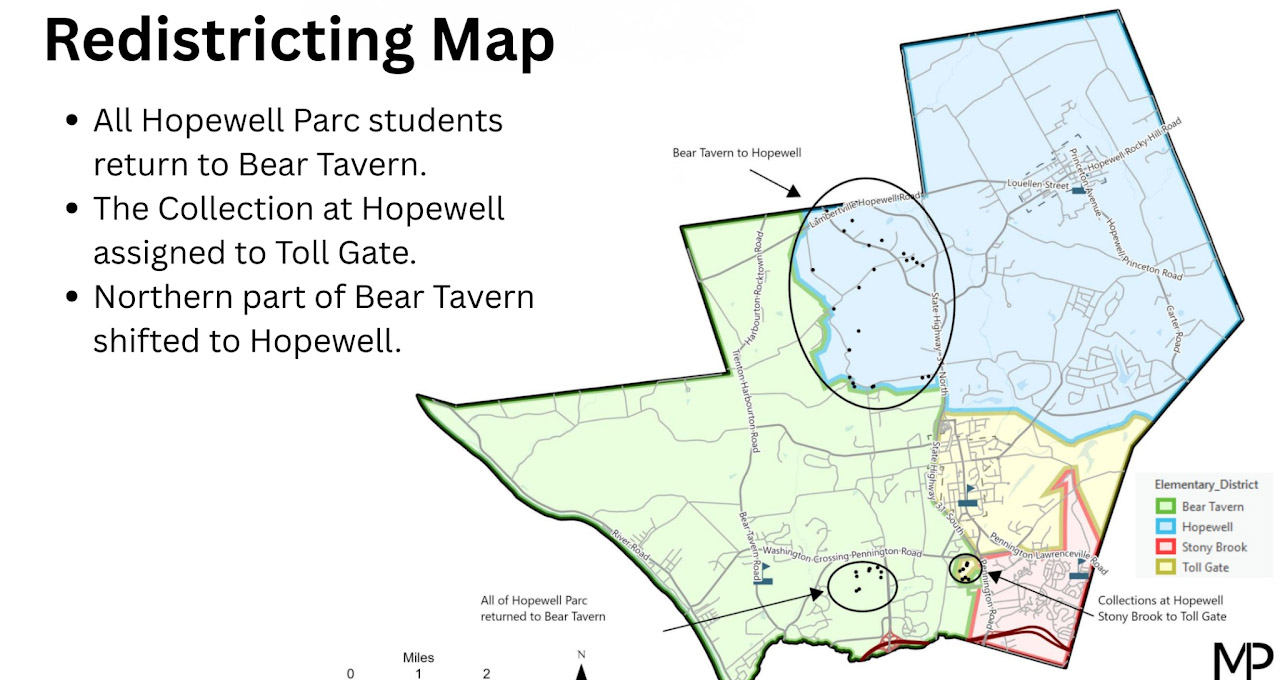
- Students in the Lambertville-Hopewell Road and Route 31 area who currently attend Bear Tavern will shift to Hopewell Elementary
- Students living in the Hopewell Parc development will attend Bear Tavern
- Students living in The Collection at Hopewell will shift from Stony Brook to Toll Gate Grammar School
District officials confirmed that only students living in those specific areas will be affected by the changes.
The district said the adjustments are intended to relieve pressure on Bear Tavern and Stony Brook, where enrollment has increased significantly in recent years.
Growth driven by housing and demographics
District leaders point to several factors driving enrollment increases.
A demographic study completed in October 2025 found that local birth rates between 2021 and 2023 were the highest seen since 2009, while home sales in the district increased by 20 percent during the pandemic.
New housing developments have already added more than 200 students to the district, with another approximately 250 students expected as construction continues.
Much of that growth is concentrated in specific attendance zones, with about 72 percent of future students tied to the Bear Tavern area and 27 percent to Stony Brook, according to district data.
Treece said the district has relied on updated demographic projections to guide the changes.
“Our demographic consultants are aware not only of the current trends, but the projections from housing that is not yet built, and can advise us accordingly,” she said.
Webinar and transition support for families
Families affected by the redistricting have been invited to a district webinar scheduled for May 6, where elementary school principals will join district leaders to answer questions about the changes and the transition process.
District officials said students will attend school and ride the bus with other children from their neighborhood, a step intended to help ease the transition.
Bus routes will be redrawn ahead of the new school year, with the goal of improving efficiency and reducing travel times where possible.
Limited changes, with some exceptions
The district is offering several exceptions for families navigating the transition.
Students entering fifth grade in the 2026–27 school year may remain at their current school if parents provide transportation. Younger siblings, however, will transition to their new assigned school.
Students with individualized education programs (IEPs) or those receiving specialized services that are specific to a particular school may remain in place, along with their siblings.
Kindergarten families who have already registered will be notified if their assigned school changes.
Part of a larger plan tied to referendum projects
District officials emphasized that the redistricting is limited in scope and is tied to a broader long-term plan to address enrollment growth.
Voters approved a bond referendum in 2025 that will fund building additions at Bear Tavern Elementary and Toll Gate Grammar School. Those expansions, expected to be completed in 2028, are designed to accommodate future enrollment and eliminate the need for classroom trailers currently in use.
District officials said that without those planned additions, the redistricting effort would have been far more extensive. The redistricting is intended to manage enrollment growth ahead of the Bear Tavern and Toll Gate additions, which are expected to be completed in 2028.
Students affected by this plan are not expected to be reassigned again, based on current projections tied to future enrollment and the planned building expansions.
Looking ahead
While the changes affect a relatively small number of families, they reflect broader shifts underway across the district, as housing development and demographic trends continue to shape enrollment patterns.
For now, district leaders say the plan is designed to stabilize enrollment in the short term while longer-term building projects move forward.
More information about the redistricting plan is available on the district’s website.