

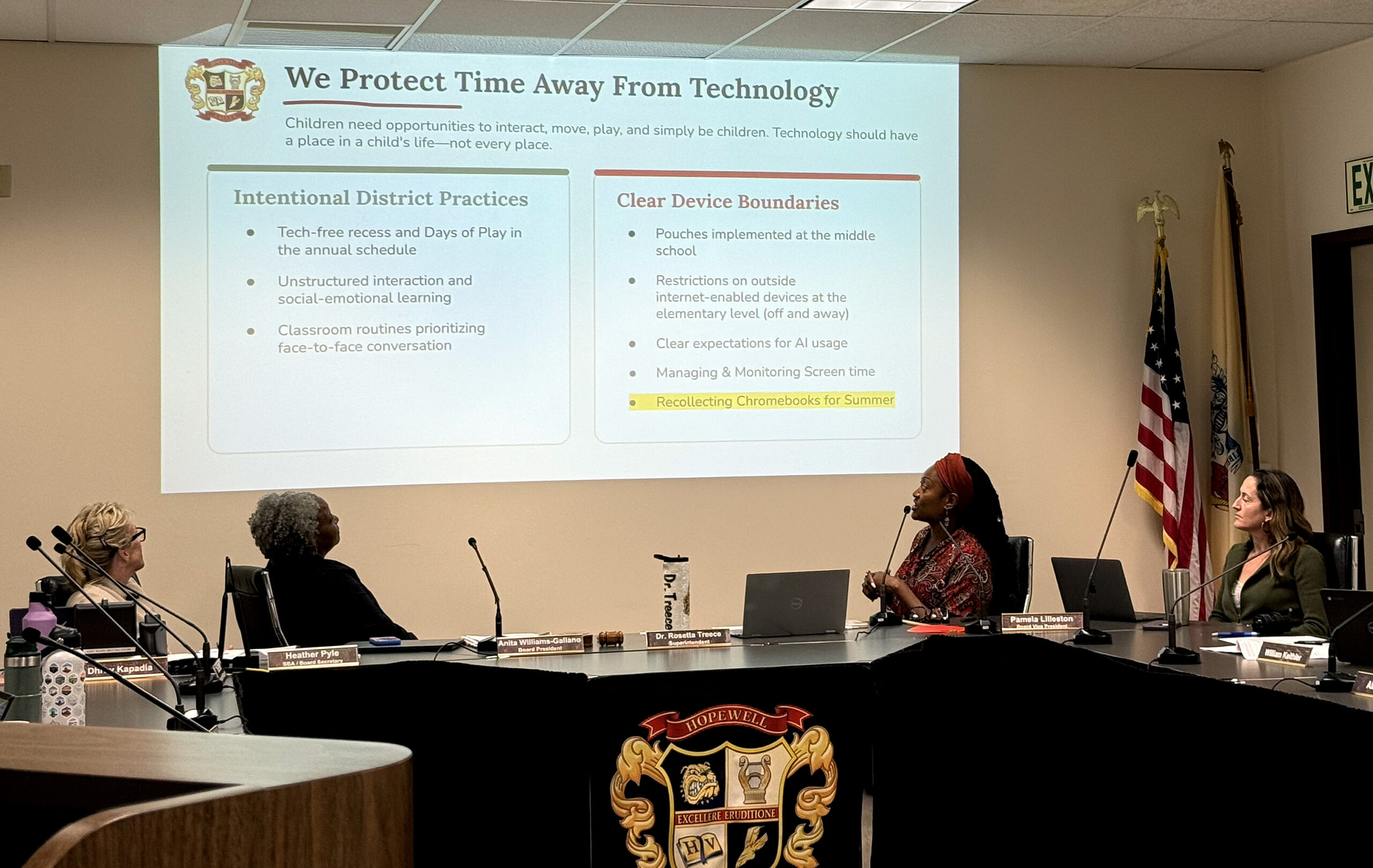
As a group of Hopewell Valley parents pushes for a more intentional approach to technology in schools, the Hopewell Valley Regional School District is preparing to track student screen time, establish limits on its use and bring more parents into discussions about digital learning and artificial intelligence.
Superintendent Rosetta Treece used a significant portion of her report at the Sept. 14 Board of Education meeting to address the growing community conversation, outlining steps the district has already taken to limit technology and protect face-to-face learning, as well as changes still in the works.
The presentation came before public comment, when parents and students involved with the effort laid out their concerns and read from a petition that had gathered more than 100 signatures in its first few days.
The discussion continued after public comment, with board members weighing how quickly the district should move and Treece making several specific commitments.
“We will have screen time limits set before this year is out,” Treece said. “We will be able to drill down and see what kids are doing and for how long before this year is out.”
She said the district is also examining additional controls around AI.
District says work has been underway
Treece began her presentation by acknowledging the renewed community interest while emphasizing that questions about technology, social media and student well-being have been part of district conversations for years.
She pointed to earlier parent involvement in the district’s Digital Wellness Committee, the “Wait Until 8th” effort encouraging families to delay smartphones, community forums, work with Common Sense Media and tech-free activities in the schools.
“We are already having those shared conversations, and I’m always open to more because we always, always, always can do better,” Treece said.
She said the district plans to revamp its Digital Wellness Committee and recruit new members, providing another avenue for parents to participate.
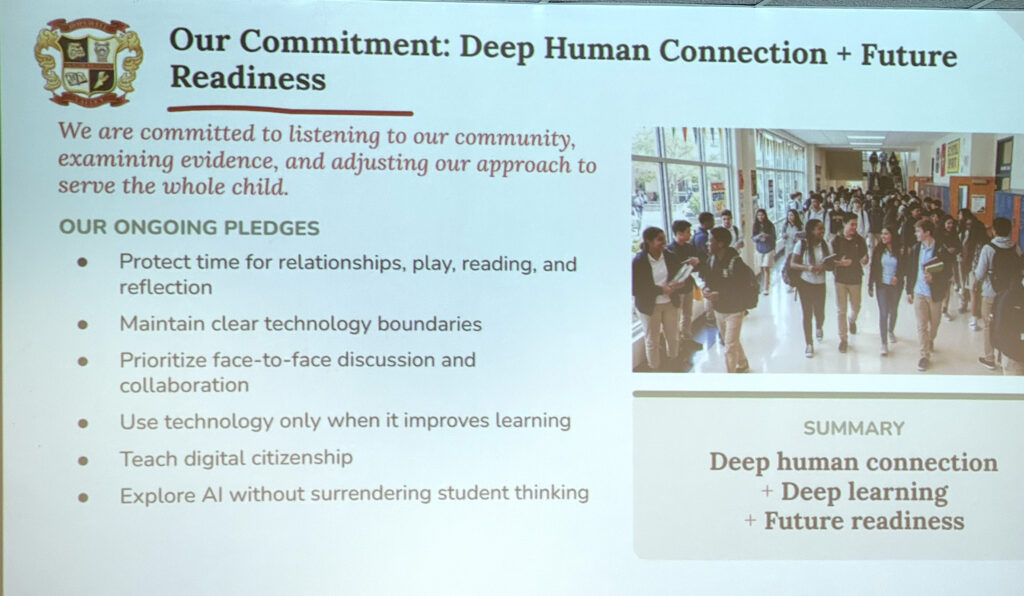
Treece also described a broader philosophy in which technology should be used when it adds to instruction rather than simply replacing work that could be done another way. The presentation characterized HVRSD’s approach as “human-centered, evidence-based, and future-ready,” centered on the question, “What best supports learning?”
Students still need to learn to use technology because it is embedded in testing, higher education and the workplace, Treece said, but it should not replace skills they need to develop themselves.
“Our job is to make sure that kids can think critically, analyze, and synthesize, that they can communicate with their words and collaborate effectively, not through a device,” Treece said.
Bell-to-bell cellphone restrictions already in place
The broader discussion comes as HVRSD implements a bell-to-bell cellphone policy this school year, prohibiting students from accessing personal internet-enabled devices during the school day. New Jersey now requires public school districts to have such policies beginning this school year.
Treece said HVRSD had already been moving toward tighter cellphone restrictions before the state requirement. Timberlane Middle School is now in its fourth year using Yondr pouches, meaning this year’s high school freshmen and sophomores had already spent their middle school years under cellphone restrictions.
At Hopewell Valley Central High School, students now place their phones in signal-blocking pouches during the school day. Treece said implementation has gone smoothly, with students complying and spending more time interacting with one another during lunch.
“They’re playing games again. The hacky sack is back,” Treece said. “They’re actually looking at each other’s faces and talking.”
The cellphone restrictions are one piece of the district’s broader effort to put boundaries around technology use. The newer questions raised at the meeting centered largely on school-issued devices, screen time and AI.
Screen-time tracking and summer Chromebooks
Among the most concrete changes is an effort to use the district’s existing technology platform to determine how much time individual students spend on school-issued devices and what they are doing during that time.
Treece said the district is close to being able to categorize use “down to the child” and establish guidelines that would allow administrators to intervene when screen use becomes excessive, whether it is happening independently or as part of classroom instruction. The district’s Education and Social-Emotional Learning Committee is targeting the spring for an initial report on the data, board member Alex Reznik said later in the meeting.
Treece also announced that the district plans to collect student Chromebooks at the end of the school year rather than routinely leaving them with students throughout the summer.
She said administrators currently receive alerts during nights, weekends and summer when students use district devices to search for or write concerning material, requiring staff to follow up.
“These are really meant to be educational tools that can assist, but it shouldn’t be — we don’t want to give kids an opportunity to just have screen time all the time,” Treece said.
There could be exceptions for students who need devices for Advanced Placement summer work or as part of an Individualized Education Program, she said.
Parents ask district to go further
The parent effort came into fuller view during public comment.
Kristin Broderick of Hopewell Township, speaking about EcoPTO’s “more green time, less screen time” work, said the group appreciated steps the district had already taken and wasn’t approaching the issue from a place of blame.
She urged district officials to listen with “really open ears,” arguing that the technology landscape has changed rapidly.
“We really value all that you’ve done,” Broderick said, adding that “there’s so much more that’s happening in 2026” and that parents wanted to continue working with the district.
Kayla McLaughlin, a Bear Tavern parent who identified herself as a member of Schools Beyond Screens’ Hopewell Valley chapter, said she believed the district was already thinking seriously about technology and AI but called for a broader systems-level approach.
“The adoption of technology has outpaced our ability to evaluate its effectiveness,” McLaughlin said.
She asked the board to consider additional districtwide technology norms and create a working group of educators, parents, community members, students and experts.
“This isn’t one group’s job,” she said. “It’s not the district’s alone. It’s not teachers alone. It’s not parents alone. It’s not students alone. All of us together have to do this, or it does not happen.”
Gabe Dominguez, an EcoPTO co-president and member of its Beyond Screens Circle, introduced the petition, saying it had collected more than 100 signatures in several days.
Dominguez characterized the effort as an attempt to encourage the direction the district had already begun taking.
“We’re here to put wind in your sails to take the next step,” he said.
The petition calls for an “analog-first” approach summarized as “screens down, pencils up,” with digital devices used when a learning objective specifically requires them. It also asks the district to measure time spent on school-issued devices and make that information available to parents, establish daily limits on certain types of screen use, end routine take-home Chromebook use and form a working group within 60 days.
Julie Cesari, a Bear Tavern parent, said she appreciated the principles Treece described but believed there remained a disconnect between the administration’s goals and what students sometimes experience in classrooms.
“We need to do more, and we need to do it now,” she said.
Board joins the discussion
The conversation continued as board members responded to the parents and Treece’s presentation.
Board President Anita Williams Galiano cautioned that reducing technology can affect students differently.
She noted that school-issued computers have helped students who may not have extensive educational support at home and that technology can also serve as an essential communication or learning tool for some students with disabilities.
“We are responsible for every single one of our children,” Williams Galiano said, adding that the district should reconsider its technology strategy without losing sight of students “on the margins” who may depend on those tools.
Board member Mark Peters pushed for a more formal plan, suggesting the district establish a working group or use an existing committee to create a strategic roadmap with goals and dates.
Peters also raised the issue of adults modeling the behavior expected of students.
“I find it challenging when an 18-year-old that’s a senior at the high school watches a 26-year-old teacher on their phone, and they’re being told they can’t be on their phone,” he said.
He encouraged the administration and board to bring community volunteers into the process and establish concrete milestones for reducing screen use where appropriate.
Treece responded that parents from the group were already being invited to participate in the district’s existing AI task force and that new volunteers would be sought for the Digital Wellness Committee.
Peters pressed for dates and measurable goals, prompting Treece to make the commitment that screen-time limits and more detailed monitoring would be in place before the end of the school year.
AI without replacing thinking
Artificial intelligence was another recurring piece of the discussion.
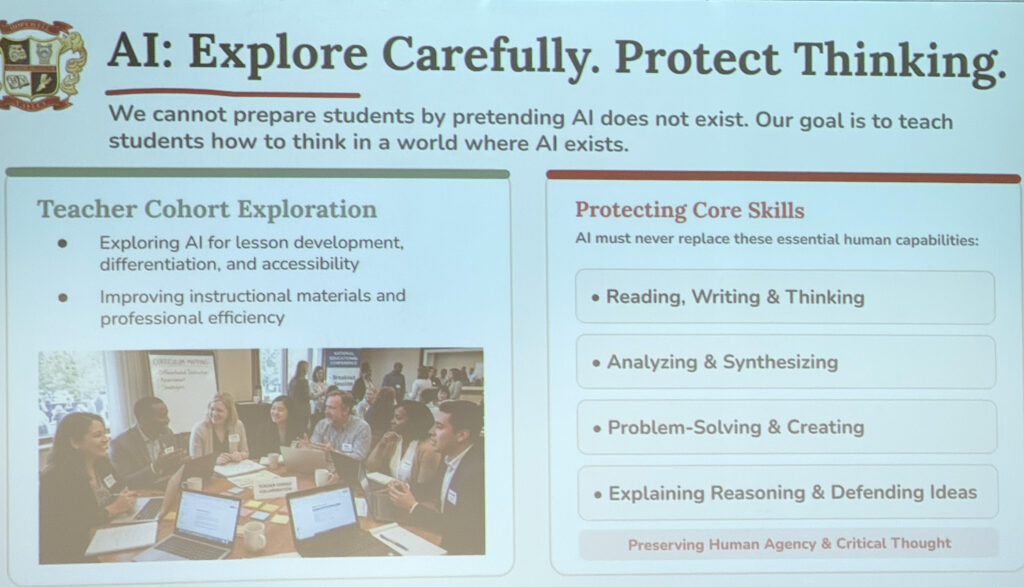
One of Treece’s presentation slides carried the heading, “AI: Explore Carefully. Protect Thinking,” and stated that the district could not prepare students “by pretending AI does not exist.”
Treece said HVRSD has guidelines governing AI and a task force of teachers and administrators exploring its use. At the same time, she said AI should not replace reading, writing, analysis, problem-solving or students’ ability to explain and defend their own ideas.
She offered her own presentation as an example. Treece said she researched and developed the content herself before using AI to help with its visual presentation.
“I put all of the content into that, and then it made it pretty,” she said.
Even then, she said she had to review and change the results because the AI altered some of her language.
“Teaching kids how to use it so that they’re more efficient at work, yes,” Treece said. “Having it do your work for you, no.”
Treece said the district intends to bring community members into both its AI and digital wellness work while continuing to evaluate where technology supports learning — and where it gets in the way.