

All 286 eligible seniors in Hopewell Valley Central High School’s Class of 2026 graduated, with nearly 87% heading directly to a two- or four-year college, according to a report presented to the Board of Education this month.
But a discussion that followed the presentation also raised a broader question for the district: How well does it know — and tell the stories of — graduates who choose a different path?
Dr. Beth Hoffman, HVRSD’s supervisor of counseling and child study teams, presented the annual graduation and college outcomes report at the board’s Sept. 14 meeting. The report is required under state law and accounts for students who earned diplomas through both standard graduation requirements and alternate state-approved pathways.
“This confirms that every student in our district received a diploma last year,” Hoffman told the board.
Multiple paths to graduation
Of the 286 graduates, 48 completed graduation requirements through one of three alternate pathways.
Eighteen students demonstrated proficiency through an approved substitute competency test such as the PSAT, SAT or ACT. Eleven graduated through the state’s portfolio appeals process, while 19 received state-endorsed diplomas by meeting alternate requirements in their Individualized Education Programs.
No student was denied graduation, including for failure to pass a required state assessment.
The class finished with an average unweighted GPA of 3.51 and a weighted GPA of 3.70. Students submitted an average of 8.23 college applications.
Where students went
The district reported that 248 graduates, or 86.7% of the class, were headed directly to college: 230 to four-year institutions and 18 to two-year colleges.
Rutgers University and The College of New Jersey were the most common destinations among the schools highlighted in the report, with 18 HVCHS graduates enrolling at each. Rutgers received 114 applications from Hopewell Valley students and admitted 66, while TCNJ received 80 applications and admitted 58.
Other frequently considered schools included Penn State, the University of Delaware, the University of Pittsburgh, the University of Maryland and Virginia Tech.
Closer to home, 16 students applied to Mercer County Community College, all were admitted and 15 enrolled.
“One of the really nice options is that from Mercer County Community College, all of our students applied, received admissions, and it was a popular choice for students who wanted to go to Mercer County Community College,” Hoffman said. “So it’s a nice pathway.”
Overall, the district reported 2,746 college applications and 1,285 admission offers. The average SAT score among students who took the exam was 1,289, while the average ACT composite score was 28.
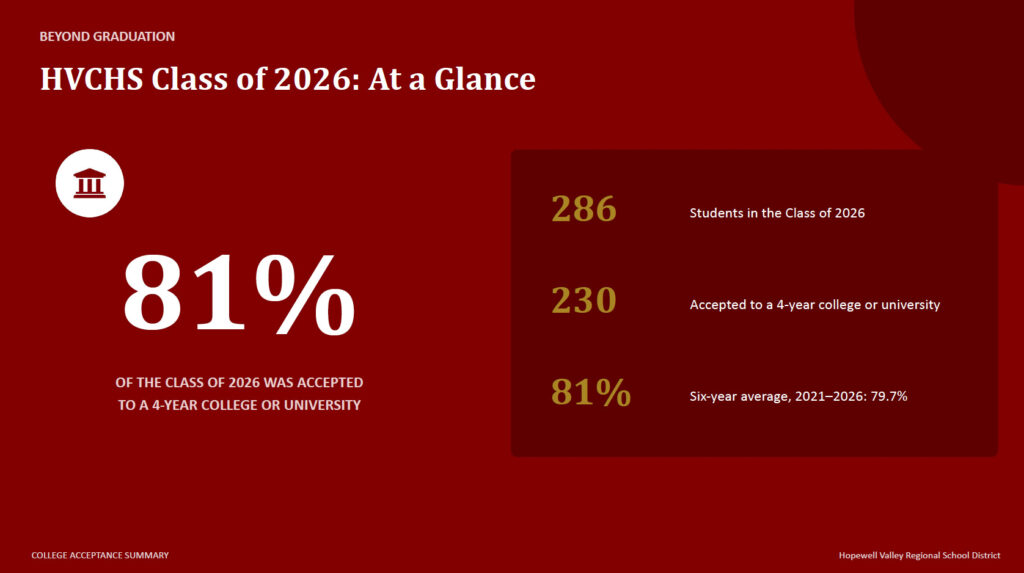
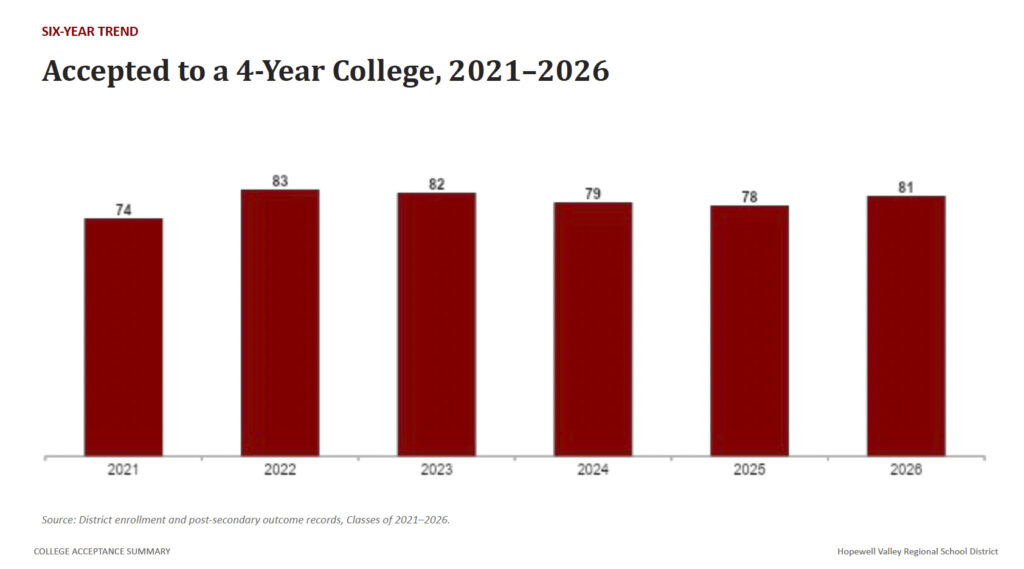
The district also reported that 81% of the class was accepted to a four-year college or university, compared with a six-year district average of 79.7%.
Looking beyond college
Much of the board discussion following Hoffman’s presentation focused not on the college numbers, but on what the report doesn’t capture as clearly.
There was discussion that the report should include more information about students who pursue the military, trades, employment or other paths.
“The students that are not going to college, like who’s going into the military? What are the other pathways they might be taking? A trade?” Dr. Rosetta Treece said. “So in the future, we’re going to be looking at that a little bit.”
Board member Alex Reznik said he has raised the issue in previous years and suggested the district could begin by tracking students who graduate with credentials through Mercer County vocational programs.
Later, Reznik said he worries that focusing the annual presentation so heavily on college admissions can send an unintended message.
“Every year when we show this presentation, sending a message that we really care much more about kids going to college, and that’s not a message that we want to say,” Reznik said. “So I want to make sure that we start highlighting success stories of kids who chose not to go to college and what they’re doing.”
Treece said some students deliberately choose to work, pause their education or take another route after high school.
“I don’t think any of us should see that necessarily as a failure,” she said. “Because I have a lot of students who chose a work route, chose a different route, and that was the route they wanted.”
High School Principal Patricia Riley said the school has also been working to strengthen its connections with graduates, including bringing recent alumni back to talk with current students about college, trades and the workforce and developing an alumni database. But a lot of the data for the report data is gathered through self reporting and if students don’t provide data, it is hard to track
Choices after Hopewell Valley
Board members also questioned why applications tend to cluster around certain out-of-state public universities, including Penn State, Delaware, Maryland, Pittsburgh and Virginia Tech.
Treece said counselors don’t steer students toward particular schools but work with students and their families to identify their interests and priorities. She also said cost has become a bigger consideration and that she has seen more students reconsider in-state options.
Board member Jacquie Genovesi noted that college choices can also be influenced by classmates and previous graduates, with different schools becoming popular from one graduating class to another.
The discussion ultimately returned to the difficulty of measuring success solely by what graduates do immediately after high school.
Board President Anita Williams Galiano said maintaining connections with alumni could help the district better understand the different paths students take over time.
“Capturing these individual stories is a little challenging,” she said, but those connections can help the district better understand students’ “pathways to success.”