

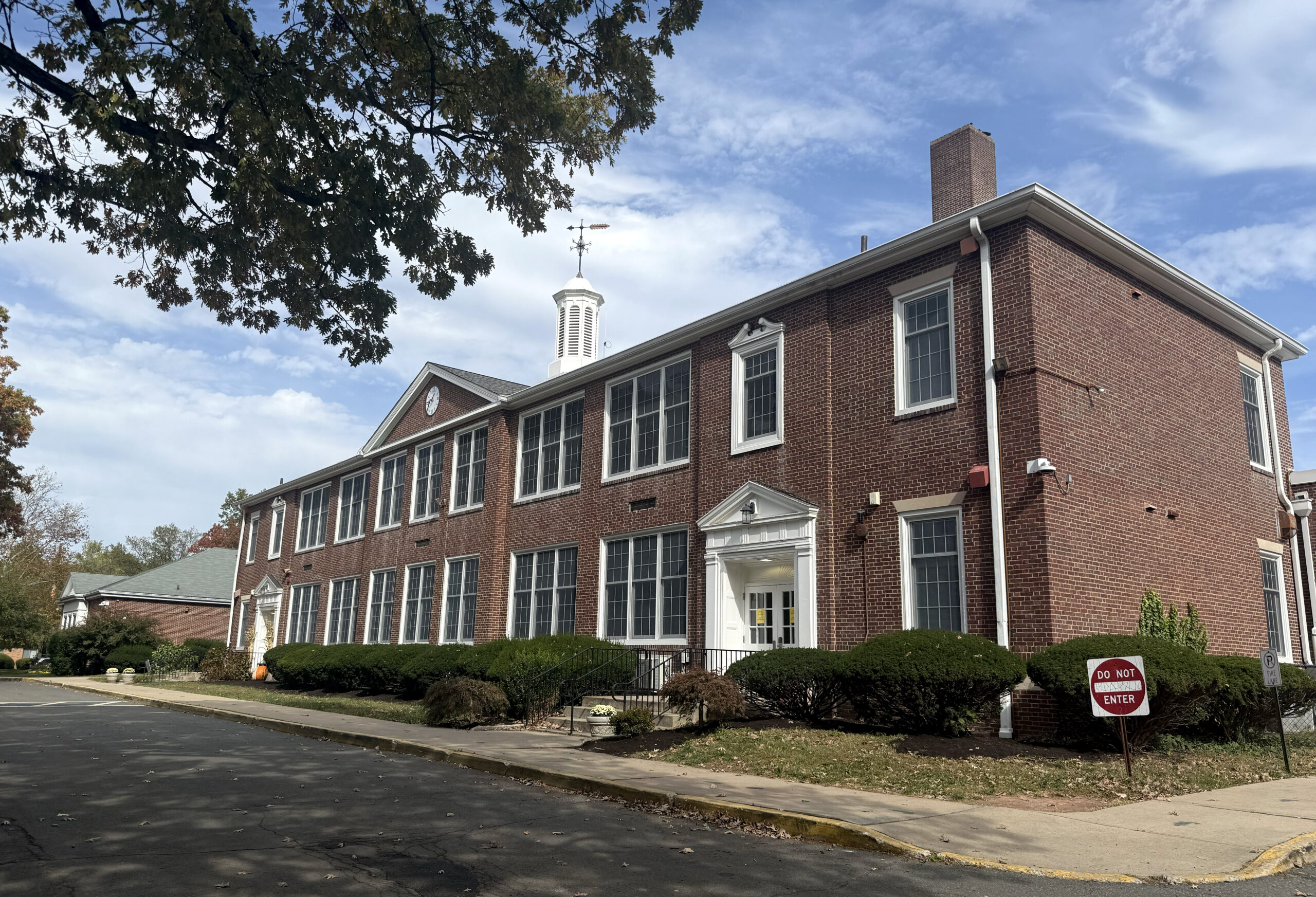
The Hopewell Valley Regional School District has notified families that it is named in a civil lawsuit alleging that a former Toll Gate Grammar School student was sexually abused in the 1990s by the father of a classmate who sometimes appeared at the school dressed as its mascot.
The lawsuit, filed July 23 in Mercer County Superior Court, identifies the former student as John Doe and uses initials for the individual defendants because of the sensitive nature of the allegations. It names Toll Gate Grammar School and the Hopewell Valley Regional School District among the defendants and seeks damages and a jury trial.
In a letter sent to district families, Superintendent Rosetta Treece said HVRSD had learned that it was named in the lawsuit but could not respond to the specifics of pending litigation.
“However, we can assure the community that no one named in the lawsuit is currently employed or connected to the district,” Treece wrote.
Treece also pointed to a significant difference between the practices described in the lawsuit and those in place today. Under current district policy, she said, only staff members and students dress as school mascots, not parents or other volunteers.
The allegations center primarily on the 1996-97 school year, when the plaintiff was 6 years old and in first grade at Toll Gate. The complaint provides a detailed account of how the plaintiff says his relationship with the alleged abuser developed through school, an alleged sexual assault that later occurred at the man’s home, and what the lawsuit contends happened when the child subsequently tried to tell Toll Gate’s principal.
Editor’s Note: This story concerns allegations of childhood sexual abuse and includes descriptions of alleged abuse involving a 6-year-old child. The court filing contains substantially more graphic allegations than MercerMe has included in this report. Some readers may find the material distressing and may wish to use discretion before continuing.
The allegations have not been proven in court. HVRSD has not addressed their merits publicly, saying specifics of the case will be addressed through the legal process.
From a school mascot to a family friendship
According to the complaint, the plaintiff attended Toll Gate from kindergarten through fifth grade between 1995 and 2001. During his first-grade year, the school’s mascot was known as Tucker the Gator, or the “Tollgator.”
The lawsuit alleges that a man identified as D.P. — the father of one of the plaintiff’s classmates — sometimes dressed as the mascot and was regularly present around children at Toll Gate.
The complaint alleges that D.P. interacted with the boy while dressed as Tucker, including having him sit on his lap during school activities. It also describes encounters outside the costume, saying D.P. approached the child during recess and became a familiar adult in his life.
That relationship eventually extended beyond the school grounds, according to the lawsuit. The complaint says D.P. and his son participated in an overnight Toll Gate trip to the Philadelphia Zoo that the plaintiff and his father also attended. It alleges that D.P. again asked the child to sit on his lap during the trip.
The complaint says the plaintiff was subsequently invited to a playdate at D.P.’s home with D.P.’s son. It alleges that Toll Gate’s principal had vouched for D.P. to the boy’s parents.
According to the complaint, D.P. brought the two boys inside from playing in the yard, made them undress and get into a bathtub together, then took their clothes and photographed and recorded them while they were naked. The lawsuit alleges he directed the children to touch one another while he filmed them.
The complaint says D.P. then removed his son from the bathroom and locked him, still naked, in a bedroom so that D.P. could be alone with the plaintiff. The plaintiff recalls the other boy screaming through the closed door, “don’t hurt my friend,” according to the lawsuit. The complaint says D.P. told his son to “shut up” as the plaintiff pleaded for his clothes back.
The lawsuit alleges D.P. then took the plaintiff into the kitchen, where the sexual assault continued. The complaint describes additional sexual acts and degrading conduct.
According to the complaint, the boy left the home physically sick and emotionally distressed.
The principal and a photograph with Tucker the Gator
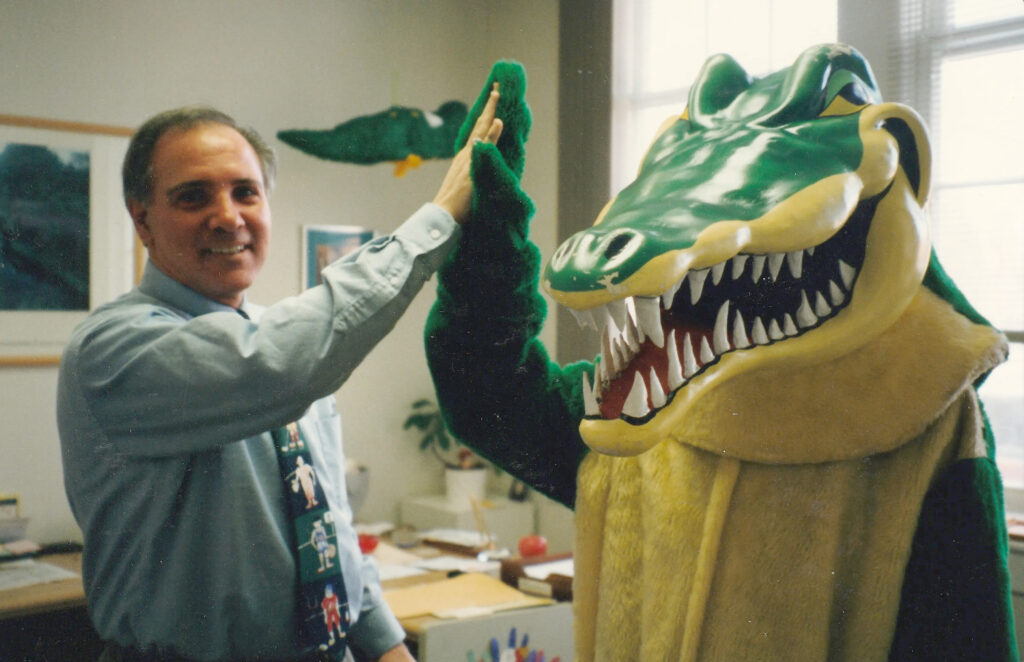
The complaint identifies the school principal only by the initials R.F. MercerMe is identifying him as Richard “Dick” Fitzpatrick, who was Toll Gate’s principal during the period described in the lawsuit. Fitzpatrick is deceased and cannot respond to the allegations.
The complaint includes a photograph of Fitzpatrick posing with Tucker the Gator. The lawsuit alleges, “based on information and belief,” that D.P. is the person inside the mascot costume in the photograph. The filing does not identify the source of the image.
The same photograph appears on the Hopewell Valley Education Foundation’s Dick Fitzpatrick Committee page, where it is used as part of a tribute to the former principal and his contributions to the community.
Lawsuit alleges child disclosed abuse to Fitzpatrick
The lawsuit’s allegations against Fitzpatrick center on what the plaintiff says happened after the alleged assault.
According to the complaint, the boy became increasingly afraid of D.P. and tried to avoid him when D.P. returned to Toll Gate dressed as Tucker the Gator.
The lawsuit alleges that Fitzpatrick brought the child over to D.P., who was in costume, and had him sit on D.P.’s lap. The complaint says D.P. then began touching the boy over his clothes. The child reacted by kicking D.P. in the knee.
The boy was then called into Fitzpatrick’s office with D.P., according to the lawsuit. When Fitzpatrick asked why he had kicked D.P., the complaint alleges, the child told the principal that D.P. had touched him in his private areas.
The lawsuit says Fitzpatrick and D.P. stepped into the hallway, where the plaintiff could hear D.P. denying that he had touched the child in a sexually explicit way. The complaint alleges that when Fitzpatrick returned, he did not ask the boy additional questions about what had happened. Instead, it says, Fitzpatrick told him that if D.P. had sexually abused him and the child continued talking about it, he would never see his friend again and D.P. could go to jail. The complaint further alleges Fitzpatrick told the boy he would lose other friends and that his parents might no longer be able to live in town.
The lawsuit alleges Fitzpatrick continued to discourage the boy from telling others, including his parents. It says the child was later sent to a school therapist because kicking D.P. was considered out-of-character behavior, but that he did not disclose the alleged abuse during the session. The complaint alleges Fitzpatrick met with the boy before and after the appointment and continued to discourage him from discussing the touching.
Those allegations are central to the plaintiff’s claims against the school and district. The lawsuit contends that the institutions failed to protect the student and properly respond to his disclosure and asserts several theories of liability.
The lawsuit does not accuse Fitzpatrick of sexually abusing the plaintiff.
Attorney says firm spent months reviewing allegations
Robert Fuggi, a New Jersey Certified Civil Trial Attorney whose Toms River-based firm has extensive experience representing plaintiffs in sexual abuse cases, represents the former student.
Fuggi told MercerMe that his office did not file the lawsuit based solely on the plaintiff’s recollection. He said his firm spent several months investigating the account and looking for details that could corroborate circumstances surrounding the allegations.
“It’s a due diligence process,” Fuggi said.
Fuggi said the plaintiff had photographs connected to D.P. and the Toll Gate mascot and that his parents were able to verify surrounding details, including the friendship between the boys and interactions between their families.
The photographs and corroboration of surrounding circumstances do not establish that the alleged sexual abuse occurred. Fuggi acknowledged that the plaintiff’s account and the evidence supporting it ultimately would have to be evaluated through the court process.
“The jury, the trier of fact, would have to determine whether or not that’s true,” he said.
Why a case from the 1990s can be filed now
The allegations in the lawsuit date back nearly three decades, but changes to New Jersey law in 2019 substantially expanded the amount of time survivors of childhood sexual abuse have to bring civil claims.
Legislation signed by Gov. Phil Murphy in May 2019 expanded the civil statute of limitations for adults alleging childhood sexual abuse to age 55 or seven years after they reasonably discover the connection between the alleged abuse and resulting harm, whichever is later. The law also created a temporary two-year window allowing some claims that had previously been barred by the statute of limitations to be filed.
The 2019 changes also expanded the circumstances under which institutions and public entities could face civil liability in sexual abuse cases. The legislation addressed claims involving negligent supervision and removed certain barriers that had previously applied to claims against public entities.
Fuggi said the changes removed significant barriers that had previously kept many childhood sexual abuse claims from reaching court.
“Well, [it] changed everything,” Fuggi said. “It made it possible to sue institutions. It made it possible to sue charitable organizations. I mean, it did away with the tort claims notices with public entities.”
He said the changes reflected an understanding that children may not disclose abuse or recognize its lasting effects until years later.
“It allowed victims that were sexually abused as minors and even sometimes as adults to come forward and to have their day in court,” Fuggi said.
Fuggi said delayed disclosure can occur for many reasons, including fear and a child’s inability to understand or process what happened at the time.
District points to safeguards in place today
Treece’s letter does not address whether the events described in the lawsuit occurred or how Toll Gate handled volunteers and mascots nearly three decades ago.
Instead, the superintendent emphasized current district practices.
“Under our current policy, only staff members and students dress as school mascots; that is not a role assigned to parents or other volunteers,” Treece wrote.
She said district employees receive ongoing training in professional and appropriate conduct involving students and that HVRSD regularly evaluates its safety protocols.
“We work every day to ensure our schools are safe, protective environments, and regularly evaluate our protocols,” Treece wrote.
She asked families to remind students to tell a parent or another trusted adult if they ever feel unsafe and pointed to the district’s guidance departments and mental health supports.
“Our district also emphasizes clear, transparent communication, which is why I am sharing this information with you,” Treece wrote.
A different memory of a longtime educator
The allegations involving Fitzpatrick may be particularly striking in Hopewell Valley because the former principal is remembered positively by many former students and families.
Fitzpatrick served as principal at Toll Gate and Stony Brook during his career and was later a school superintendent. Following his death from glioblastoma, an aggressive cancer, a scholarship was established in his name for a graduating Hopewell Valley Central High School senior who attended Toll Gate or Stony Brook.
MercerMe asked Fuggi about the contrast between that community legacy and the account presented by his client.
“I am not saying that you can’t have positive memories of a person,” Fuggi said. “If that’s their recollection of him, and that’s if he’s embraced by the community, you know, so be it. But from my client’s perspective, it’s a different perspective.”
“Both could be correct,” Fuggi said. He said Fitzpatrick could have “done a nice job as a principal” and been “well embraced by the community,” but also could have “selected the wrong friend and the wrong person to be the alligator.”
“I don’t think they’re mutually exclusive,” Fuggi said.
The plaintiff’s case focuses instead on what he alleges Fitzpatrick did when confronted with his disclosure as a first-grader and whether the school and district had a responsibility to protect him.
Fuggi described that as a question of secondary liability under New Jersey’s Child Sexual Abuse Act — whether someone responsible for supervising a child knew or should have known of abuse and failed to act.
‘Having his voice heard’
The complaint seeks compensatory, punitive and statutory damages along with other relief. It does not specify a dollar amount.
Fuggi said his client sees the lawsuit as being about more than financial compensation.
“I think justice for this particular plaintiff is having his voice heard,” Fuggi said. “Having their voice heard and, you know, litigating the case and having these facts come out.”
For its part, HVRSD told families that none of the individual parties identified in the lawsuit is currently employed by or connected to the district and said the district will address the specifics of the case through the legal process.