

Mercer County has reported four human cases of West Nile virus this year, the second-highest total among New Jersey counties, as state health officials urge residents to continue taking precautions against mosquitoes well into the fall.
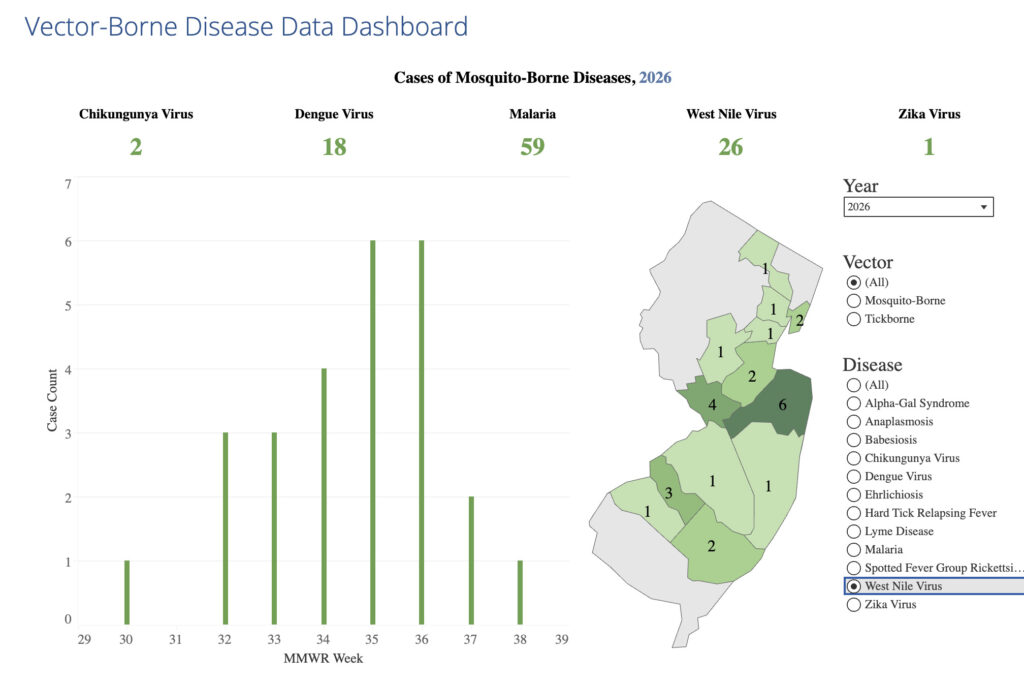
The New Jersey Department of Health reported Friday that 26 human cases of West Nile virus have been identified statewide in 2026, including the state’s first confirmed death from the virus this year. Monmouth County has reported the most cases with six, followed by Mercer with four and Camden with three.
The 26 cases reported so far this year have already surpassed the 23 recorded statewide in all of 2025, according to the state’s Vector-Borne Disease Data Dashboard. New Jersey reported 41 cases in 2024 and 14 in 2023. The state has previously said a typical year sees about 14 human West Nile infections, although totals can vary considerably from year to year.
Of this year’s cases, 19 people have experienced neurological illness, according to the Department of Health, and 69% of the cases have occurred among people age 60 and older. Fourteen people became ill during the final week of August or during September, and several additional cases remain under investigation.
Virus detected widely in mosquitoes
The increase in human cases comes during a year of widespread West Nile activity in New Jersey’s mosquito population.
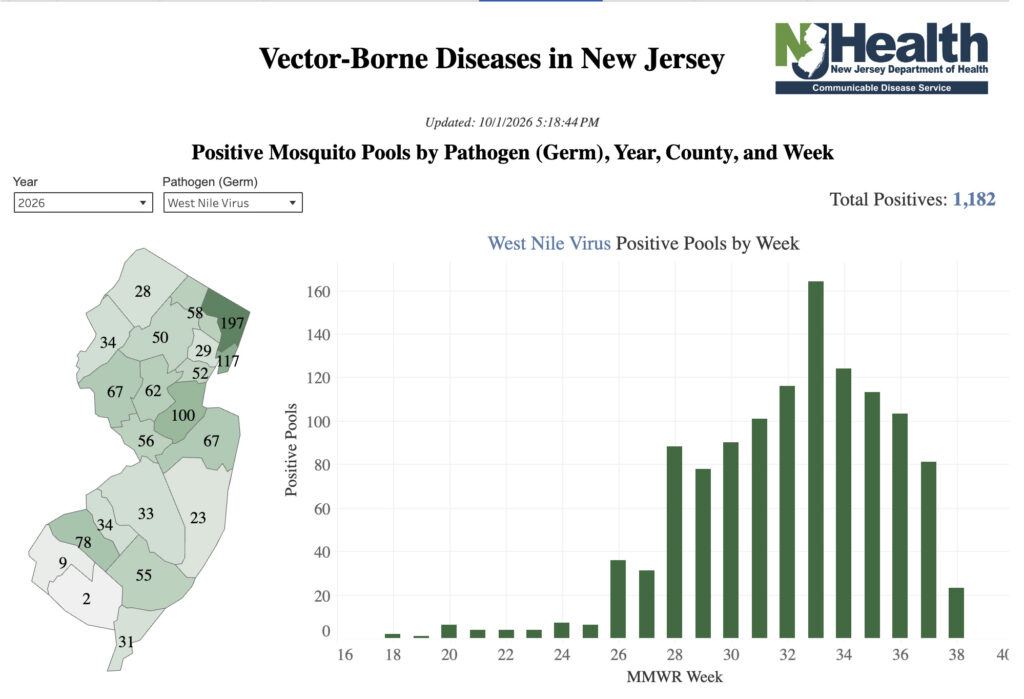
West Nile virus has been detected in 1,182 mosquito pools across all 21 counties in 2026. A mosquito pool is a collection of mosquitoes gathered at a particular location and tested together for the virus.
State data show 56 positive mosquito pools in Mercer County this year. Bergen County, with 197, Hudson County, with 117, and Middlesex County with 100 have reported the highest raw totals on the state’s current dashboard.
The Department of Health said West Nile detections in mosquitoes in recent weeks have been higher than historical averages and identified Mercer among the counties with the highest levels of mosquito detections.
Mosquito surveillance is conducted by county mosquito-control agencies, which trap mosquitoes and submit pools for testing. Testing generally takes place from mid-May through early November, depending on environmental conditions.
Residents urged to remain cautious into fall
State officials cautioned that cooler temperatures do not mean the risk has ended.
“When we see numbers increasing and loss of life from WNV, we are reminded that prevention is key and we must all play our part,” Health Commissioner Dr. Raynard E. Washington said. “We extend our condolences to the individual’s family and urge our residents to continue to take the necessary steps to prevent mosquito bites and to help reduce mosquito populations in and around their homes.”
West Nile virus is generally transmitted to people through the bite of a mosquito that has fed on an infected bird. It is not transmitted directly from birds to people.
Most people infected with West Nile virus do not develop symptoms. Those who do may experience fever, chills, body aches and joint pain. In rare cases, infection can lead to serious neurological illnesses including meningitis or encephalitis. Older adults and people with weakened immune systems face a greater risk of severe illness.
The state’s mosquito-borne disease guidance says severe symptoms can include high fever, stiff neck, seizures, confusion, paralysis and brain swelling. People who develop symptoms after possible mosquito exposure are advised to contact a health care provider.
There is no specific treatment for West Nile virus.
West Nile also poses a risk to horses
The state also sent reminders that West Nile virus can also cause serious illness in horses, an important consideration in communities with farms and equestrian properties.
The virus can affect a horse’s neurological system, but an infected horse does not pose an increased risk of infection to people. Horses, like humans, are considered “dead-end” hosts, meaning they do not carry enough virus in their bloodstream to pass the infection back to mosquitoes and continue the transmission cycle.
Unlike people, horses can be vaccinated against West Nile virus. Vaccines are also available for Eastern equine encephalitis, another mosquito-borne disease that can cause severe neurological illness in horses. The New Jersey Department of Agriculture recommends that horse owners work with their veterinarians on an appropriate vaccination schedule and contact their veterinarian if their animals are not current on vaccinations.
Equine mosquito-borne disease is generally detected in the state from August through November.
Reducing mosquito exposure
The Department of Health recommends using EPA-registered insect repellent, wearing long sleeves and pants and using mosquito netting over cribs, strollers and baby carriers. Residents can also reduce mosquito breeding areas by regularly dumping standing water and keeping window and door screens in good condition.
Standing water can collect in flowerpots, birdbaths, pet dishes, pool covers, clogged gutters, children’s pools and wheelbarrows, as well as less visible areas around buildings and landscaping.
State officials said residents should empty or replace standing water at least once a week to interrupt the mosquito breeding cycle.
“Fall does not mean mosquito season ends,” New Jersey Secretary of Agriculture Ed Wengryn said. “The cooler weather makes it a great time to enjoy outdoor activities and visit our farms, but mosquitoes remain active and can still pose risks. We encourage everyone to take simple precautions to protect themselves.”