
To the Editor and the entire Hopewell Valley community,
In the wake of the Board of Education’s adoption of the tentative budget for the 2026–2027 school year, I wanted to share my personal reasons for supporting this budget. For those interested in how school funding works—or doesn’t work—in our state, I hope this provides some useful context.
The opinions expressed here are my own, not those of the Board or any other member. The facts and figures referenced are publicly available, largely drawn from the Board’s March 23 budget presentation.
Key Budget Facts
The proposed tax levy increase is 5.2%. This includes a 5.8% increase in the general fund, offset by reduced debt service. The impact of the recent referendum is included in this figure, but its effect on the 2026–27 budget is minimal. Most projects require time for design and approvals and are not expected to begin until summer 2027. In the meantime, interest earned on bond proceeds helps reduce overall debt service.
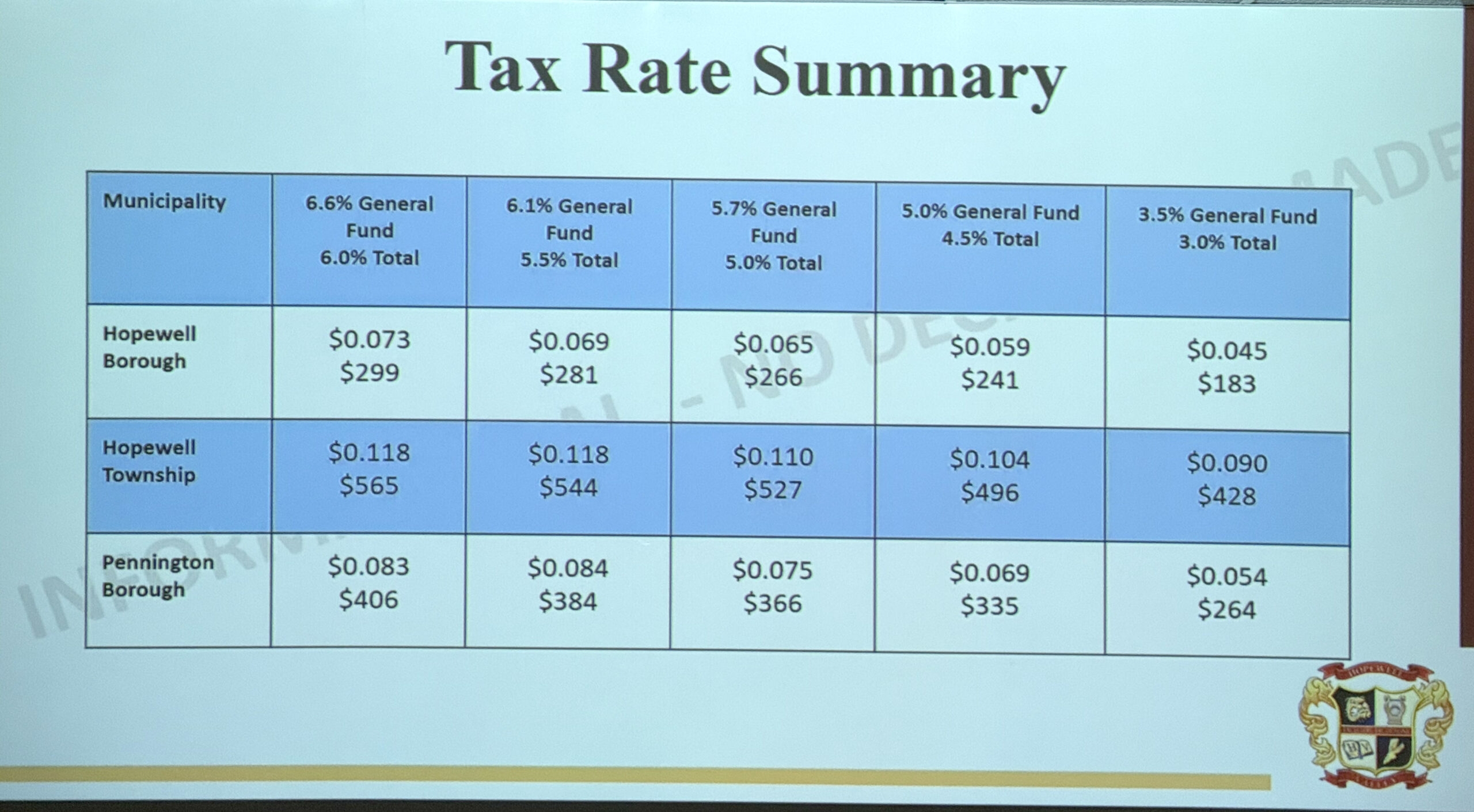
As a regional district, once the total tax levy is set, it is allocated across the three municipalities based on property values using a state-mandated formula. This means the school tax impact will vary depending on where you live. The district has no control over this allocation and limited transparency into how it is calculated.
A Simple Framework
To explain my thinking, it helps to consider a simplified model. School budgets are largely driven by two factors: enrollment and the cost of goods and services.
Enrollment in Hopewell Valley has increased by roughly 100 students over the past year—about 2.9% of the total student population. At the same time, health care costs alone rose by approximately $3 million this year, representing about 3% of the overall budget. Total health care spending now accounts for roughly 20% of district expenses.
Other costs—transportation, utilities, materials, and services—have also risen, often at rates above general inflation. Even with a conservative estimate of 3% increase for non-healthcare costs, maintaining existing services would suggest a budget increase of close to 9% – not a figure that was ever seriously considered, but one that highlights the true scope of our challenges.
Importantly, a change in the school budget does not translate directly into the same change in property taxes. Ideally, enrollment growth would be offset by additional taxpayers, and cost increases would track with broader economic trends. In practice, that balance rarely exists.
The Real Impact on Taxpayers
Property tax increases affect all residents, including those on fixed incomes who may not directly benefit from the school system. This is a fact that is not lost on me. At the same time, maintaining strong schools is central to the community and has a direct impact on property values. Balancing these competing realities is one of the most difficult aspects of the budget process; this year, that balance was even more difficult to achieve.
PILOT Agreements
PILOT (Payment In Lieu of Taxes) agreements add another layer of complexity. These agreements direct revenue to municipalities rather than school districts.
At the same time, PILOTs do not reduce the total funding that school districts are eligible to collect – if enrollments increase, they raise them. Instead, PILOTs shift the tax burden tied to enrollment or other costs to the non-PILOT taxpayers.
Whether a PILOT project is ultimately a net positive or negative to the overall community depends on how municipalities use the revenue they provide. Hopewell Township’s commitment to apply PILOT funds toward the expansion of Bear Tavern Elementary School is an excellent sign of the importance that the Township places on the quality of our schools. It leaves me optimistic about the ongoing discussions between the District, the Township and the Boroughs.
That being said, the structure of PILOTs will remain an issue as long as the state allows municipalities to retain the full benefit of development while the school district—often the most impacted entity—has no guaranteed access to those funds. This is a matter of state law, not local policy, and should therefore be addressed by the state.
Health Care Costs
Health care costs are among the largest and fastest-growing components of the district’s budget. Approximately 20% of total spending now goes toward employee health benefits.
State law, particularly Chapter 44, limits the district’s ability to manage these costs. It mandates the structure of benefit plans and fixes employee contributions as a percentage of salary. While districts are not required to participate in state plans, they must offer equivalent coverage, effectively removing flexibility in negotiations.
This creates a situation where one of the largest portions of the budget is largely outside of local control. While it is essential to provide strong benefits to teachers and staff, the current structure makes it difficult to balance those costs against other priorities.
Looking Ahead
This year’s budget reflects a difficult but necessary compromise. It includes approximately $1 million in reductions while maintaining core programs. The tax increase, while higher than I would have preferred, remains below the level driven by underlying cost pressures.
Looking forward, these challenges are unlikely to ease. Without structural changes at the state level—not just in funding formulas, but also in mandates—districts will continue to face difficult trade-offs between program reductions and tax increases. This is a question of how the system itself is designed, and whether it can remain sustainable.
Sincerely,
Alex Reznik
Board Member, Hopewell Valley Regional Board of Education (Pennington Borough Representative)
Writing in a personal capacity